An early collateral line · 1753 to 2021
The Kulm Line, or: the Return to the Starting Point
The probably youngest brother of Johann Friedrich (II.) moves early to the right bank of the Vistula, into the Starostei Chelmno (starosty). Nine generations later a branch of this line leads back to the Sauerland — to an area that served the Bommert family as its origin for centuries.
- Progenitor
- Peter (I.) Bomert, son of Friedrich (I.), brother of Johann Friedrich (II.). For his year of birth the chronicle gives three different estimates.
- Marriages
- 1753 Eva Cerclau in Swiete Wielki / Groß Schwenten · 1757 Eva Pomplun in Grupa / Kommorsk, Kreis Schwetz
- Children
- Two from the first marriage (Christian, Gottfried) · three from the second marriage (Peter (II.), Johann, Christine)
- Names of the lines
- The Kulm line is named after the town of Chelm / Kulm, roughly 50 km south of Graudenz (Grudziądz). After the area around Graudenz the main line is called the Graudenz line.
- Line of descent followed
- Nine generations down to the present. The further descendants of this line are left aside in this account.
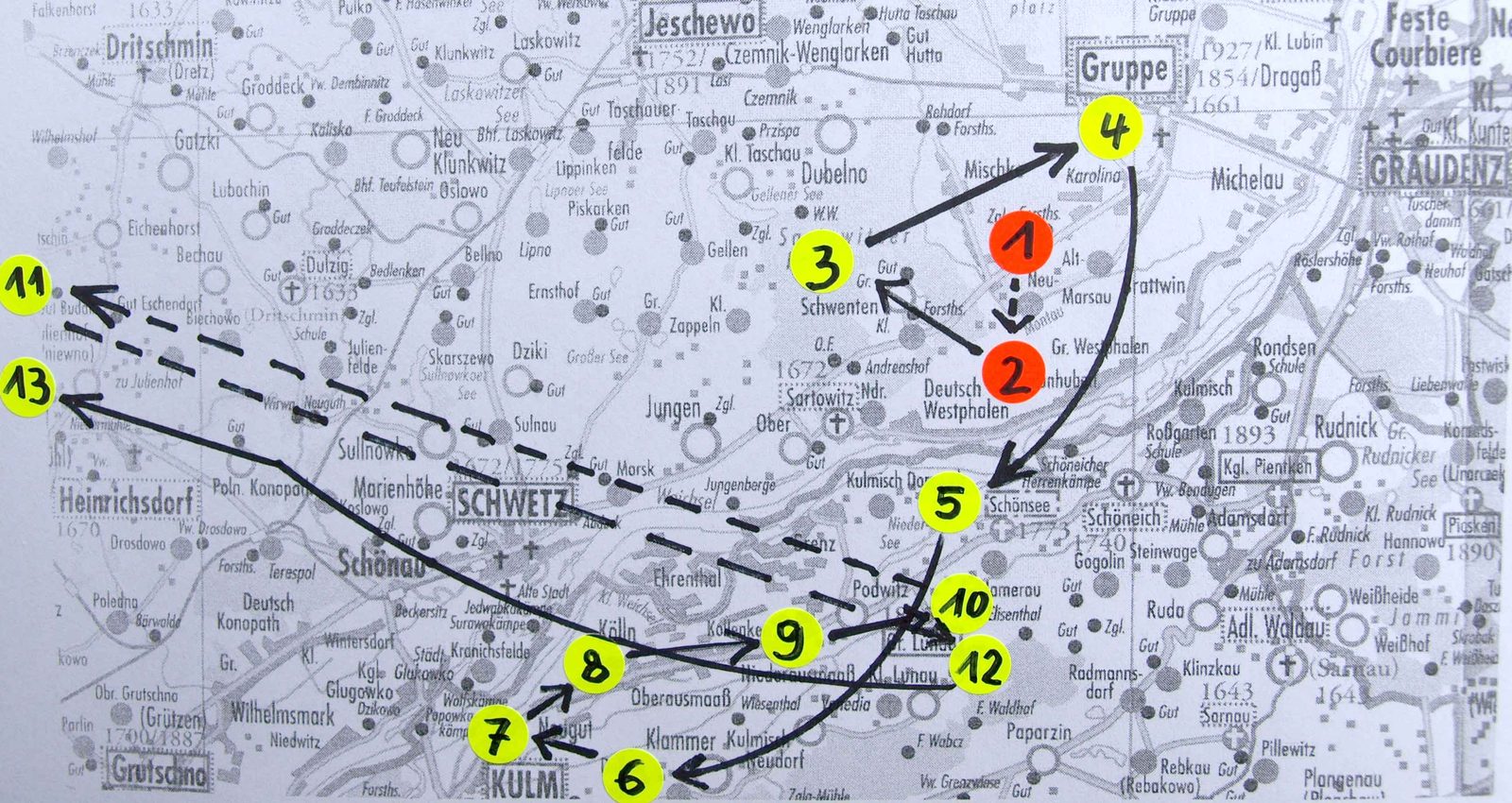
The division
Why a collateral line is told at all
In this volume the greatest attention belongs to the main line around Johann Friedrich (II.). A look at the early branching is nevertheless of interest — not as an appendix, but as a cross-check: a family that began from the same position and took a different path.
The line crosses over from the left to the right bank of the Vistula very early, into the Starostei Chelmno, and remains traceable there for a long time. The author therefore names it after the old town of Chelm / Kulm, roughly 50 kilometres south of Grudziądz / Graudenz.
The account confines itself to a single strand of the numerous descendants of Peter (I.) and leaves all the others aside. The reason is not a love of tidiness but the pattern of movement: in the end it leads back to where the family may have come from before its arrival in Poland. Where possible, the list gives the number of children, so that the extent of the branching remains visible.
The name Bommert west of the Vistula
How the chronicle handles this. It claims no origin. It shows a movement — for nine generations eastwards and south-eastwards, then back across the Vistula and finally to the western edge of the Sauerland — and leaves the conclusion to the reader.
The line of descent
Nine generations in keywords
The stations follow the manuscript. The count begins with the immigrant Friedrich (I.) and runs via Peter (I.) and his son Johann to the two youngest generations.
- 1st generationFriedrich (I.) · * c. 1675, after 1722 · immigrant in Marzy Nowe.
1. m. Gertrud, * c. 1680, † c. 1720 · 2. m. around 1721 Anna (Catharina?), who in 1737 marries Adam Gotkie (later Kottke) in her second marriage.
Four children: three sons, one daughter. - 2nd generationPeter (I.) · * between 1724 and 1736 · progenitor of the Kulm line.
1. m. 1753 Eva Cerclau in Swiete Wielki / Groß Schwenten · 2. m. 1757 Eva Pomplun in Grupa / Kommorsk, Kreis Schwetz.
Two children from the first marriage: Christian and Gottfried. Three children from the second marriage: Peter (II.), Johann and Christine. - 3rd generationJohann · * c. 1761 (calculated), † 1790 · resident in Klammer.
m. Christine Rode from Klammer, the marriage concluded in Schönsee.
Four children: Eva, Peter (III.), Johann and Ferdinand. - 4th generationFerdinand · * 1790 in Klammer, † 1845 in Koelln.
Places of residence: Neugut, Niederausmaß, Rathsgrund and Koelln. m. 1814 Anna Buchholz in Klammer.
Ten children: three sons, seven daughters. - 5th generationFriedrich Eduard · * 1835 in Koelln, year of death not known · Käthner (smallholder); resident in Rathsgrund and Koelln.
m. Maria Görz.
Eight children: three sons, five daughters. - 6th generationEduard Friedrich · * 1858 in Rathsgrund, baptised in Groß Lunau, † 1898 in Groß Lunau.
m. 1884 Auguste Könitz in Groß Lunau.
Two children: one son, one daughter. - 7th generationGustav Friedrich · * 10 November 1886 in Groß Lunau, Kreis Kulm.
m. 23 September 1911 Luise Marie Zabel in Groß Lunau.
Nine children, born between 1911 and the nineteen-twenties in Hückeswagen, in Kulm and in Saxony. - 8th generationBorn in 1930 in Großbruch near Leipzig.
The chronicle lists this generation by name. - 9th generationLives in Grimma in Saxony.
The chronicle lists this generation by name as well.
On naming the youngest generations. The manuscript gives the members of the eighth and ninth generations of this line with their first names and places of residence; according to its information, descendants live in Grimma and Bad Lausick near Leipzig to this day. For this edition the two youngest generations are listed without names. Personal data of family members still living do not belong in a publicly readable version as long as those concerned have not consented. Anyone who needs the names will find them in the manuscript.
1911 to 1920
The wedding trip that never was
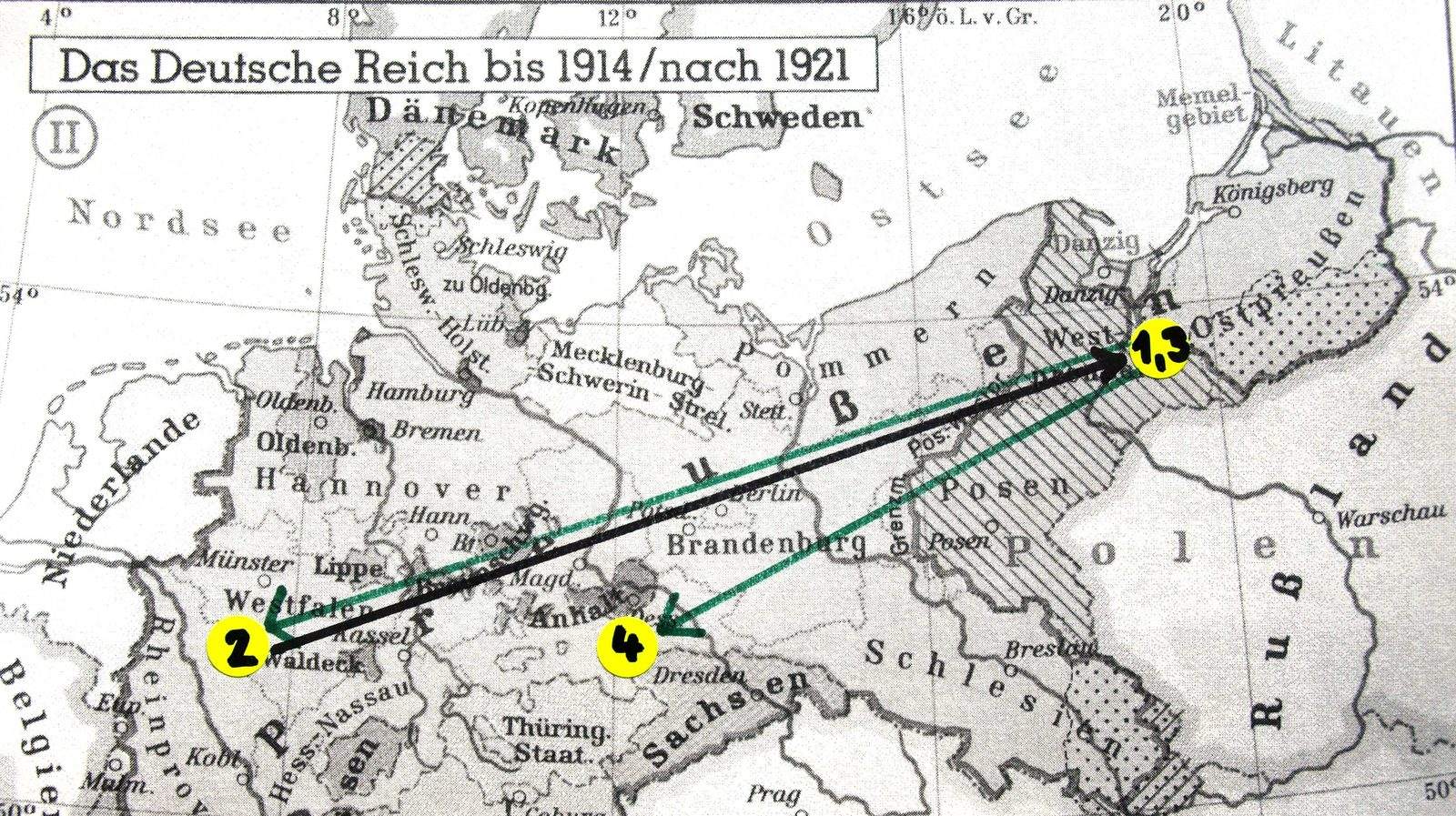
Gustav Friedrich Bommert and Luise Marie Zabel marry on 29 November 1911 in Groß Lunau in Kreis Kulm. Shortly after the wedding the couple leaves West Prussia and moves to the western edge of the Sauerland, to Hückeswagen — more than 500 kilometres, in the opposite direction to all previous migrations.
The route is traced on the map of the German Empire of 1911 to 1912: from Kulm across the Vistula, straight through Posen (Poznań) and Brandenburg, as far as Hückeswagen in the Rhineland. Still before the outbreak of the First World War the couple returns with their first son, born on 12 May 1912 in Hückeswagen, to Groß Lunau and Kulm.
At the beginning of the nineteen-twenties the second departure follows. The unstable political situation in West Prussia within the newly formed Polish state prompts the married couple to choose a distant destination once again: Großbruch near Leipzig in Saxony. Nearby, in Grimma and Bad Lausick, descendants live to this day according to the manuscript.
For the chronicle the story of the Kulm line thus ends not in Kulm but in the west of Germany — after a movement that had led nine generations in the opposite direction.
1911 and 1912. For the birth of the first son the manuscript initially gave 12 May 1911 in Hückeswagen — a date before the wedding of 29 November 1911, which could not be maintained as it stood. The author has corrected the passage: Karl was born on 12 May 1912, and the family returned from Hückeswagen to Groß Lunau and Kulm as early as 1912, in any case before the outbreak of the First World War. What was planned as a short wedding trip in 1911 became a departure with the return the following year. The manuscript’s two wedding dates, however, diverge: the line of descent gives 23 September 1911, the account of the departure 29 November 1911. Both statements stand side by side here so that neither of them is taken for the only one.
- Wedding
- 29 November 1911, Groß Lunau, Kreis Kulm
- Destination I
- Hückeswagen, Rhineland — western edge of the Sauerland
- Return
- 1912, to Groß Lunau and Kulm, before the First World War
- Destination II
- Around 1920 Großbruch near Leipzig, Saxony
On precision
All estimates lead into the same period
For Peter (I.) the manuscript gives two formulations that mean the same window:
- “* between 1724 and 1736” in the line of descent of the Kulm line;
- “* around 1725 ± 5 years” in the account of the second generation, derived from the death of the second wife Anna in the year 1724.
Both times the same thing is meant: the boy came into the world after the family had left Marzy Nowe in 1724, and at his first marriage in 1753 he was at least eighteen years old. Until recently, by contrast, the summary overview of the second generation gave “* before 1717” — a date that does not fit a complete baptismal register with not a single entry in his name. The author has since changed this passage to “* after 1724, + before 1789”; the overview now agrees with the line of descent. Anyone continuing the line of descent of the Kulm line should reckon with the estimate “between 1724 and 1736”, because the two marriages of 1753 and 1757 and the marriage age of 18 years narrow down this period.
Why such passages remain. A chronicle that smooths over contradictions loses its verifiability. The author marks his estimates with “± 5 years” and spells out his uncertainty. This project follows suit.
Back to the left bank of the Vistula
In the same years the main line continues in Kreis Schwetz: in 1769 Gottfried Friedrich (III.) marries into a blacksmith’s family and nevertheless remains an Instmann (farm labourer bound to the estate).