Second generation · 1737 to 1756
Six places of residence in twenty years
Johann Friedrich (II.) Bomert is the forefather of the Graudenz line. He comes to Poland as a child, loses both of his mothers early on and afterwards moves as an Instmann (a farm labourer bound to the estate) from one noble estate to the next — on average every two years.
- Life dates
- * estimated 1710 ± 5 years abroad · † after February 1756 and before 1759
- Marriage
- around or before 1737, at an unknown place, to Marianne (birth name not handed down); in 1759 she marries Georg Boldt as her second husband
- Children
- Elisabeth, * before 1738 · Gottfried Friedrich (III.), * 19 April 1741
- Occupation
- Instmann on noble estates — an agricultural migrant labourer with contracts of two to three years
- Confession
- Lutheran; the record was drawn up in Catholic churches, because at that time there was no Protestant church in the Starostei (starosty) Swiece (Świecie)
Origin
Arrived as a child, half-orphaned at eleven
He was, so the author estimates, ten years old, with an uncertainty of five years up and down; his brother Andreas two to three. By 1717 at the latest both are likely to have arrived at Marzy Nowe in the Starostei Swiece (Świecie) together with their father Friedrich (I.), his first wife Gertrud and the group of immigrants. About his youth and young manhood all reports are missing: no sponsorship, no witness, nothing.
Only what collapses around him is documented. Gertrud, the mother, is last mentioned in a record in 1719 and presumably dies shortly afterwards. The father's second wife, Anna, is last named in 1724 as a baptismal witness and in all likelihood dies soon after as well. After that the sources of the parish fall silent for thirteen years.
When Johann Friedrich (II.) steps into the genealogical light himself for the first time in the year 1737, he is already a husband and father. One thing is certain: he cannot have been born after 1724, because marriage in Poland presupposed full age at 18 years. His proof of birth therefore lies with certainty outside the church district, in a country that the chronicle does not know.
The third place of residence
Stwolno Niemieckie — the village behind the dam
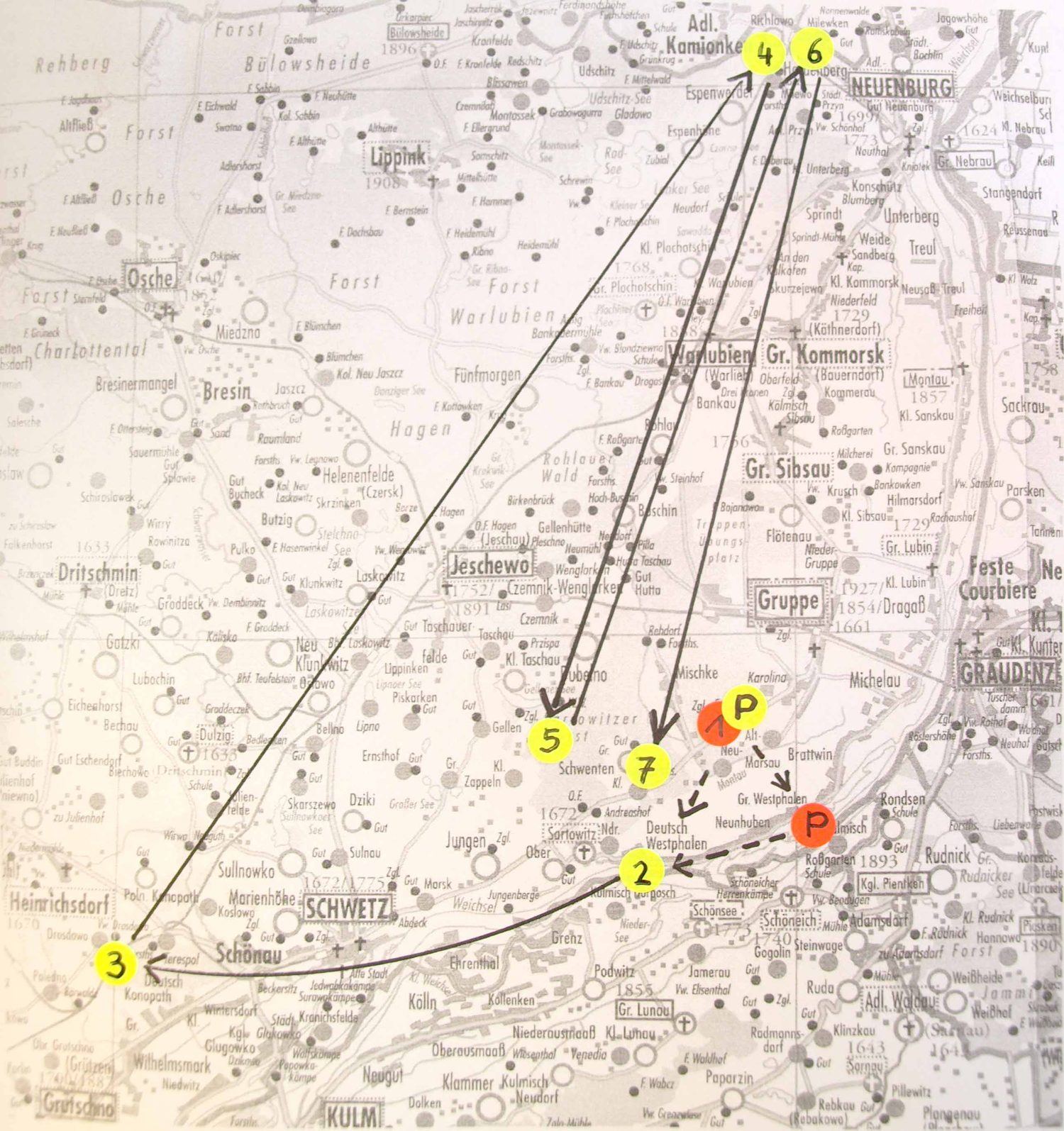
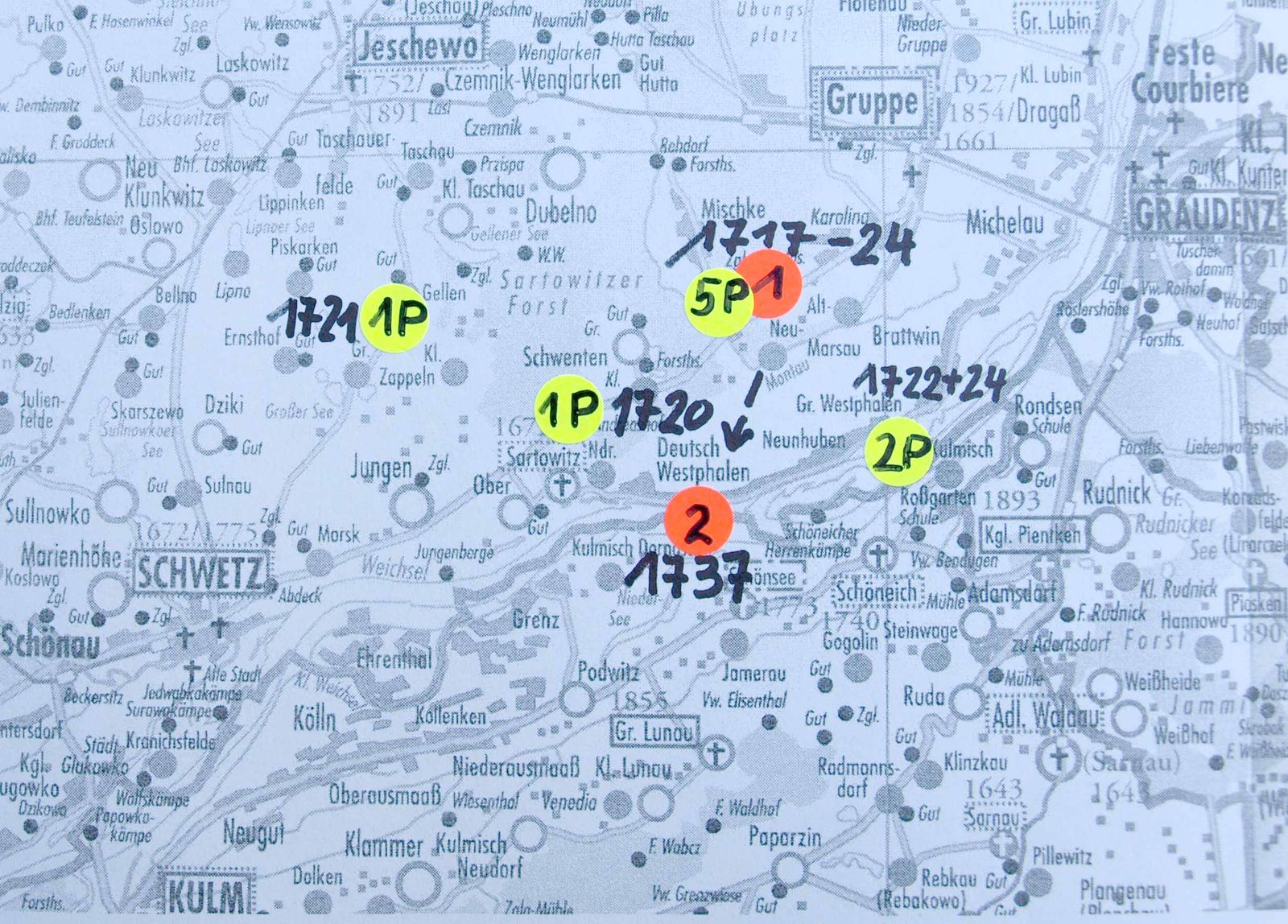
By 1737 at the latest the remaining family lives in Stwolno Niemieckie / Deutsch-Westfalen, the village of the stepmother Catharina and her second husband, the linen weaver Adam Kottke. It is a village on the Vistula (Wisła), on mediocre soil, without protection from the river.
For the young family it was not an advancement but a lesson. In 1741 the Starostin and princess Johanna Jablonowska granted the whole village under “Holländischer Gerechtsame” (Dutch law tenure) — 17 named leasehold farmers shared 29 Hufen (hides) 13 Morgen behind the dam and 3 Hufen 17½ Morgen in front of the dam and paid 6.400 Prussian Gulden in Einkaufsgeld (purchase money) for it. Whoever did not have this money was left out.
Johann Friedrich (II.) did not have it. That answered the question of his place in the village long before it was asked.
Clues to the situation of the small people
- 1565
- Stwolno Niemieckie belongs to Swiete / Schwetz Castle. Four peasant farms, each holder pays 12 Groschen; the women gather cabbage and spin. Belonging to the parish of Michelau.
- 1642
- The captain of Schwetz leases out 16 waste Hufen to Dutchmen for 50 years on a fixed-term lease — with fishing in the Vistula and the Montau, the shipping of the produce and the Krugrecht (right to keep an inn).
- 1741
- 17 leasehold farmers, 6.400 Gulden in Einkaufsgeld, 20 Gulden rent per Hufe, the upkeep of the roughly 800 rods long Vistula dam as a joint burden.
- 1772/73
- In the contribution cadastre: 5 Eigenkätner (smallholders owning their cottage) (2 tailors, 1 linen weaver) and 22 Instleute (estate labourers) (2 linen weavers, 1 tailor, 1 schoolmaster).
- Levies
- 3 tailors together 3 Reichstaler, 3 linen weavers 3 Reichstaler, 2 gardeners 60 Groschen each, 19 Einlieger (lodgers) together 6 Reichstaler 30 Groschen.
For context. These rates do not reproduce incomes but tax burdens. They do show the gradient within the village, however: between the craftsmen, the Eigenkätner and the 19 Einlieger lie a few Groschen — and between all of them together and the leasehold farmers with their 6.400 Gulden in Einkaufsgeld lies a world.
The earliest evidence of this generation
The baptism of 1741
The first record in which Johann Friedrich (II.) and his wife Marianne are named together is the baptism of their son. It comes from the Catholic baptismal register of Swiete / Schwenten and is written in a Latin in which abbreviations and full spellings are mixed.

Eod(em) d(at)o d. 23. Apr(ilis) Ego id(em) baptisavi infant(em) natu(s est) 19. ejusd(em) ex Joanne Bomert et Marianna Leg(ittimo) con(iugo) Paro(chia) Svec(ensis), cui nomen dat(est) Fridericus, Patrini fuerunt Joannes Radyia (et) Catharina Ochomowa (ex) Par. Svec.
On the same date, 23 April, I baptised the child that was born on the 19th of the same month out of the lawful marriage between Johannes Bomert and Marianne; it was given the name Fridericus. The godparents were Johannes Radyia and Catharina Ochomowa from the parish of Schwenten.
One name, three spellings
Johann, Friedrich or both
Without doubt the forefather bore two forenames, but they were only rarely named together. In eight surviving records he appears five times as Johann(es), once as Johann(es) Friedrich and twice as Friedrich. The chronicle therefore carries him throughout as Johann Friedrich (II.).
The name has to be carried in double form in the chronicle because on its own it cannot be distinguished: the grandfather was called Friedrich (I.), the son became Friedrich (III.). The ordinal number refers exclusively to the forename Friedrich and allows a quick glance at the number of the generation after the immigration.
- 1741 · Stwolno Niem. Baptism of the son — here the father is named Joanne Bomert. Cath. baptismal register Swiete / Schwenten 1725–1755
- 1747 · Konopat Niem. Taking on a sponsorship — again Joanne Bomert.
- 1748 · Konopat Niem. Witness at the marriage of his brother Andreas — here he is named Fridericus Bombert. Cath. parish register Przysiersk / Heinrichsdorf, Mormon film no. 7949029
- 1753 · Rychlowa The only evidence with the full name: Joanne Fridericus. It removes the last doubts about the identity of “Johann” and “Friedrich”.
- 1756 · Suburb of Nowe Last report: witness for the labourer Johann Makanski — Fridericus.
The numbering comes from the author, not from the sources. The parish registers know no generation numbers. They were introduced because the same leading name Friedrich occurs in four successive generations.
Places of residence
A new farm every two years
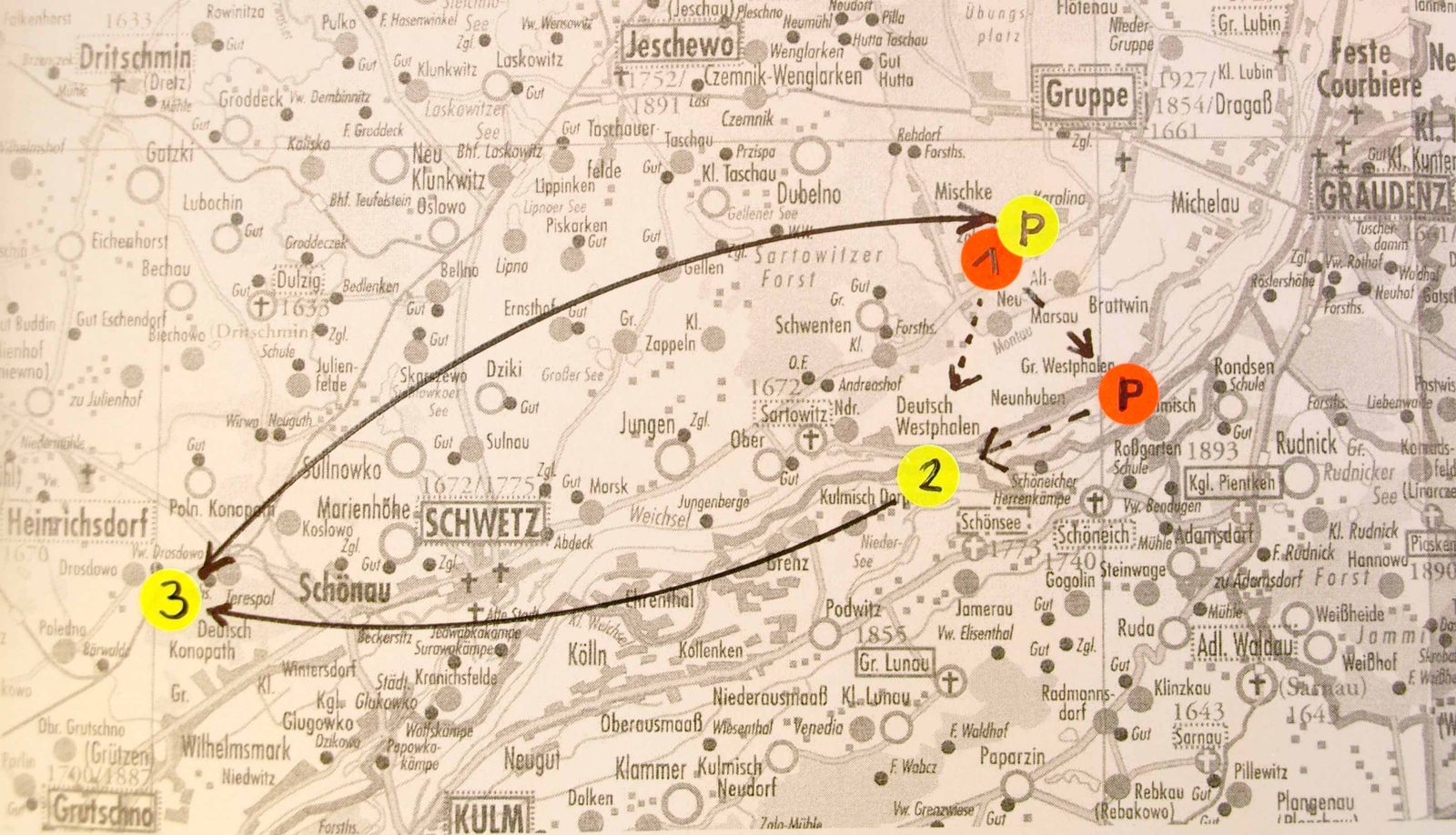
After the move out of Stwolno Niemieckie in the autumn of 1746 a zigzag course through the district of Schwetz begins. The author counts six places of residence in some twenty years. No craft tolerates this rhythm — that is why he did not continue the linen weaving of his step-parents.
-
The way through the district
1737 to 1756
- 1737 – 1745Stwolno Niemieckie / Deutsch-WestfalenSecond place of residence of the family; here the son is born in 1741. The village has already been cultivated land for almost 300 years — leasehold land here is to be had only against a high Einkaufsgeld.
- 1747 – 1748Konopat Niemieckie / Deutsch-KonopathSouth-eastern corner of the district, parish of Heinrichsdorf. The brother Andreas follows him here; the sponsorship of 1747 falls in this period.
- 1749 – 1750Mieliwko / Mielevken near NoweIn the north of the district. Here the double forename Johann Friedrich is confirmed in full composition in 1753.
- 1751 – 1752Swiete / SchwentenBack in the original area of immigration. In 1755 the Lutheran confession of the family is confirmed directly for the first time at a baptismal sponsorship.
- 1753 – 1756Mieliwko, againThe family stays here for about three years. On 24 February 1756 Johann Friedrich (II.) appears for the last time — as a witness in the suburb of Nowe.
- from 1759Swiete Male / Klein SchwentenSeventh place of residence, but not his: on 28 January 1759 the widow marries Georg Boldt and moves here with him.
The end
A grave without a death record
Between February 1756 and 1759 Johann Friedrich (II.) dies, estimated at the age of 49 to 51 years, with an uncertainty of five years. There is no death record. The conclusion rests on a single gap: from 1756 the records fall silent, and in 1759 Marianna Bomert marries Georg Boldt in Klein Schwenten.
He leaves behind two children: Elisabeth, about 19 to 22 years old, and Gottfried Friedrich (III.), 15 to 18 years old. There can be no talk of a noteworthy inheritance — little household goods, bedding, small livestock. „Der ersten Generation der Tod und der zweiten die Not“: in his case the sentence does not sound far from reality.
“Death to the first generation and hardship to the second”.
The burial registers of the parish of Schwenten begin only in 1759 at all. Even if a funeral had therefore taken place, it would not have been recorded.
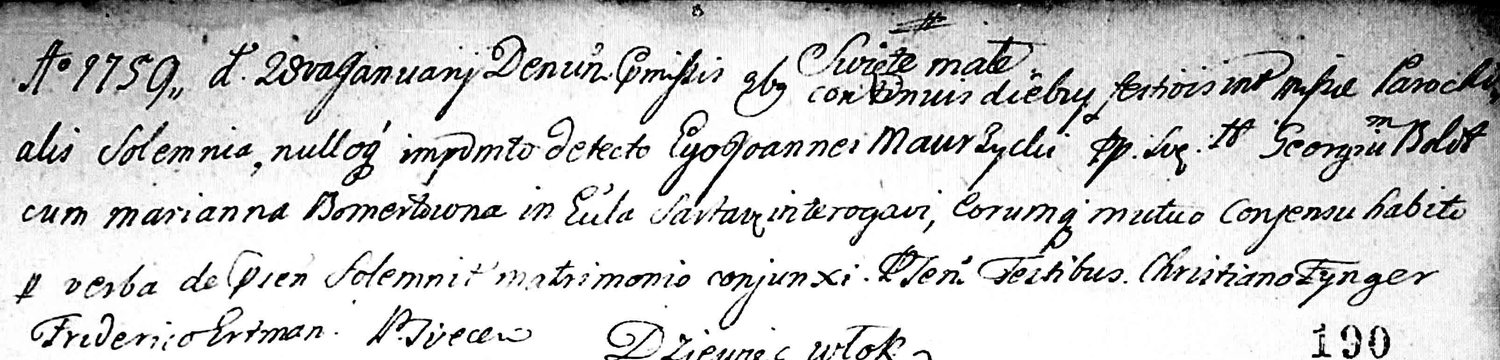
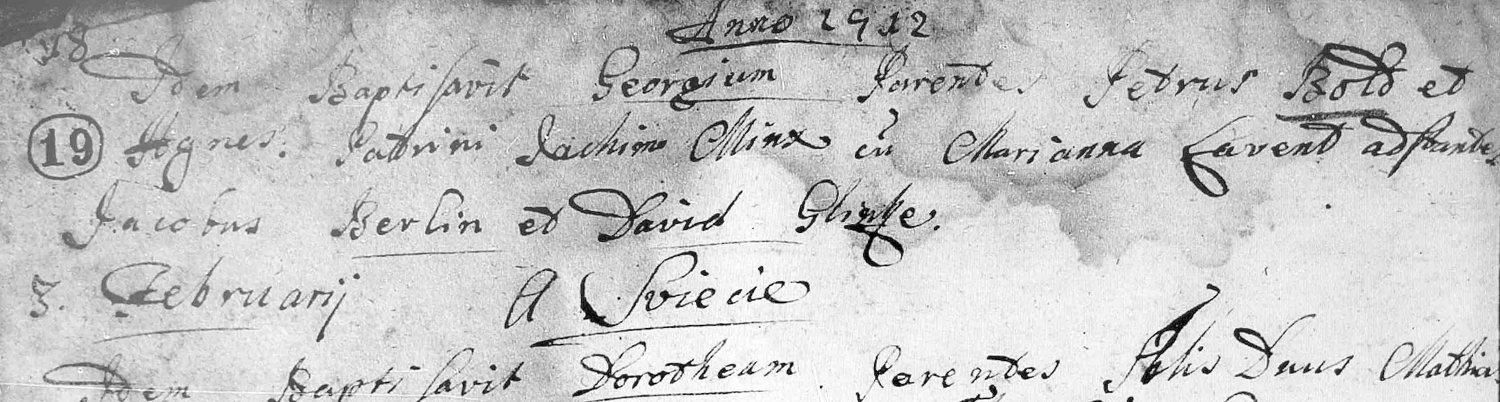
Why this evidence counts. Marianna Bomert is the last person of the second generation whose path can be traced. Georg Boldt will have married in 1759 at the age of 47, she at an estimated 43 years — the author calculates both details back from a baptismal register of 1712 and from marriage ages. More detailed reports about the occupation, religion and status of Georg Boldt could not be found in the first survey.
Occupation and standing
The proof comes from the tax list
That Johann Friedrich (II.) was no weaver the author concludes not from an occupational designation — there is none — but from the form of his life. A craft with a workshop cannot be moved every two years. The brother Peter is described in 1757 as “Laboriosus”, as a labourer; a blurred word that covers servant, Einlieger and Instmann.
Servant and maid
In the peasant's household, board and wages, no household of their own.
Einlieger
A pure day labourer, often with a chamber or a small annex for rent.
Instmann
Contract for two to three years with an estate or a Vorwerk (demesne farm): cottage, garden, wages. In the tax list of 1772/73 the lowest level with a contract of its own.
Vollbauer (full farmer)
Leaseholder with two Hufen of land. In Stwolno Niemieckie in 1741 to be had only against 6.400 Gulden in Einkaufsgeld.
The Vorwerke at Groß Schwenten (Święte) and Deutsch Konopat (Konopat Niemieckie) were estate farms in noble or royal hands, situated away from the villages and often branch enterprises of larger farms. They could take in many servants and farmhands, male and female, Einlieger and migrant labourers — and they paid on short contracts. Precisely this rhythm can be recognised in the places of residence.
Another village of his stations was Schwenten. In 1773 Groß and Klein Schwenten together counted 48 households with 215 Catholic and Lutheran inhabitants, 17 peasant leaseholders keeping teams, two tradesmen and one teacher. In 1669 the place had a blacksmith and a potter. In Groß Schwenten lived the married sister Marianne.
„Der ersten Generation der Tod, der zweiten die Not, erst der dritten das Brot!“ The author's maxim
Death to the first generation, hardship to the second, bread only to the third.
What follows from this. For Johann Friedrich (II.) the standing of the Vollbauer can be ruled out and the standing of the Instmann assigned. For his father Friedrich (I.) the emigration is likely to have been the “lost paradise” — unless he and Gertrud had come to Poland from the beginning as Kätner (smallholders) or simple serving people.
Genealogical overview
The second generation
- (1.1.)
- Johann Friedrich (II.) Bomert — * estimated 1710 ± 5 years abroad, † after February 1756 and before 1759. By occupation Instmann. Married at an unknown place around or before 1737 to Marianne NN, * estimated 1715 ± 5 years, † after 1759. In 1759, in her second marriage, she marries Georg Boldt in Klein Schwenten, * 1712 in Stwolno Niemieckie.
- Children
- Five entries the author lists; the first two certainly belong to the line.
| No. | Name | Birth | Place and evidence |
|---|---|---|---|
| 1.1.1. | Elisabeth Bomert | before 1738 | Born in the recordless time between 1724 and 1737, outside the parish of Schwenten. Evidence solely through a sponsorship in 1753 in Rychlawa / Miliwko — a church sponsorship was possible only from the age of 16. Every further trace of Elisabeth is missing. |
| 1.1.2. | Gottfried Friedrich (III.) Bomert | 19 Apr. 1741 | Born in Stwolno Niemieckie, baptised on 23 April in Swiete / Schwenten. Our ancestor and bearer of the main line. To the chapter |
| 1.1.3. | Paul Bromert | 1750 | * in Rychlowa near Mielewko / Neuenburg; father Joannis, mother Marianna. No marriage and no descendants known. |
| 1.1.4. | Michael Brom | 1753 | * in Rychlawa near Mielewko / Neuenburg; father Joannis, mother Marianna. No marriage and no descendants known. |
| 1.1.5. | Catharina Brumunt | 1754 | * in Mielewko; father Joannis, mother Marianna. Further reports are missing. |
Why the last three entries are uncertain. The author considers it highly probable that Paul, Michael and Catharina do not belong to this line. The three baptisms fall in the years in Mieliwko in which Johann Friedrich (II.) and Marianna demonstrably lived there — and the father is recorded in all three entries as Joannis. A second family of the same name in the same parish is therefore not excluded, but not documented either. The chronicle therefore carries the three with question marks and not as descendants.
The apple did not fall far from the tree
Gottfried Friedrich (III.) will go the same way — only this time, because his wife comes from a blacksmith's family, with the vague prospect of an advancement that does not come.