First generation · in Poland 1717–1737
The immigrant Friedrich (I.) Pomert / Bomert
A hard life! An early death! — What remains of this generation are a few church records, mostly sponsorships at the baptisms of befriended families.
- Origin
- unknown; the records give names from the German-speaking lands
- Immigration
- 1716 or 1717 into the starosty of Swiece (Świecie) / Schwetz district, Kingdom of Poland
- First place of residence
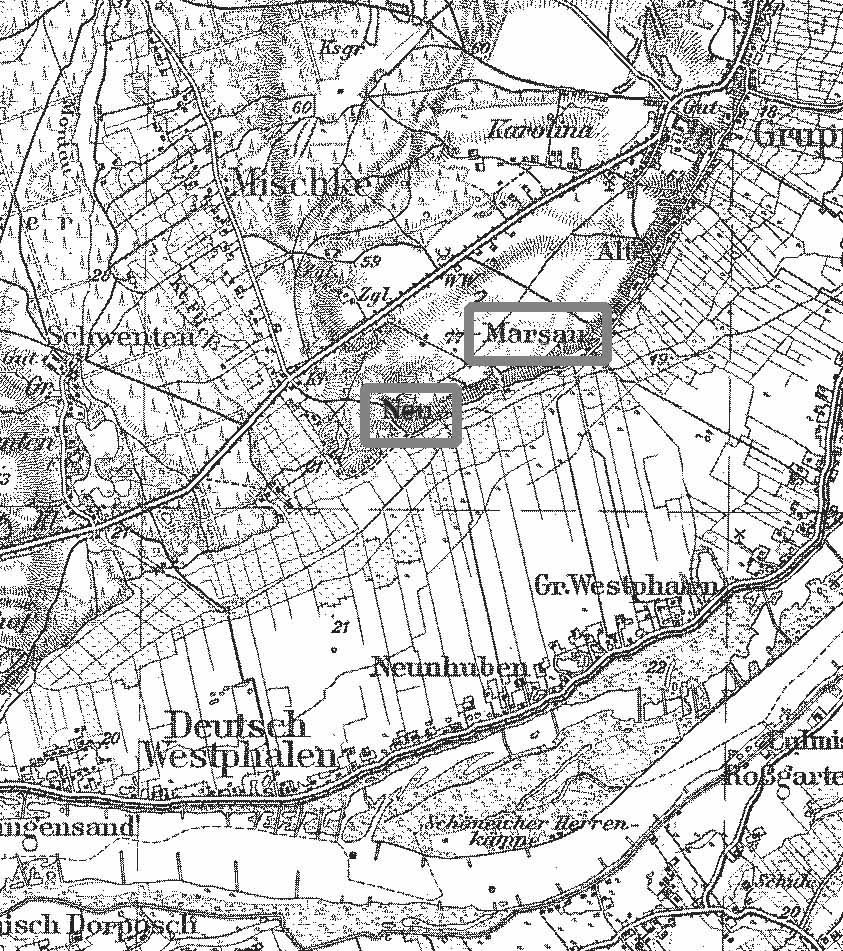
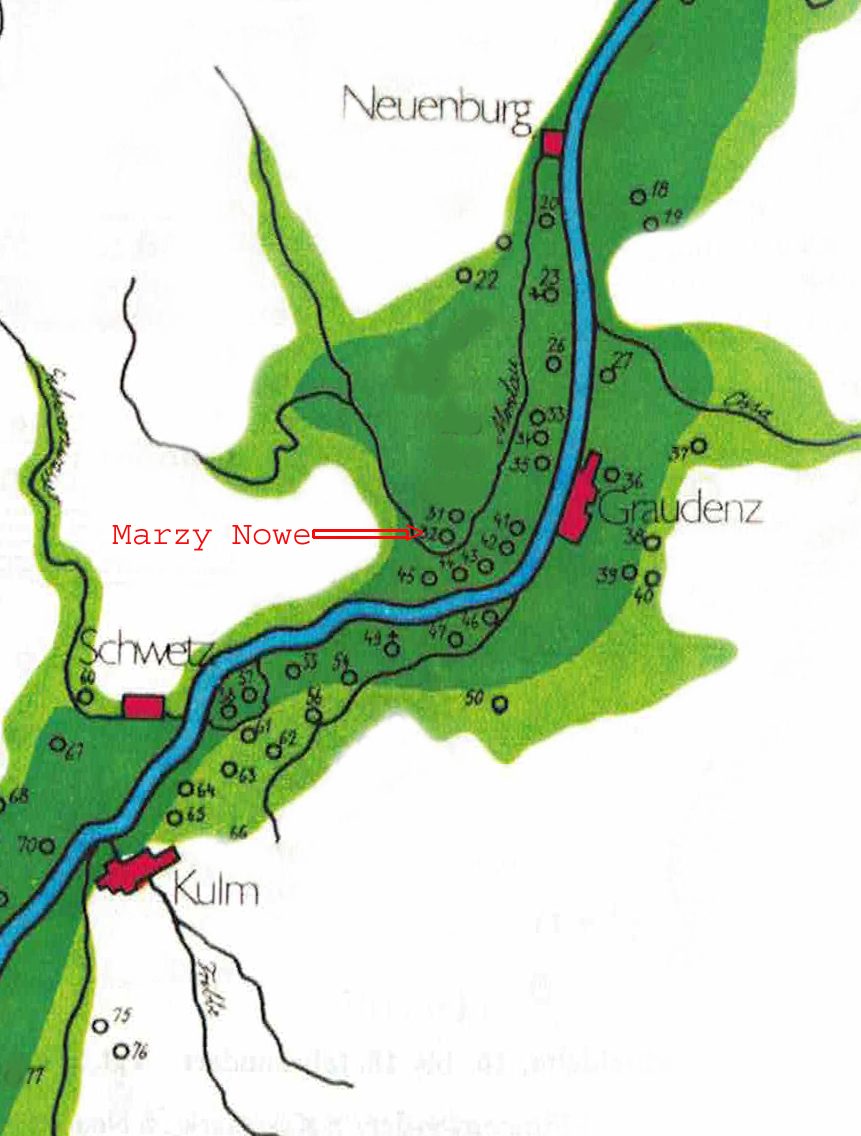
- Marzy Nowe / Neu-Marsau, 1717 to 1724
- Marriages
- three: Gertrud, Anna, Catharina
- Children
- four: Johann Friedrich (II.), Andreas, Marianne, Peter (I.)
- Life dates
- born around 1685, died before 1737 — the author's estimates with a range of ±5 years
On the images
What exists of this generation — and what does not
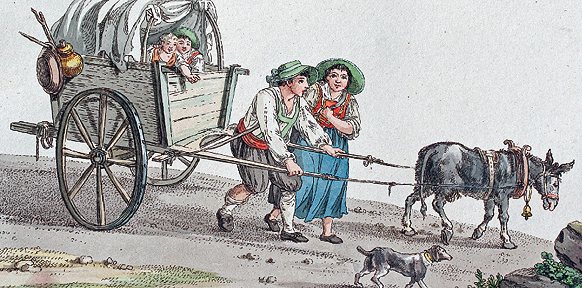
The first chapter is the only one in the volume that has to manage entirely without a portrait. For the first generation there are no proofs of birth, only two marriage certificates of the sons, and no proofs of death; no image, no description, no epitaph. Everything that can be said about them stands in sponsorship entries of other families.
The engraving is therefore not a substitute portrait but an illustration: it shows the event, not the persons. Holding to this distinction is the reason why no drawing stands in for an ancestor anywhere in the volume — the illustrations are records, maps and photographs, and they are named as such.
So werden die „brutalen“ Erfahrungen zahlloser Auswandergenerationen gewöhnlich in einem Satz zusammengefasst.
This is how the “brutal” experiences of countless generations of emigrants are usually summed up in a single sentence.
“Death to the first generation, hardship to the second, bread only to the third.”
Arrival
Lured with promises
Like thousands of settlers before them and after them, who streamed eastwards over the centuries, they had left their homeland, their relatives and friends, and burned the bridges behind them. An uncertain future awaited them.
From the records found to this day it emerges that it was Friedrich (I.) Bomert (Pomert), his wife Gertrud and at least one son, Johann Friedrich (II.), who arrived at Marzy Nowe in 1716 or 1717 — presumably with a larger group of settlers. Since at least 1710, as far back as the baptismal registers reach for the place, there had been no more births here. Now, however, the baptismal entries increased by leaps and bounds.
A second son, Andreas, was presumably also born in the old homeland. The youngest son Peter (I.), by contrast, probably already in Poland — though not in the parish district of the immigration destination. He must have been born after 1724, after the family had left Marzy Nowe again.
The family is first mentioned in August 1717, on the occasion of taking on a sponsorship. For all those named in the group of immigrants there are no proofs of birth, only two marriage certificates — those of the sons Andreas and Peter (I.) — and no proofs of death.
Motive
Why Poland, why not to Prussia?
We do not know the true reasons. The author surmises them — and states expressly that they are surmises.
Avoiding military service
Whoever came from Prussia and settled anew in Brandenburg or East Prussia was again subject to military service. If one wanted to spare one's sons that fate, Poland was a solution.
Escaping serfdom
Emigration promised to escape a hated lordship — provided one had the means to buy oneself free at home. The manumission fee was occasionally reduced or waived altogether in order to get rid of “poor devils”.
Being a free colonist
In Poland one was, as a colonist, a “free” peasant, settler or “free” servant — in a wholly different position from the serf Polish peasant, over whose life and death the noble landowner could decide.
Why settlers were in demand just then
In 1716 the Polish-Lithuanian king, at the same time king of Saxony, Augustus the Strong, found himself in a precarious situation. After the expulsion of the Swedish occupation by Russia in the Great Northern War, a smouldering conflict had developed into a bloody civil war: the nobility pressing for freedom and conscious of tradition joined together in the Tarnogród Confederation; opposite it stood the king's party, pressing for centralisation.
The struggle waged bitterly since the autumn of 1715 continued after the signing of the “Warsaw Pacification Treaty” of 3 November 1716 and ended only with the Sejm on 1 February 1717. In this final phase the opportunity had come to offer settlers security in Poland.
The village
Marzy Nowe / Neu-Marsau
A nobleman's village that was enlarged and leased out in one go in 1716. For the families who came it was not an attractive destination.
According to Maercker, Marzy Nowe was a nobleman's “village” first mentioned in 1676 — presumably no more than a single farmstead. It is a splinter off Marzy Stare / Alt-Marsau, which already existed in 1470. At the beginning of the 18th century its owner was Stanislaus Anton Szczuka, chancellor of Lithuania; through inheritance the village came into the possession of Count Potocki, who was still the proprietor in 1773.
Although no proof exists, in 1716 a sudden extension and leasing out of the nobleman's village land must have taken place. After the parcelling of about 25 Hufen (hides) 10 morgen of waste land, 13 peasants were settled, each single peasant with just under 2 Hufen — around 35 hectares. Beside the full farmers settled Kätner (Gärtner, smallholders) and Einlieger (lodgers), along with farmhands and maids. Within the shortest time the ancestral family, as one among about 35 families, will have erected its farm or moved into its cottage.
The soil was mediocre: a third counted as arable land of medium quality, two thirds as inferior, as “flying sand”. Hay the peasants could not sell, it sufficed only for their own needs; high-quality wheat could not be grown, and floods always brought more sand onto their property.
- Foundation
- 1676 first mentioned (Marzy Kl.), 1682 Marzynowo, 1773 Neu-Marso
- Area
- 25 Hufen (hides) 10 morgen of parcelled waste land
- Peasants settled
- 13 in the year 1716
- Families 1773
- 33, among them 2 Mennonite
- Gross yield
- 353 Reichstaler
- Surplus per Hufe
- just under 5 Reichstaler
For comparison, the family's second place of residence: at Stwolno Niemieckie / Deutsch-Westfalen, 24 Hufen yielded a gross return of 1048 Reichstaler; 17 peasants shared this return, at higher dues about 7 ½ Reichstaler per Hufe.
Evidence
The first records, 1717 to 1741
All records between 1717 and 1724 in which the family's name is listed are reproduced here — in a favourable case they can narrow down the period of the stay.
- 1717, 7 August Marzy Nowe. Gertruda Bomertowa assists beside Catharina Cevencowa; the sponsors are Carl Henrik and Dorothea Bargen at the birth of Catharina, daughter of Jacob Karpat and his wife Anna. Kath. KB Schwetz/Swiece 1711–1752, Mormonen Nr. 1194822
- 1719, 11 April Marzy Nowe. Gertrud Bomertowa is sponsor beside Joannes Renwans, the assistants are Elias Ellel and Marianna Trechlerowa, at the baptism of Marianna on 17 April. Kath. KB Schwetz/Swiece 1711–1752, Mormonen Nr. 1194822
- 1719, 18 June Marzy Nowe. Gertrud Pomortowa is sponsor beside Henricus Meller at the baptism of Johannes Szywelben. The assistants are Martin Gerc, Jacobus Chel… [remainder illegible, hidden in the fold], Catharina Drotowa. Kath. KB Schwetz/Swiece 1711–1752, Mormonen Nr. 1194822
- 1720, 29 January Marzy Nowe. Fridericus Pomert is sponsor beside Anna Grotowa(?), the assistant is Marianna Berentowa, at the baptism of Marianna, daughter of Christian Closs and his wife Anna. Kath. KB Schwetz/Swiece 1711–1752, Mormonen Nr. 1194822
- 1720, 24 November Swiete (Schwenten). Fridericus Pomert is the assistant beside Barbara, the sponsors are Henricus and Marianna Harnatowa, at the baptism of Martinus, son of August Zandzyk(?) and his wife Barbara. Kath. KB Schwetz/Swiece 1711–1752, Mormonen Nr. 1194822
- 1721, 14 February Czaple (Zappeln). Fridericus Pomert is sponsor beside Anna Cybartowa at the baptism of Elisabeth on 16 February, daughter of Joannis Cholewius and his wife Eva. Kath. KB Schwetz/Swiece 1711–1752, Mormonen Nr. 1194822
- 1722, 3 April Stwolno Polskie (Polnisch-Westfalen). Fridericus Pomertus is assistant beside Catharina Malonowa at the baptism of Henricus Julius, son of Henricus Janc and his wife Elisabeth. Kath. KB Schwetz/Swiece 1711–1752, Mormonen Nr. 1194822
- 1722, 30 November Marzy Nowe. Birth and baptism of Marianna on 8 December, daughter of Fridericus Pomert and his wife Anna. The sponsors are Joannes Cholevius and Elisabeth Jancowa. Kath. KB Schwetz/Swiece 1711–1752, Mormonen Nr. 1194822
- 1723 Marzy Nowe. Anna Bomertowa is sponsor beside Christian Grasina at the baptism of Marianna on 25 July, daughter of Michael Felger and his wife Ertmuta. Kath. KB Schwetz/Swiece 1711–1752, Mormonen Nr. 1194822
- 1724, 4 August Stwolno Polskie. Anna Bomertowa is sponsor beside … Malon at the birth of Marianna, daughter of David Meller and his wife Anna. The last record before the thirteen silent years. Kath. KB Schwetz/Swiece 1711–1752, Mormonen Nr. 1194822
-
1737, 23 November
Stwolno Niemieckie / Deutsch-Westfalen. Anno 1737 d. 23. 9bris .. Adam Gotkie et Catharina Bomerzowa vidua Par. Svec. in Eccla. Swiatensi interrogavi .. Testibus Joanne Knop?, Jacobo Meyster Paro. Swecensis. The marriage of the widow of Friedrich (I.) — the proof that he died before 1737.
Kath. K. Schwenten, Mormonenfilmnr. 1194825
In the year 1737, on 23 November .. I questioned Adam Gotkie and Catharina Bomerzowa, widow, of the parish of Schwetz, in the church at Swiete [Schwenten] .. with as witnesses Joanne Knop?, Jacobo Meyster, parish priest of Schwetz.
- 1741, 23 April Stwolno Niemieckie / Deutsch-Westfalen. Baptism of Fridericus, born on 19 April, son of Johann Bomert and his wife Marianna. Baptismal witnesses: Johannes Radyia, Catharina Ochomowa. — The first evidence of the second generation as a household of its own. Kath. TaufB Swiete / Schwenten 1725–1755, Mormonen-FilmNr. 1194825
What the sponsorships achieve. Between 1717 and 1724 the family appears exclusively as sponsor or assistant, at baptisms of other people's children — nine times in all: five times at Marzy Nowe and four times elsewhere, at Klein-Schwenten (Święte) (1720), at Czaple (1721) and twice at Polnisch-Westfalen (1722 and 1724). For all places outside the place of residence the following holds: there is an increased probability of presuming here families that stood very close or even relatives, for whom the journey was undertaken. The nine entries stand singly on the page of the fellow immigrants.
Fellow immigrants
The names that stand in the same records
Each of these records names, besides the family, the parents of the child, the sponsors and the assistants. These names are the neighbourhood in which the family arrived, and the names of those who at that time sat in the village with them — thirty-two in number, from Marzy Nowe, Swiete, Czaple and Stwolno Polskie.
They now stand singly on a page of their own, one after another and without selection, each with the record in which he occurs, with place and date. For researchers who carry one of these names in their own line, this is the shortest way to the common origins of the settlement — and for the author the opportunity to learn about them.
Social status
Four categories, one probability
We possess no civil records, no tax lists, no title deeds, no images, no diaries and above all no settlement contract. The author therefore examines four occupational categories that are known from Prussian settlement policy.
Full farmer
For extensive heavy work and the clearing of land the family, with a seven-year-old and a one-year-old son, was certainly not well placed. From the three following generations, demonstrably no one has run a farm.
Kätner / Instmann
Several family members become traceable later as Instmänner (estate labourers) and after 1800 as settled Kätner with property of their own. The position of a Kätner is the most probable one.
Farmhand and maid
To set out on a long, costly journey with two minor sons and then to enter the station of a farmhand as a person without means does not appear probable — it cannot be entirely ruled out.
Craftsman
Friedrich (I.) evidently did not arrive as a craftsman: his descendants down to the third and fourth generation are nowhere demonstrably recorded as having worked as craftsmen.
If one considers the further development of our ancestors, and bears in mind the experience that “the apple does not fall far from the tree”, one would have to regard the position of a Kätner / Instmann as the most probable!The author, first generation
Everyday life
Earth hut, barn, oil lamp
Whether tenant farmer or Kätner — after his arrival the colonist first had to present himself to the landowner. Only then was he allowed to begin the structural measures on the parcel of land assigned to him. In the expanding young village, the creation of makeshift shelter and the clearing of the land stood entirely in the foreground.
A first emergency shelter was the earth hut or emergency hut: half dug into the ground, with a light roof. Through such hovels the entire German peasantry in Poland ultimately passed. They are a symbol of that incredible frugality which the settlers had to take upon themselves in order to reach a halfway secure existence in a foreign land. Water came from newly dug wells, light from oil lamps.
For the women it meant, besides taking part in the village's infrastructure works and in service for the lordship, securing the family's food for the winter, sharing in garden and field work, weaving linen and bringing children into the world.
Work in the garden and in the field awaited the children. Of schooling there was certainly no question in the first years; the nearest Protestant school and church were at first far away in Grudziądz / Graudenz.
- Years of freedom
- as a rule 7 to 8 years, depending on the condition of the leased land
- Start of the free years
- the day of Saint Adalbert, 23 April
- First rent
- Martinmas, 11 November
- Hufe
- “a farm property that can be worked with one plough” — around 17 hectares
- Timber
- from the manorial heath, otherwise from the lordship directly
The church record is incomplete and misleading in itself: in 1674, during a flood, the water stood three ells high in the church at Schwetz and destroyed the parish registers. For the period between 1676 and 1725 only baptismal registers have survived; marriage and burial registers are lost.
The gap
Thirteen silent years
In 1724 Anna took on a sponsorship for the last time at Stwolno Polskie. After that the news about the family breaks off. Only thirteen years later, in 1737, does the silence of the sources end. If Friedrich (I.) and his two wives had been named as baptismal witnesses almost annually until 1724, the family now appeared as if swallowed by the earth.
The author draws one conclusion from this: the family had left Marzy Nowe. A serious illness and the early death of the second wife Anna from 1724 could be a plausible explanation — so that Friedrich (I.), with three children aged about 15, 9 and 2 years, could no longer hold the tenant farm as a possible tenant farmer and had to vacate it before his time.
It remains remarkable how late contact with Marzy Nowe broke off: when Anna stood sponsor at Polnisch-Westfalen in 1724, the family was thus still in the wider surroundings of the village. The new place of residence that the widow Catharina moved into after her remarriage became Deutsch-Westfalen.
Four years after this marriage Gottfried Friedrich (III.) is born there, the eldest son of Johann Friedrich (II.) and his wife Marianna. Therefore the volume follows the further development of the new family and that of the direct forefather Friedrich (II.) jointly in the next chapter.
The family's library contains, according to the author, for the two first generations only a single proof of birth — that of the daughter Marianne from the year 1722. The identification of the persons nevertheless usually succeeds astonishingly easily, because in the whole district of Schwetz, with few exceptions, there are no similar-sounding surnames.
Overview
Friedrich (I.) and his four descendants
| No. | Person | Birth | Death | Marriage |
|---|---|---|---|---|
| (1.) | Friedrich (I.) Bom(m)ert (Pomert) | around 1685 | around 1737 | three marriages: Gertrud, Anna, Catharina |
| 1.1. | Johann Friedrich (II.) Bomert | around 1705–1710 | shortly before 1759 | around or before 1737 Marianne NN |
| 1.2. | Andreas Bom(m)ert (Bombert) | before 1717 | unknown | 12.9.1748 |
| 1.3. | Marianne | 8.12.1722 | unknown | 25.11.1745 |
| 1.4. | Peter (I.) Bomert | after 1724 | before 1789 | 1753 and 1757 |
Children
Four descendants, two flourishing lines
- Johann Friedrich (II.)1.1 · first marriage Our direct forefather and founder of the Graudenz main line, in which the leading name “Friedrich” was carried on across several generations. First mentioned in 1741 with his wife Marianne at the birth of the son Friedrich (III.). Chapter: Graudenz main line
-
Andreas Bom(m)ert (Bombert)1.2 · first marriage
Mentioned only in his marriage record of 1748, without any indication of parents, age and place of birth — 31 years after the family's arrival at Marzy Nowe. That he was a “Bomert” and not a stranger “Bombert” emerges from the witness of his brother: 1748, Sept. 12, Konopat Niemiecki. Trauung des Andreas Bombert u. d. Hevam Willowna. Zeugen: Fridericus Bombert u. Martinus Ledlinck? Afterwards, despite searching, no further news of Andreas was found.
1748, Sept. 12, Konopat Niemiecki. Marriage of Andreas Bombert and the Hevam Willowna. Witnesses: Fridericus Bombert and Martinus Ledlinck?
- Marianne1.3 · second marriage The only one of her siblings born at Marzy Nowe. Married on 25 November 1745 Michael Schywelben at Swiete Wielkie / Groß-Schwenten; from the marriage at least one child came, Peter (II.), born on 23 April 1748. The surname appears in the sources also as Schiefelbein, Czywelbom and Cholevius — from Polish choleva, in German dialect Schywelben.
- Peter (I.) Bomert1.4 · third marriage Founder of the Kulm line that still exists today, who gave his forename to the following generations as a leading name. He married Eva Cerclau on 18 November 1753 and, at Grupa on 4 June 1757, Eva Pomplun. Both spouses are described in the record as workers, “Laboriosus”, and all those present as “Luterani”. Chapter: Kulm line
The hardship of the second generation
Johann Friedrich (II.) moves six times, on average every two years. His son marries into a family of craftsmen — and remains an Instmann all the same.