Volume 2 · Kingdom of Poland and Prussia · 1717–1863
A Song of Death and Hardship?!
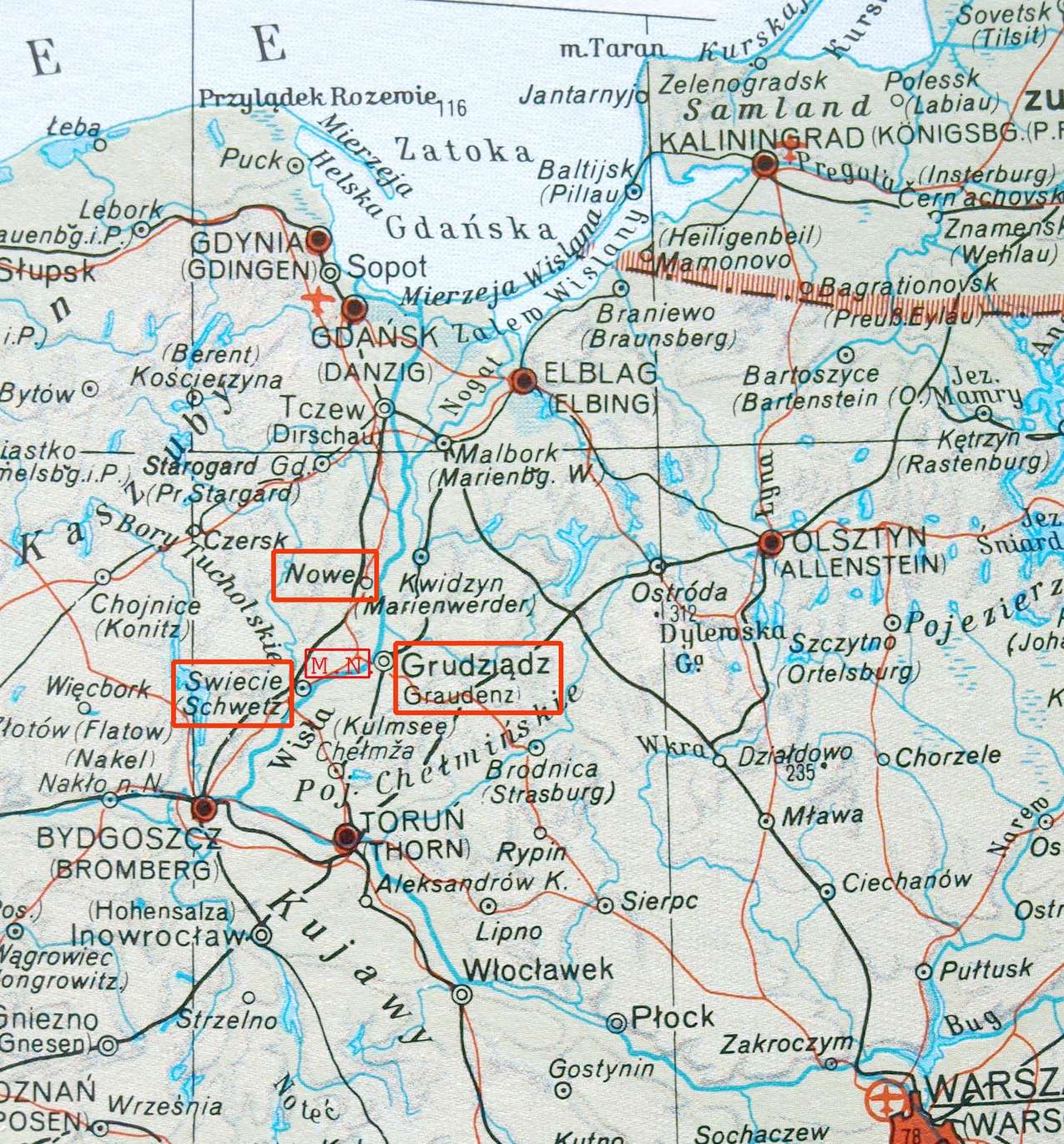
The emigration to Poland carries the immigrant Friedrich (I.) Pomert and his family into the starosty of Swiece (Świecie), to the Vistula (Wisła), to Graudenz (Grudziądz), Kulm (Chełmno) and finally to Russian Poland. Four generations, which the author has pieced together step by step from parish registers, contribution cadastres and official gazettes.
Structure · arranged by generations
The four generations
The records are the framework of the chapters. For the first two generations they are few lines; from the third onwards the transmission grows denser, from the fourth it is incomplete in a different way.
Friedrich (I.) Pomert / Bomert — the immigrant
With his wife Gertrud and his eldest son he arrives at Neu-Marsau in 1716/1717. Three marriages, four children, and a farm that cannot be held once the free years are over.
Johann Friedrich (II.) — six places of residence in twenty years
The forefather of the Graudenz line moves as an estate labourer (Instmann) from estate to estate through the district of Schwetz (Świecie): a new farm every two years, a new contract every two years.
Peter (I.) — forefather of the Kulm line
Probably the youngest brother crosses to the right bank of the Vistula (Wisła) early on. Nine generations later a branch moves back to the Sauerland — and to Saxony.
Gottfried Friedrich (III.) — died at the age of 44
He marries into a family of craftsmen and remains a migrant labourer all the same. In the contribution cadastre he is listed without a cow and without a pig; his widow marries twice more.
Peter (III.) Bommert and Anna “Maria” Bommert
A musketeer, distiller, field surgeon and innkeeper with three marriages between Prussian Poland and Russian Poland — and a niece who travels the spas as a baroness.
The volume in figures
Year of the emigration to the Kingdom of Poland. The earliest evidence is a sponsorship in August 1717 at Neu-Marsau.
Generations the volume follows — from the immigrant to the births of the year 1863.
Illustrations in the manuscript: pages of parish registers, extracts from cadastres, wanted notices, migration maps, one photograph.
On the figures. All details come from the manuscript itself. Dates before 1737 are the author's estimates; he derives them from the marriage years of the sons and the marriage ages customary at the time and marks them with “±5 years”.
Der ersten Generation der Tod, der zweiten die Not, erst der dritten das Brot!
Death to the first generation, hardship to the second, bread only to the third.
Death
Friedrich (I.) dies before 1737, estimated at the age of 50. Not one of his three wives reaches his age.
Hardship
Johann Friedrich (II.) moves at least six times as an Instmann — on average every two years, with his family in tow.
Bread
Only the sons of the third generation leave the migrant trade behind: butcher, musketeer, Kätner (smallholder), militiaman.
From the preface
The Writer's Cage
Du bist nur vergangener Wanderer Erkunder.
Du siehst auf Papier entstehen und vergehen.
Kennst nicht ihre Wahrheiten, siehst nicht ihre Wunder,
Nicht die Mühsal, nicht die Qual,
nicht ihr stilles Sinnen,
lautes Lachen und ihre Verehrer`Innen.
Du magst forschend rück- und sternenwärts jagen,
und fühlst doch nie ihr Herz – nur Dein eigenes fragendes: noch schlagen.
Jürgen Bomert
You are only an explorer of past wanderers.
You see it rise and pass away upon the paper.
You do not know their truths, you do not see their wonders,
not the toil, not the torment,
not their silent brooding,
loud laughter and their admirers, women and men.
You may hunt through research backwards and towards the stars,
and yet you never feel their heart – only your own questioning one: still beating.
Jürgen Bomert
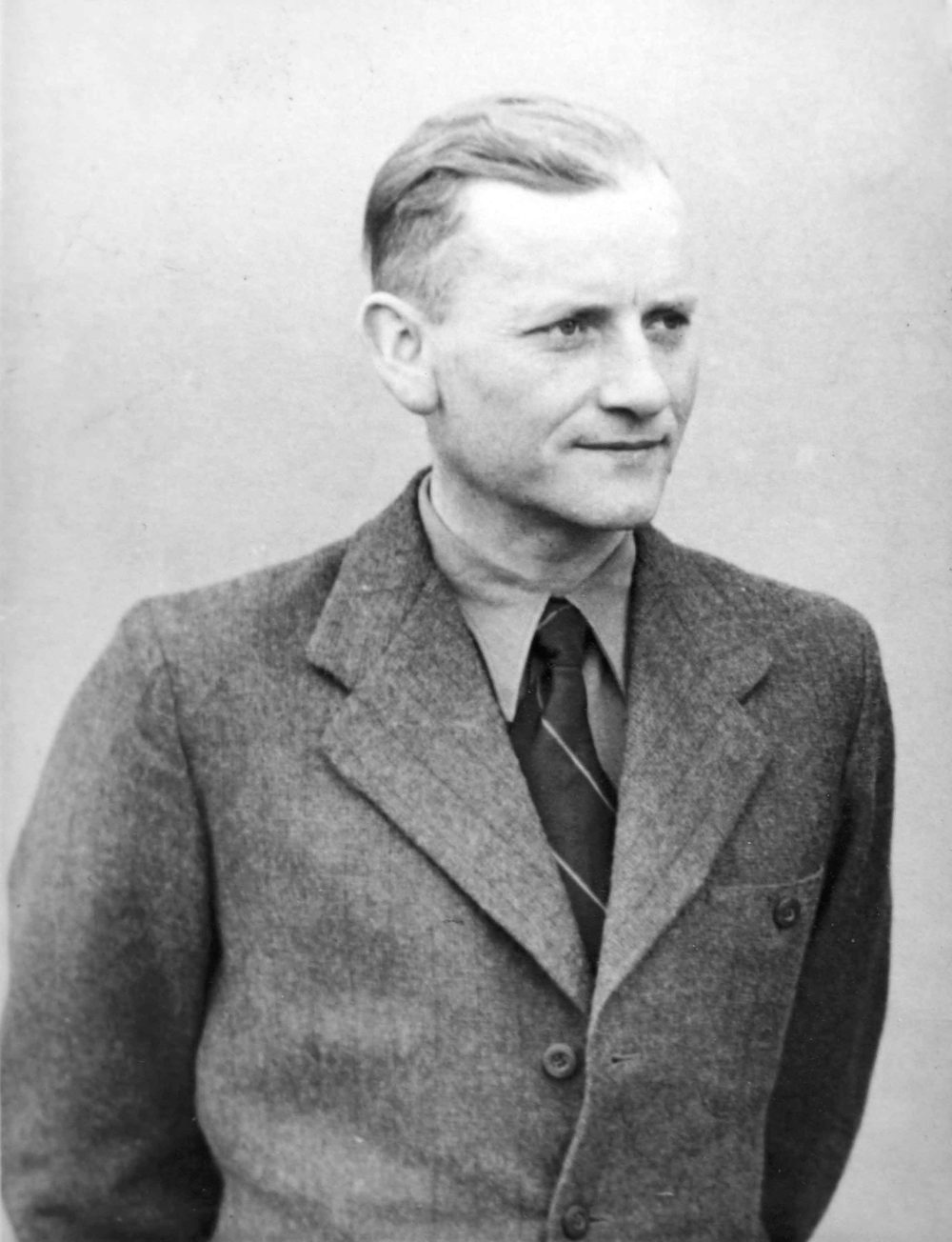
The author places this poem where he speaks of biographies of the no longer living being “easier” to write, because they can no longer defend themselves. Perhaps, he says, the image at the end reveals more about the writer than about them.
The source
Sheet by sheet from an uncle who wrote in exile
Heinrich Bomert wrote the first family history under the most difficult conditions — in exile, in English, German and Polish, without any practical possibility of consulting old records, and without suitable maps. His notes are the starting point of volume 2; the author has supplemented them with an archival foundation.
What was missing, Heinrich describes himself: „Bis 1948 hatte ich eine grosse Landkarte von Polen (1 × 1,5 m), eine zweite von Deutschland, dort hatte ich jeden Ort, der mich betraf, schön bezeichnet. Leider wurden sie mir gestohlen – weil es tatsächliche Seltenheiten waren, jedes Dorf, sogar einzelne Häuser.“
His story of a French physician named Julian de Bonmert, who marched to Moscow with Napoleon's army in 1812 and stayed in Poland wounded, has a historical core by present knowledge — as the family's history of origin it is refuted. A granddaughter was named “Ciel” after it.
Appendix
What the appendix contains
The appendices fall into a family part and a general part. The family part reproduces the records with notes; the general part sets out the conditions under which the four generations lived.
Notes and church records as well as the “bare” line of descent
Four sections, one for each generation: the sponsorships, marriages and baptisms that date the family's stay.
The fellow immigrants — the names from the same records
The families that stand beside the Bomerts in the parish registers between 1717 and 1724 at Marzy Nowe, Swiete, Czaple and Stwolno Polskie, listed one after another: for researchers from these lines.
Three historical sources on the early places of residence
Marzy Nowe / Neu-Marsau, Stwolno Niemieckie / Deutsch-Westfalen and Muntawy / Muntau — after Maercker's district chronicle and the Prussian contribution cadastre of 1772/73.
Anna “Maria” Bommert — impostor, thief and character in a novel
A niece of the forefather, wanted by notice in 1830 and 1841, prosecuted in Berlin, Elbing and Bromberg (Bydgoszcz), twice escaped from Prussian prisons — and in 1856 a character in the Leipzig “Gartenlaube”.
The “call to the East”, the social structure and the history of Poland
The Prussian invitation patent of 1711, the four estates of the colonists, Instmann and Kätner, full farmer and demesne — the partitions of Poland from 1772 to 1795 with the uprisings of 1768, 1794, 1831 and 1863. Alongside them the announced ninth appendix on the situation of the working class and the lower military ranks.
Literature, measures, abbreviations and glossary
Maercker, the contribution cadastres, the Geographical Dictionary of the Kingdom of Poland; alongside them hide, morgen and Reichstaler, the terms of the chapters and the numbering by which forenames of the same form are distinguished. The index of names and places is still missing — in the manuscript as here.
The volume begins with a grave without evidence
For every person named in the group of immigrants there is no proof of birth, only two marriage certificates and no proof of death. The first generation is the most thinly documented — and the one without which the others would not exist.