Appendix 2 · Three historical sources
Three villages in which the family lived
The chapters name the places of residence, but they do not describe them. This appendix does — with the three sources on which the account of the first fifty years rests: Maercker’s history of the district of Schwetz (Świecie), the Prussian contribution cadastres of 1772/73 and the neighbourhood registers in which every person, every head of livestock and every Hufe (hide) is listed individually.
- Marzy Nowe
- Neu-Marsau, the destination of the emigration from 1717 to 1724, in the starosty of Swiece (Świecie) / district of Schwetz
- Stwolno Niemieckie
- Deutsch-Westfalen, Amt Schwetz — the residence of the surviving family from 1737
- Muntawy
- Muntau, on the left bank of the Vistula (Wisła) — the residence of the Instmann (estate labourer) Gottfried Friedrich (III.) in the cadastral year 1772/73
- Sources
- Maercker, History of the District of Schwetz · West Prussian Contribution Cadastre 1772/73 · Emphyteutic privileges and assessments of the 18th century
The destination
Marzy Nowe — a village without a founding history
„Was ist das Besondere an diesem Ort, worauf hatte man sich da eingelassen?“, fragt der Verfasser — und muss zuerst eine Lücke einräumen: Eine Gründungs- und Siedlungsgeschichte dieses Dorfes existiert nicht. „Ganz besonders schmerzhaft ist das Fehlen der Ansiedelungsverträge, die dem Nachweis des Ankommens der Familie und für ihren anfänglichen Status Klarheit gebracht hätte.“ (“What is special about this place, what had one let oneself in for?”, asks the author — and must first admit a gap: no founding and settlement history of this village exists. “Particularly painful is the absence of the settlement contracts, which would have brought clarity to the proof of the family’s arrival and to its initial status.”)
What can nevertheless be said comes from a comparison of several sources — and yields the picture of a village owned by the nobility that was an offshoot of the older Alt-Marsau. Neu-Marsau lay on the western edge of the Vistula (Wisła) valley, in the immediate neighbourhood of the church village of Swiete / Schwenten, where the family was baptised, married and buried its children.
For the immigrants the place was favourable in several respects: the soil first had to be prepared, so in the early years the conditions were negotiable; there was no long-established village community that could have fended off the new arrivals; and with the nearby church village there existed at least an administrative structure in which the family became documentary traceable.
That it was not enough is shown by the departure of 1724. What the sources do not reveal is the question whether the family had begun with leased land and lost it — or whether it came as Kätner (smallholders) or hired servants from the outset. The author leaves both open.
The place in figures
- Location
- Western edge of the Vistula (Wisła) valley, starosty of Swiece (Świecie) / district of Schwetz, Kingdom of Poland
- Church village
- Swiete / Schwenten, Catholic — at that time no Protestant church existed in the whole starosty
- 1773
- 33 households with 141 inhabitants, in part Mennonite, for the most part Lutheran
- Structure
- 13 peasant tenants keeping a team of draught animals (Gespann) · 7 Eigenkätner (smallholders holding their own plot) · 9 Einwohner (residents) · 4 craftsmen and 1 tradesman
- Missing
- The settlement contracts. Without them the family’s initial status remains a well-founded supposition.
What is striking about the figure of 1773. A hundred households of this size knew thirteen tenants — and around sixteen households without land: Kätner (smallholders), residents, craftsmen. The family of the immigrants lived in a minority that owned no hide. It is precisely this minority that is on the move in this chronicle from the second generation onwards.
The second place of residence
Stwolno Niemieckie — a village behind a dam that did not hold
The place is called “Deutsch-Westfalen” because Dutchmen and Germans had been settled there — an emphyteutic lowland village, that is a village held on a temporary lease against purchase money, situated in the Amt Schwetz on the Vistula (Wisła).
„… dieselbe bestehet in 17 Bauern, welche 24 Hufen 15 Morgen besitzen.“
Source of the 18th century, reproduced in the manuscript
“… the same consists of 17 farmers who hold 24 Hufen 15 morgen.”
„… soll das Dorf 29 Huben 13 Morgen hinter dem Damm und 3 Huben 17½ Morgen vor dem Damm haben.“
Source of the 18th century, reproduced in the manuscript
“… the village shall have 29 Hufen 13 morgen behind the dam and 3 Hufen 17½ morgen in front of the dam.”
Two sources, two figures. The assessment names 17 farmers and 24 Hufen 15 morgen, the privilege 29 Hufen 13 morgen plus 3 Hufen 17½ morgen. The statements cannot be brought into agreement; the chronicle gives both and refrains from a reconciliation.
- 1565
- A village belonging to Swiete castle on the Vistula (Wisła) on mediocre soil, with the obligation of corvée labour (Scharwerk) “in the country and at haymaking”. Four peasant holdings, pasturage in abundance, timber washed up on the Vistula. Attached to the parish of Michelau.
- 1642
- The captain of Schwetz and castellan of Danzig (Gdańsk), Johann Zawadzki, gives 16 hides, then waste and without buildings, to Dutch settlers on a 50-year temporary lease — with fishing in the Vistula and in Montau, the shipping off of the produce and the right to keep an inn (Krugrecht).
- 1745 / 1746
- Purchase money of 6,400 gulden to Prince Jabłonowski as starost of Schwetz; the privilege for 50 years is dated 29 March 1746. Forty years later, 28 of the fifty years were still to be served.
- The dam
- The tenants had to maintain the Vistula dam, roughly 800 rods long. Already in 1746 the three hides in front of the dam were “torn away by the Vistula”; in the year after the purchase the river broke through once more.
- 1772/73
- In the cadastre: 5 Eigenkätner (2 tailors, 1 linen weaver), 22 Instleute (estate labourers: 2 linen weavers, 1 tailor, 1 schoolmaster). No further leaseholding farmers are recorded.
Why this place counts for the family. Here the immigrant’s surviving family lived from 1737 to 1746 — with the stepmother Catharina, her second husband Adam Kottke and four half-siblings. Here Gottfried Friedrich (III.) was born in 1741. And here the attempt to buy into the lease of land failed: 6,400 gulden of purchase money was a limit at which a linen weaver and a widower with many children came to an end.
The cadastral year
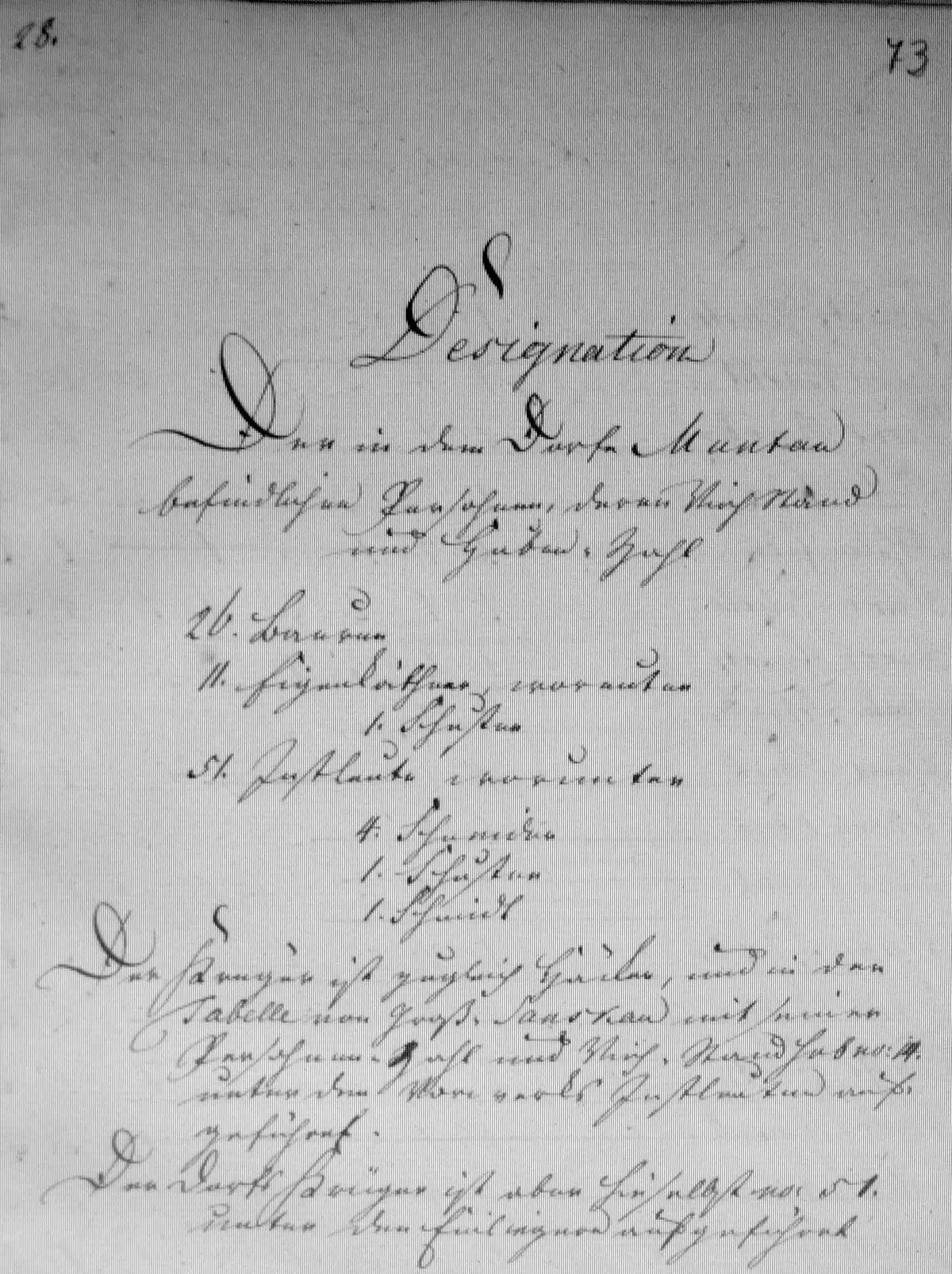
Muntawy — the recording of a village population in columns
For Muntau there is not only a tax list but a complete designation: every person, every animal and every hide of the village was recorded individually. Our direct forefather stands in the third table.
Farmers
Eigenkäthner, among them a cobbler
Instleute, among them four shoemakers, a cobbler, a blacksmith
„Die folgende tabellarische Vermögensaufstellung zeigt, dass er in dieser Rangfolge den ärmsten Familien, Instleute ohne eine Kuh, angehört“, schreibt der Verfasser über den Eintrag seines Vorfahren — „Gottfried Bommert, Ehefrau und ein Sohn unter zwölf Jahren“. (“The following tabular statement of property shows that in this ranking he belongs to the poorest families, Instleute without a cow”, writes the author about the entry for his forefather — “Gottfried Bommert, wife and one son under twelve years of age”.) The son is Johannes, born in 1770; the absence of Gottfried Friedrich (IV.), born in 1772, is explained by the fact that he was still an infant at the time of the recording.
The village’s Krüger (innkeeper) is recorded as well: he was at the same time a Häcker (smallholder with a garden plot) and appears in the table of Groß Sanskau among the Instleute of the Vorwerk (demesne), while the village Krüger is listed among the Einlieger (lodgers). Farmhands and maidservants were merely counted, not recorded by name — a sign of whom the tax collection was aimed at.
What counts in this source for the family history is not the number of Instleute but the empty column: in a village with 26 farmers and a flourishing inn business, the family’s own forefather did not own a single head of livestock.
The columns of the form
- Persons
- Men · women · sons over and under 12 years · daughters over and under 12 years · farmhands · maidservants
- Livestock
- Horses · foals · oxen · cows · young cattle · sheep · goats · pigs
- Area
- Hufen (hides) · morgen · square rods
- Condition
- In the cadastre of Deutsch-Westfalen and Schwenten the official category: Vollbauer (full farmer), Eigenkätner, Einlieger (lodger), Instmann (estate labourer)
A source with limits. The designation counts people and animals, not life stories. It says who owned how much — not how someone lived. Precisely for that reason the chronicle needs both: the records for the events and the cadastres for the circumstances.
On method
How the three sources work together
None of these sources was created for family research. They all served the administration: taxes, leases, land surveying. Their value lies precisely in that. A contribution cadastre takes no interest in genealogy — but it records every head of livestock, and with it a person’s social status, with an accuracy that a parish register never attains.
Maercker’s district chronicle supplies the framework: the history of the villages, the rights, the burdens, the owners. The cadastres supply the figures. The records supply the events. Only together do they produce the picture that the chapters draw: a family that lived in villages in which it belonged to a minority without hides, and that is nevertheless documentary traceable in every one of these villages.
For the fourth and fifth generation. In Russian Poland the cadastres recede into the background; there the work “Słownik Geograficzny Królestwa Polskiego” (the Geographical Dictionary of the Kingdom of Poland) of the 1880s takes their place. It describes the villages with figures for inhabitants, houses and confessions — and is thus the source with which Koboszyn can be described as “tiny” and Miaczyno Małe as a village with twelve houses and one mill.
And the history into which all this falls
Anyone who wants to understand why settlers were summoned at all must know the “call to the East” — and anyone who wants to understand why the family slowly moved further east after 1772 must know the partitions of Poland.