Third generation · Kingdom of Poland and Prussia
The Instmann who died at the age of 44
In 1769 Gottfried Friedrich (III.) Bomert marries the daughter of a village blacksmith. It is the only chance of advancement that this generation has — and it comes to nothing, because he does not give up the migrant trade of his father.
- Life dates
- * 19 April 1741 in Stwolno Niemieckie · † 20 February 1785 in Voßwinkel near Graudenz (Grudziądz), buried on 24 February
- Cause of death
- „Seitenstechen“ (a stitch in the side) — the author reads in it an indication of a disease of the upper abdominal organs
- Marriage
- 1769 to Elisabeth Röder / Raeder / Redder, * 1748 in Alt-Mühlbach, baptised on 17 March 1748 in Groß Nebrau. Five living children were born of the marriage.
- Occupation
- Instmann (farm labourer bound to the estate); recorded in the Prussian contribution cadastre of 1772/73 in Muntawy — with wife and one son, without a cow and without a pig
- Places of residence
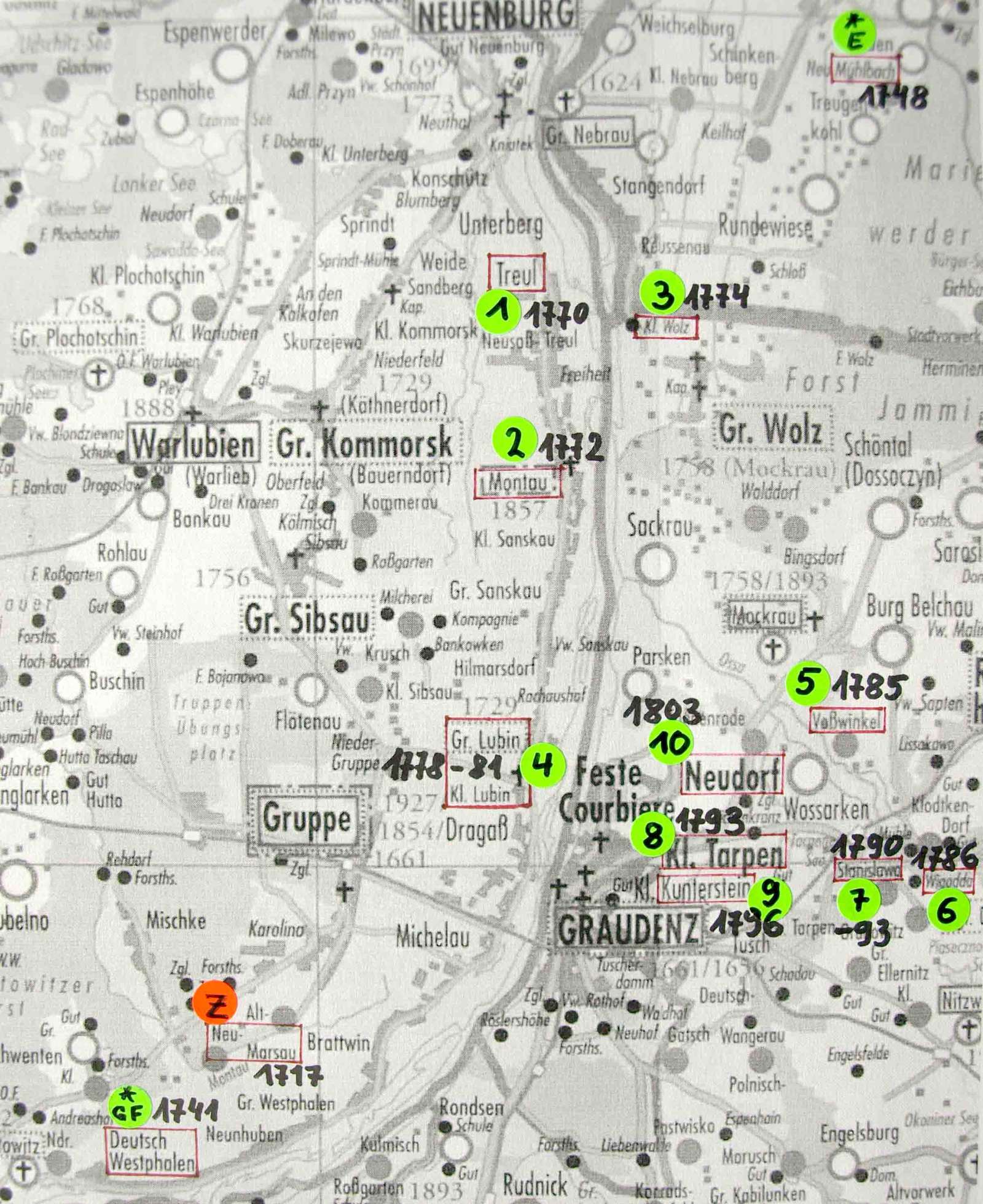
- Tryll / Treul · Muntawy / Montau · Klein Woltz · Lubin · Voßwinkel
The sources
Suddenly the transmission grows denser
For the second generation the birth, marriage and death records were almost entirely missing. For the third they are available — with one exception, the marriage record of 1769. The statement of the duration of the marriage in the death record leads back to this year, and the year of the marriage fits the birth of the eldest sons in 1770.
All the same, the parish registers in the district of Schwetz remain minimalist. In marriage records the ages are as a rule missing, the maiden name of the wife is rarely given, details of the parents almost always, the confession rarely and occupations almost never, places of birth never. Some of it is like looking for a needle in a haystack.
That changes in 1772 with the Prussian administration: from then on marriage and birth records frequently give the maiden name of the wife, details of occupation and age — and death records give details of the survivors and of the cause of death.
The name
Friedrich or Gottfried — depending on the scribe
In 1741 the child was baptised with the name Fridericus. In later records the same man appears almost exclusively under his familiar name Gottfried: in 1770 as Godfridt, in 1772 as Friedrich, in a cadastre entry as Gottfried. Both forenames were still treated as synonyms in the eighteenth century.
The author refers to him throughout as Gottfried Friedrich (III.) and mostly uses “Gottfried” in the text, because it is the name that the forefather himself chose.
On reliability. The mixing of the names is not an error of the chronicle but a feature of the source. It has consequences for research: whoever searches for a “Friedrich Bomert” in the district of Schwetz finds the same person as under “Gottfried”.
1769
Marrying into a family of craftsmen
Elisabeth Röder is the daughter of the village blacksmith Johann Jacob Roedder and of Elisabeth, née Schroder, a carpenter's daughter from Graudenz. With this marriage Gottfried Friedrich (III.) marries into a family of craftsmen — in principle the opportunity for a social ascent. It turned out otherwise.

“had Joh. Jacob Roedder with his wife Elisabeth baptise a daughter, Elisabeth. Godparents Jac. Spode, Christina Peckholtzin.”

“Johan Jacob Redder, journeyman blacksmith, with Elisabeth, Wilh. Schröder's daughter.”
- Father-in-law
- Johann Jacob Roedder, village blacksmith. First documented in 1742 in the parish register of Groß Nebrau; by 1759 nine children had been born. The eldest son Christian took over the trade and the smithy of his father.
- Mother-in-law
- Elisabeth, née Schroder, * 24 June 1718 in Graudenz, daughter of the carpenter Wilhelm Schröder.
- Wife
- Elisabeth Roedder, * 1748 in Alt-Mühlbach. She is the fourth child and the eldest daughter.
- Consequence
- None. The author sees in the marriage “in principle” the possibility of an ascent into the class of craftsmen — but the frequent changes of residence of the young family show that Gottfried practised none of the trades of his parents-in-law.
Five stations in fourteen years
From the Vistula (Wisła) back to the Vistula
The family changes constantly between the left and the right bank. No stay lasts longer than four years, none brings property.
- 1770 · TryllThe twins Johannes and Jacob are born.The father's forename in the entry reads “Godfridt”. Around 1789 Tryll is an emphyteutic village with 40 hearths on the Vistula together with a new settlement (Neusaaßerei) of 8 hearths; for a tenant's post the purchase money was lacking. The twin Jacob was no longer alive in 1785.
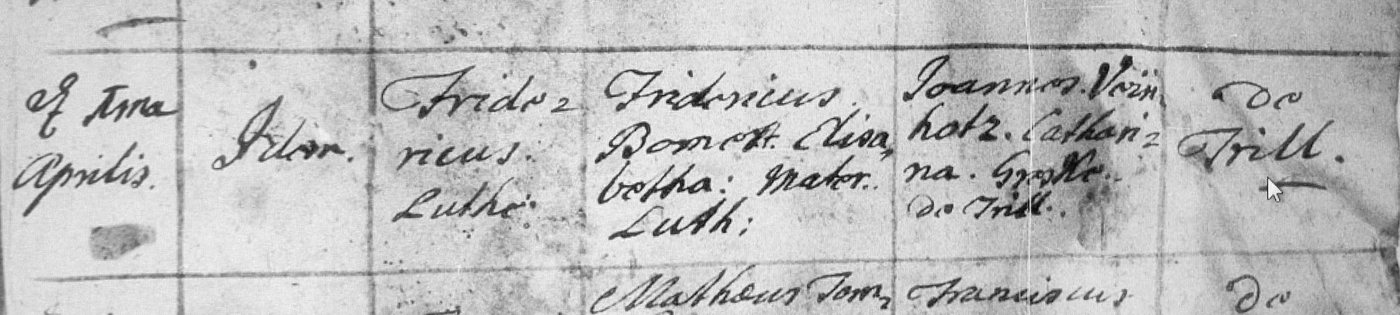
- 1772 · MuntawyBirth of Friedrich (IV.), on 1 April, baptism in Neuenburg.The parents and the child are expressly described as „Lutherani“ — the second direct evidence of confession of this family. A change of residence need not have been connected with it; the godparents of the twins had given their residence as „de Tryl ultima Muntawy“, that is, “in Treul at the outermost end of Montau”.
- 1774 · Klein WoltzBirth of Christian on 8 September.Right bank of the Vistula, a very small emphyteutic village with only 9 hearths not far from Groß Nebrau, to whose parish the Lutherans belonged. Here too existence remains dependent on the tenants.
- 1778 and 1781 · LubinBirth of Peter on 24 June 1778 and of Wilhelm on 31 January 1781Groß Lubin is an emphyteutic lowland village with 36 hearths and a Catholic church, Klein Lubin a hereditary free village with 8 hearths.
- 1785 · VoßwinkelThe father dies on 20 February.A small noble farming village with 19 hearths and a watermill, east of Graudenz on the right bank of the Vistula.

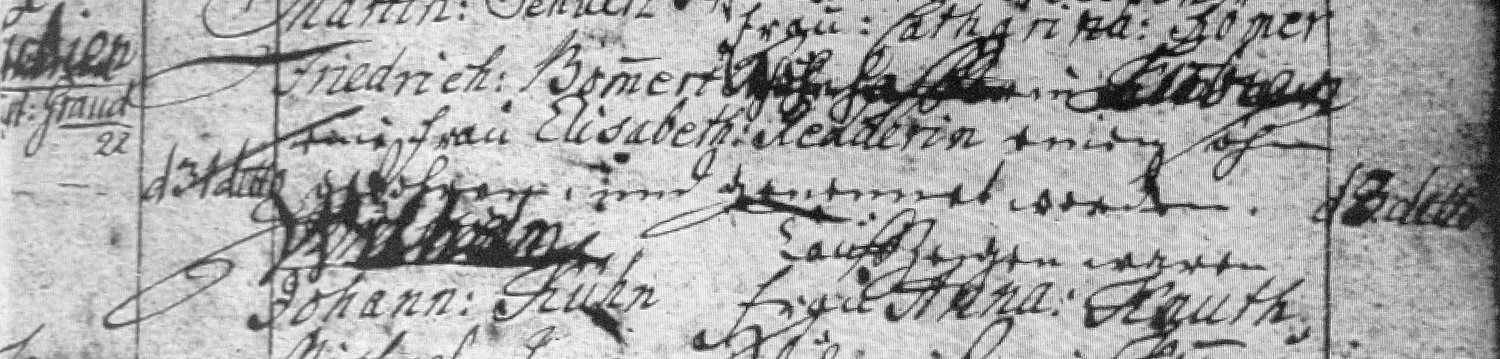
“Friedrich Bomert, inhabitant, with Elisabet née Roeder, lived 16 years in the marriage, and father of 5 living children.”

“Joannes and Jacobus, twins.”
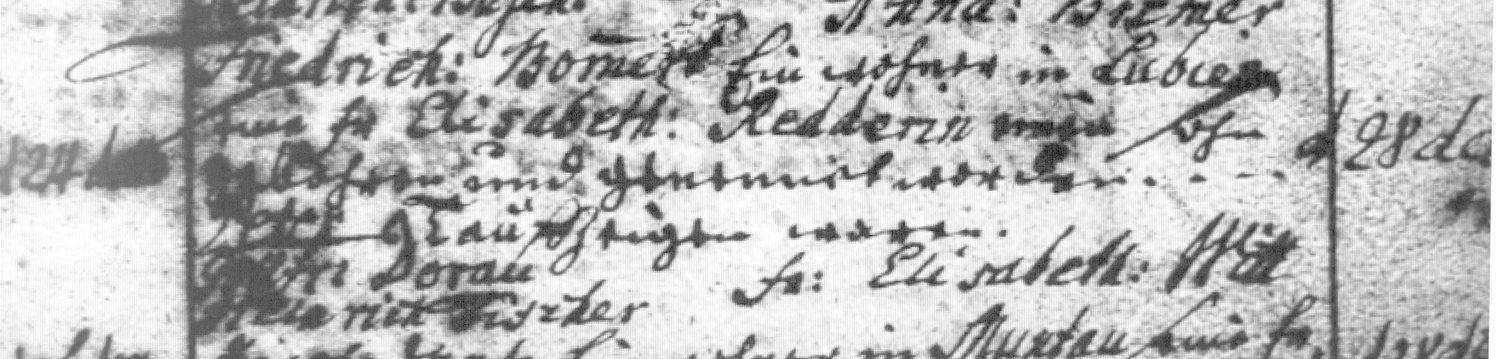
“Friedrich Bommert, inhabitant in Lubien, has had a son born to him by his wife Elisabeth Redderin and he has been named … Peter.”
1772 / 73
An official certificate of poverty
After the annexation of the Polish territory Frederick the Great had the West Prussian contribution cadastre drawn up in order to introduce the Prussian tax system. Heads of family, members of the household, livestock and landed property were recorded.
In Muntawy the entry reads Instmann Gottfried Bommert mit Ehefrau und 1 Sohn unter 12. The son is the Johannes born in 1770; Friedrich (IV.) is missing, because at the time of the survey he was still an infant. Of property the cadastre records nothing — not even a cow, and no pig.
Instmann Gottfried Bommert with his wife and 1 son under 12.
The author puts the finding into perspective: the Instmann had wages, a rented cottage, a garden, possibly a little arable land and poultry, besides a contract for at least two years and weekly working time for his own commissions. Linen weaving was widespread. Compared with Einlieger (lodgers) and pure day labourers he thus stood one rung higher.
At the same time the distance to the full farmers remains overwhelming. The Prussian officials called the Eigenkätner (smallholders with their own cottage) and the Einwohner (landless villagers) “the small people in the village”.
„Nicht einmal eine Kuh im Besitz und auch kein Schwein!“ From the contribution cadastre for Muntawy
“Not even a cow in his possession, and also no pig!”
- Muntawy
- Instmann Gottfried Bommert, wife, 1 son under 12. No livestock.
- For comparison
- In Schwenten (Święte) the same cadastre recorded among the Eigenkätner a Christian Bolt with wife, 1 son, 1 daughter and 1 cow.
- The author
- “Does such an Instmann still differ from the day labourer, the farmhand or the serf?” He considers the situation less dramatic than the empty column suggests — but the entry remains an official proof of a very low social status.
The political background
Born a Polish subject, died a Prussian
The childhood of Gottfried Friedrich falls in the years in which the Polish state disintegrated under the pressure of its neighbours. The uprising of the Confederation of Bar, 1768 to 1772, took place in central Poland; the starosty of Swiece (Świecie) was not directly affected by the fighting, but the antagonism between the Catholic and the non-Catholic population hardened.
In 1772 began the first of the three partitions of Poland; 1793 and 1795 the two others followed. The district of Schwetz came under Prussian rule, the Lutheran and Mennonite population breathed more easily — and the unloved Prussian military service began. For the records of the family the change is a stroke of luck: the recording becomes more precise, from 1772 onwards ages, occupations and causes of death are given.
An ascent was not connected with it. The end of this biography falls in the middle of the Prussian awakening, in which the forefather had no share. How the second partition and the uprisings of 1794, 1831 and 1863 affected the family is told in the appendix.
After 1785
The widow Elisabeth and a musketeer as stepfather
At the age of 36 Elisabeth marries in 1786 the musketeer Johann Kummer, 44 years old, of the regiment of von Hallmann and the company of Captain von Brosart. Her children are 5, 8, 12, 14 and 16 years old. Two further marriages follow.
- 1786Johann Kummer, Prussian musketeerThe wedding takes place in Wigoden / Wigodda, a royal hereditary-lease tavern (Erbpachtkrug) with 2 hearths. A Krug is a tavern or inn, let on hereditary lease — the author suspects that Kummer worked here as a distiller or innkeeper in a secondary occupation. His stepson Peter, our forefather, later took exactly these three paths.
- 1790Birth of the common son Carl in StanislavkenKummer is by then the owner there. Around 1785 Stanislavken was a very small royal village with only 3 hearths.
- February 1793Death of Johann Kummer in Tarpen of „hitzigem Fieber“ (inflammatory fever)He leaves behind his wife Elisabeth and one child.
- March 1793Death of the son Carl, two years and three months old, in Stanislavken of „Fleckfieber“ (spotted fever)The author reads the two death entries as one infectious event in rapid succession.
- 1796Johann Malon, Eigenkätner in Kunterstein, 61 years oldElisabeth is 48. No children come of the marriage; Malon brings three children from his first marriage. The author suspects that Malon achieved the ascent to Eigenkätner through the inheritance of Kummer.
- 1803Death of Johann Malon in Neudorf after an unfortunate fallHe leaves behind his wife and three children from his first marriage. Elisabeth stands there once more without a provider — but with a modest fortune, a cottage of her own.

“Marriage of Johann Kummer, 44, musketeer of the von Hallmann regiment and of Captain von Brosart's company, with Frau Elisabet, widowed Bromert, 36.”
What became of Elisabeth. No death record was to be found. The author considers it justified to assume that she spent the evening of her life with one of her sons. Her cottage in Neudorf, immediately by the fortress of Courbiere outside Graudenz, was to all appearances taken over by her son Gottfried Friedrich (IV.), who died there in 1812 as a butcher, labourer and owner.
A word on the women of this generation. “Either the women died young, in childbed perhaps, or else the men died young after a hard working life.” Elisabeth Raeder went the second way and outlived three husbands. A continuous schooling of the children was evidently not to be thought of in this time; child labour was a condition of survival.
The upheaval
None of the sons becomes a migrant labourer
Only in this generation does the trade of the father break off. The author attributes this to the descent of the mother from a family of craftsmen — and to the stepfather from the Prussian military, who evidently had a lasting influence on the boys. The external circumstances did the rest.
Johannes
Settled Eigenkätner and militiaman. „Im Feld geblieben“ (stayed in the field), died before 1814. His marriage to Helena Taez remained childless.
Gottfried Friedrich (IV.)
Butcher in Neudorf. Died in 1812 at the age of 43. His daughter Anna (Maria) was born in 1805 — the fourth chapter is devoted to her.
Christian
In 1796 Einwohner in Tusch near Graudenz, marries Catharina Knoll from Muntau. In 1803 listed in the record as „beurlaubt“ (on leave) — in the language of the officials a soldier on leave.
Wilhelm
The youngest. Owner in 1822, Kätner (smallholder) in 1833 in Klein Tarpen. Two marriages; the second, to Eva Bork of the Mennonite congregation of Graudenz, remained childless.
„Ein kurzes, abhängiges und unstetes Leben als Wanderarbeiter, Instmann, gekennzeichnet durch den Begriff der Wanderarmut, charakterisiert unseren Vorfahren und seine mitwandernde Familie.“ The author on Gottfried Friedrich (III.)
“A short, dependent and unsettled life as a migrant labourer, Instmann, characterised by the concept of migrant poverty, characterises our forefather and his family migrating with him.”
The bread of the third generation. „Der ersten Generation der Tod, der zweiten die Not, erst der dritten das Brot!“ — For this branch the promise did not come true. Even after the political upheaval the social ascent failed to appear. The ascent that the chronicle then tells of comes through military service and the inn, not through the field.
“Death to the first generation, hardship to the second, bread only to the third.”
Genealogical overview
The children of Gottfried Friedrich (III.)
| No. | Name | Birth | Place | Occupation and fate |
|---|---|---|---|---|
| 1.1.2.1. | Johannes | 14.06.1770 | Treul / Trill | Born as a twin; his brother Jacob probably died as an infant. Eigenkätner and militiaman, died before 1814 „im Feld“ (in the field). Marriage to Helena Taez childless. |
| 1.1.2.2. | Gottfried Friedrich (IV.) | 01.04.1772 | Trill | Butcher in Neudorf; † 19.01.1812 at the age of 43. Marriage on 18.05.1797 to Anna Kurschinowsky from Kommerau. Five children, among them Anna (Maria), * 1805. |
| 1.1.2.3. | Christian | 08.09.1774 | Klein Woltz | In 1796 Einwohner in Tusch, marries Catharina Knoll from Muntau, widow of Jacob Knoll. In 1803 listed as „beurlaubt“ (on leave). |
| 1.1.2.4. | Peter | 24.06.1778 | Lubien | Our direct forefather. Musketeer, distiller, field surgeon and innkeeper; three marriages between Prussian Poland and Russian Poland. A chapter of his own. To the chapter |
| 1.1.2.5. | Wilhelm | 31.01.1781 | Lubien | Married twice: to Florentine Felge(r), † 1827 of „hitzigen Fieber“ (inflammatory fever), and from 1828 to Eva Bork. Owner in 1822, Kätner (smallholder) in 1833 in Klein Tarpen. |
On the number of the children. The death record of 1785 names five living children — the five sons in this table. According to the statement of the duration of the marriage in the same record the marriage lasted sixteen years; with the twin birth of 1770 the marriage thus comprises six children, one of whom died in infancy.
The forefather whose file the police opened
Peter (III.) Bommert joins the army and becomes a distiller and innkeeper. Anna Maria, the daughter of his brother Gottfried Friedrich (IV.), born in 1805 at Neudorf, is sought by wanted notice in 1830 — by Prussia, for theft, with a personal description accurate to the centimetre.