Fourth generation · 1778 to 1863
The musketeer who went east
Peter (III.) Bommert is the fifth son of the Instmann (farm labourer bound to the estate) and the first in this family to leave the land. He becomes a Prussian musketeer, marches with Napoleon’s auxiliary troops as far as Lithuania, becomes a distiller, innkeeper and field surgeon — and around 1828 emigrates to Russian Poland with his third wife.
- Vital dates
- * 24 June 1778 in Lubien, rural municipality of Graudenz (Grudziądz) · † 10 February 1842 in Wisniewo near Mława, then Russian Poland
- Marriages
- Three. 1808 Justina (Augusta) Böhmfeld · 1826 Louise Ottke · around 1828 Johanna Sophia Ilsabe Greifhahn
- Children
- Four from the first marriage, none from the second, five from the third. His youngest son Julian, * 1836, is the next direct ancestor.
- Occupations
- Musketeer · Brenner (Polish gorzelany, brandy distiller) · innkeeper · according to tradition field surgeon and folk healer
- Places of residence
- Graudenz (Grudziądz) · Danzig (Gdańsk) · Groß Schönwalde · Schakenhof · Koboszyn · Miaczyno Małe · Rumoka · Wisniewo
1798 to 1817
Nineteen years in the king’s coat
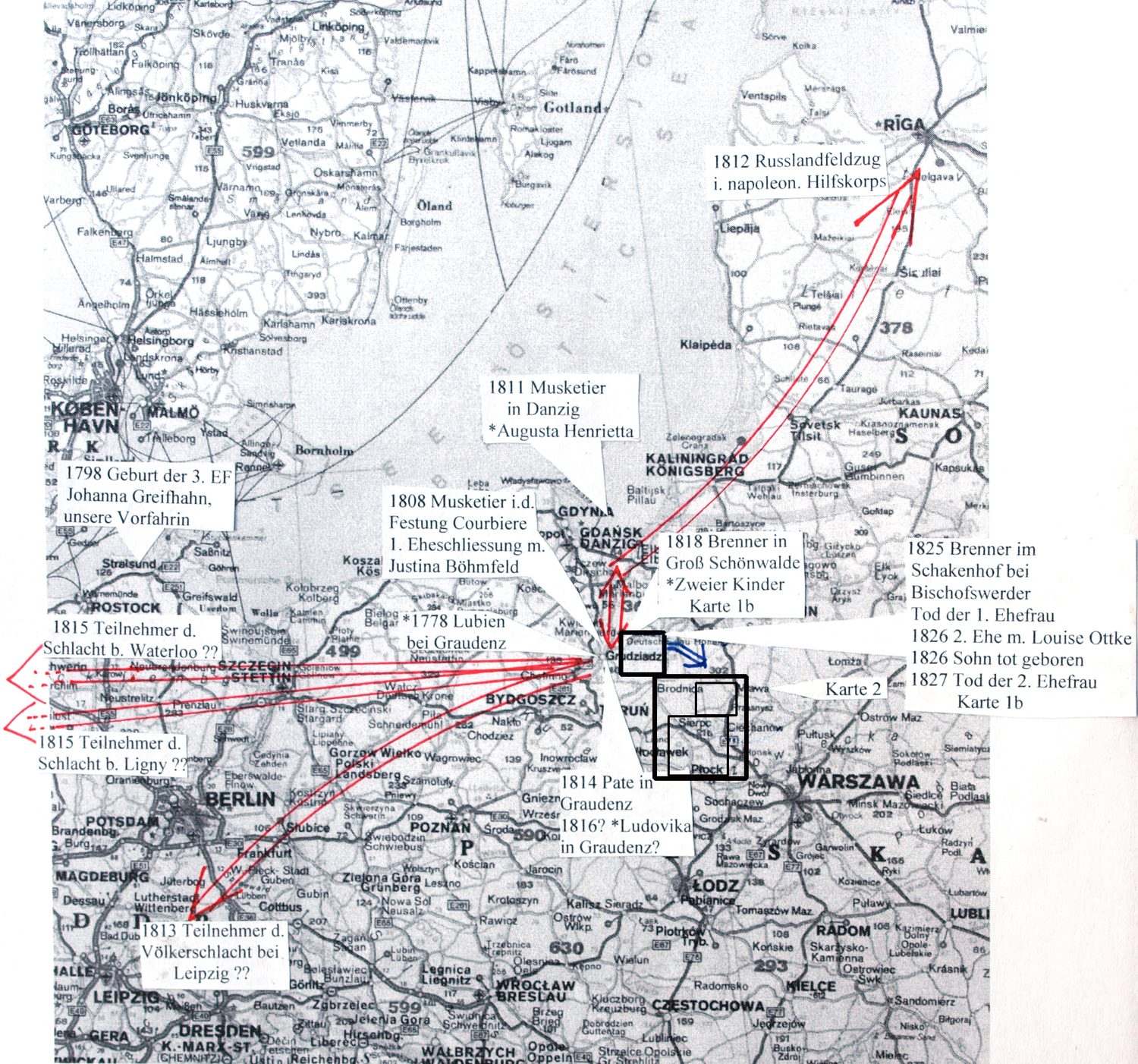
The musters concerned men of twenty. From about 1798, then, Peter is to be presumed in Prussian military service — with a term of service that under the rules of Frederick William I was in principle for life, was later limited to ten years and in wartime could be arbitrarily extended. The Old Prussian military rolls were destroyed in the Second World War; important evidence is therefore missing for ever.
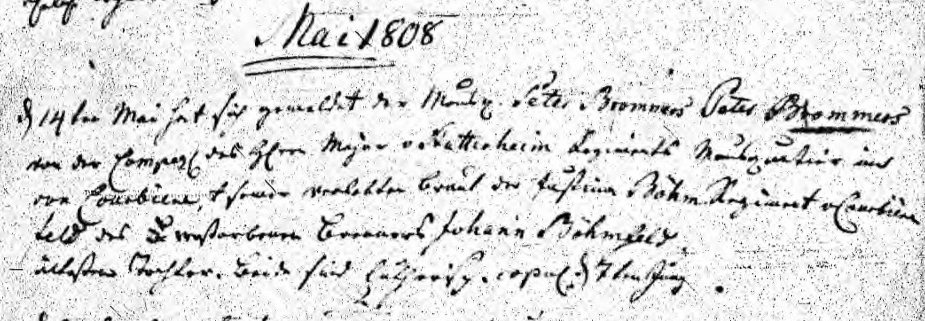
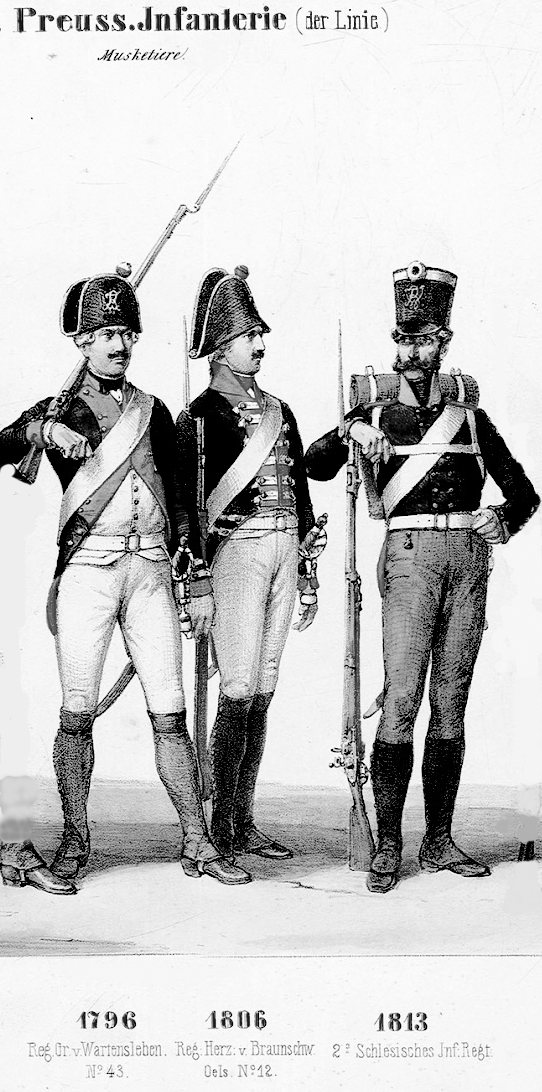
In 1806 and 1807, when the old army collapsed against Napoleon, he is likely to have been involved in the defence of Graudenz or of Fortress Courbiere. In 1808 he appears for the first time by name as a musketeer in the regiment of Fortress Courbiere near Graudenz, in the company of Major von Ketterheim — on the occasion of his first marriage, which was entered in the military church register.
In 1811 he is in Danzig, in the third company of the “Otto von Diericke” grenadier regiment, when his daughter Augusta Henrietta is born. In 1812 this regiment took part in the campaign against Russia, but with the Prussian auxiliary troops under Yorck it got only as far as about Riga in Latvia and fought, as military experts read it, two “restrained battles” — no one wanted to give the neighbour Russia too much ground for acts of revenge. Whether he was present at the Battle of the Nations at Leipzig in 1813 is conceivable but not established. The regiment was not involved in the battles of Ligny and Waterloo in 1815.
How the life of a soldier’s family looked is described by Bernhard Lindenblatt for the time of Frederick the Great: no family could live on eight groschen of pay for five days. Women had to hire themselves out as maids, and in the end the soldier’s wife was not even recognised as a bourgeois corpse — only the little hearse for the poor was her due, and no soldier in uniform was allowed to escort her. For the period around 1800 and after 1808 this would have to be investigated anew.
The decision
Why a distiller went to Russian Poland
In 1808 Peter was a musketeer, in 1817 a distiller at Groß Schönwalde, in 1829 a distiller and innkeeper at Koboszyn near Szrensk — beyond the border. Between the two dates lies a legal situation that made the trade practically impossible in Prussia.
„… dass das durch die neueste Gesetzgebung hinsichtlich der Abgaben und der Kontrolle dem Branntweinbrennen völlig gleichgestellte Destillieren niemanden auf dem platten Lande gestattet werden soll, als solchen Personen, die zu Destillieren eine Realberechtigung haben, oder ein Grundvermögen von 15.000 Reichstaler nachzuweisen im Stande sind.“ Quoted from the manuscript
“… that the distilling, placed by the most recent legislation on a completely equal footing with brandy-burning as regards levies and control, is to be permitted in the open country to no one but such persons as hold a real right to distil, or are able to prove landed property of 15.000 Reichstaler.”
Anyone who did not possess 15.000 Reichstaler in landed property was not allowed to distil in the countryside. In the town competition would have crushed him. The way out was the border.
Congress Poland · decree for foreigners
- Art. 1
- Every foreign craftsman or countryman who settles in the Kingdom of Poland is exempt for six years from all burdens and public levies.
- Art. 6
- Anyone who crosses the border in order to settle is free of all customs duties — for his livestock as for his remaining effects.
- Art. 7
- Those arriving may pass through every customs post without exception, but must report to the next border police office in order to prove that they are suspected of no crime.
- Art. 8
- All foreigners thus legitimised stand under the special protection of the Commission of the Interior and of Police.
What the chronicle concludes from this. Peter’s emigration was not a flight from poverty in the narrower sense, but an occupational decision with six years of exemption from tax as a push. The author expressly compares it with the emigration of Friedrich (I.) a hundred years earlier — and calls it just as momentous.
The trade
Distiller, innkeeper, field surgeon
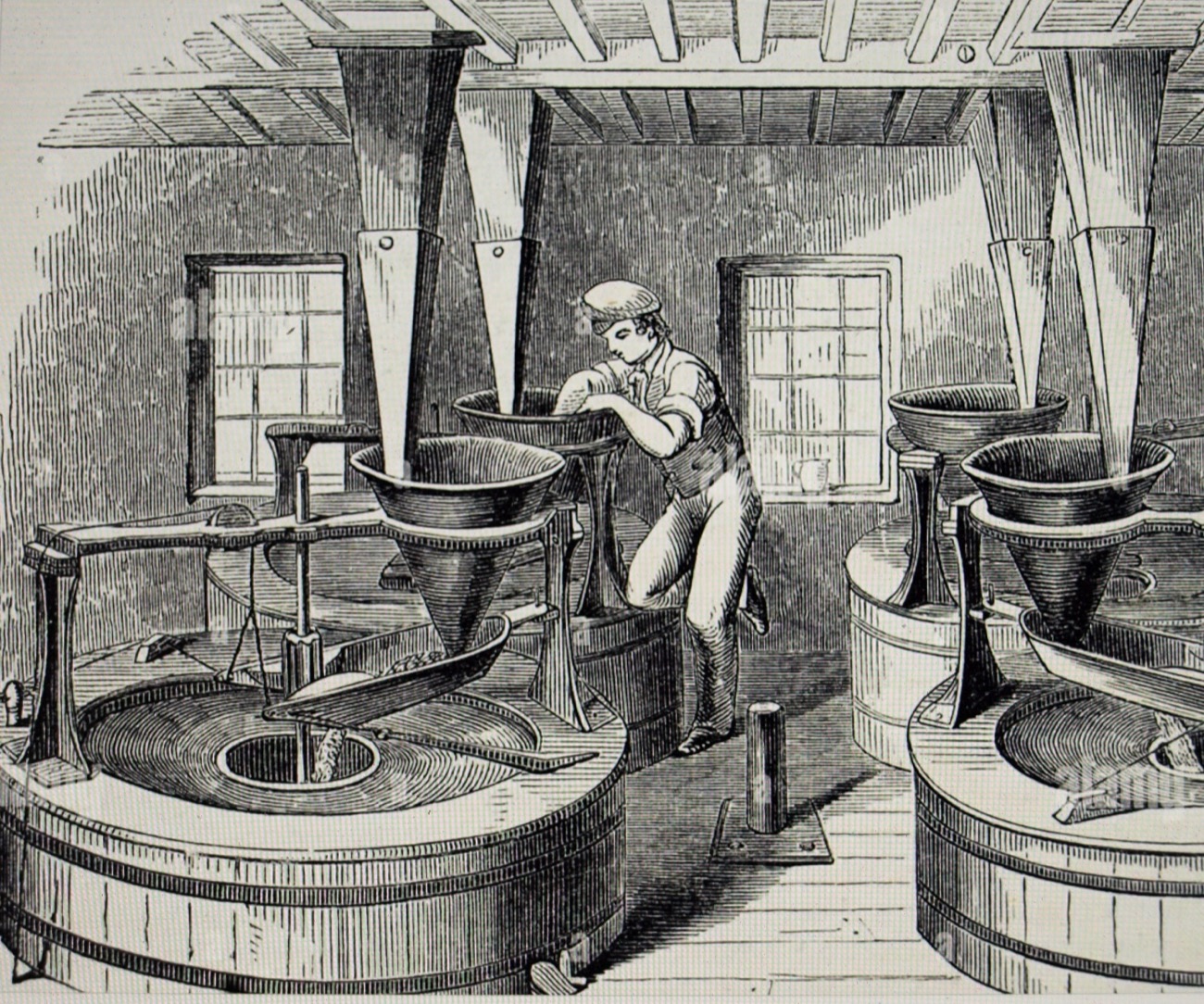
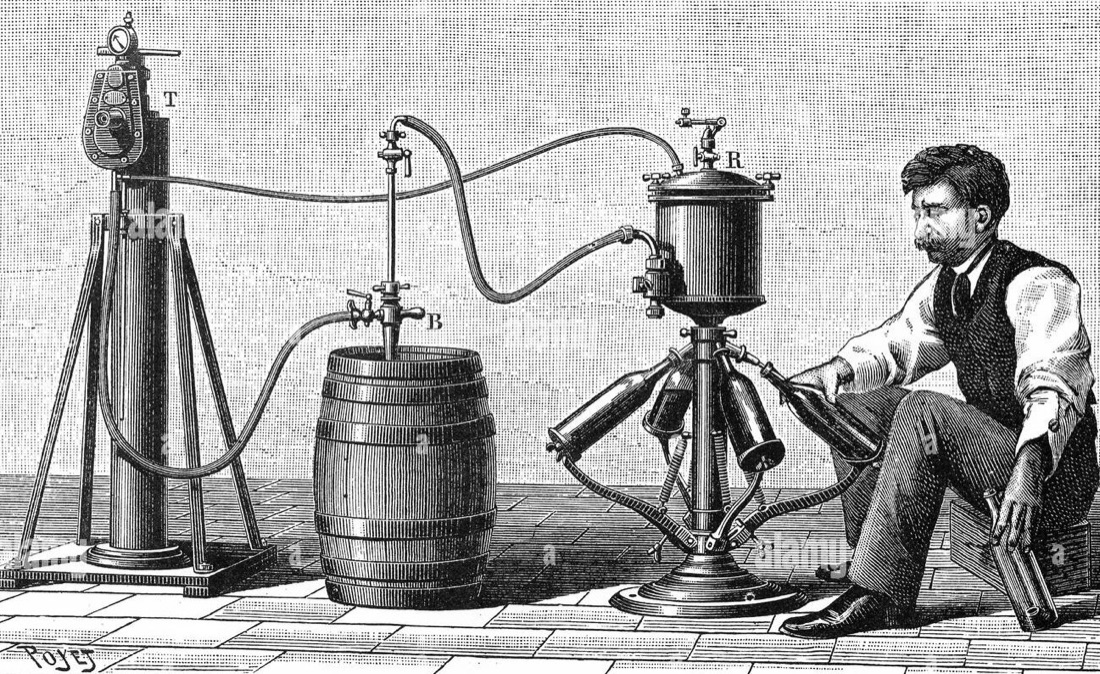
Two pictures from the manuscript explain the trade — the milling of grain for the mash tun and the distiller himself, whom the author calls “distilleur or Brenner, Polish gorzelany”.
Running an inn was an obvious choice for a distiller, and indeed Peter appears once expressly as an innkeeper: at Miaczyno Małe, a village with twelve houses, three stone buildings, 151 inhabitants and a mill. A distiller who serves drink is at the same time a man in contact with customers — and in a time without physicians the man who uses brandy as a disinfectant, a painkiller and an anaesthetic.
From two accounts that Heinrich Bomert took down from old people comes the image of the “folk healer”: “He had just the same name as them, only somewhat different … he was a handsome man, very concerned about the working people, kept himself hidden from the Russians and sometimes disappeared for a couple of years. Both knew that he healed the people like a …”. The author considers the exaggeration likely and the role as a field surgeon — as a “half-physician” between physician and medical orderly — plausible.
1829 to 1842
Four places of residence, barely ten kilometres
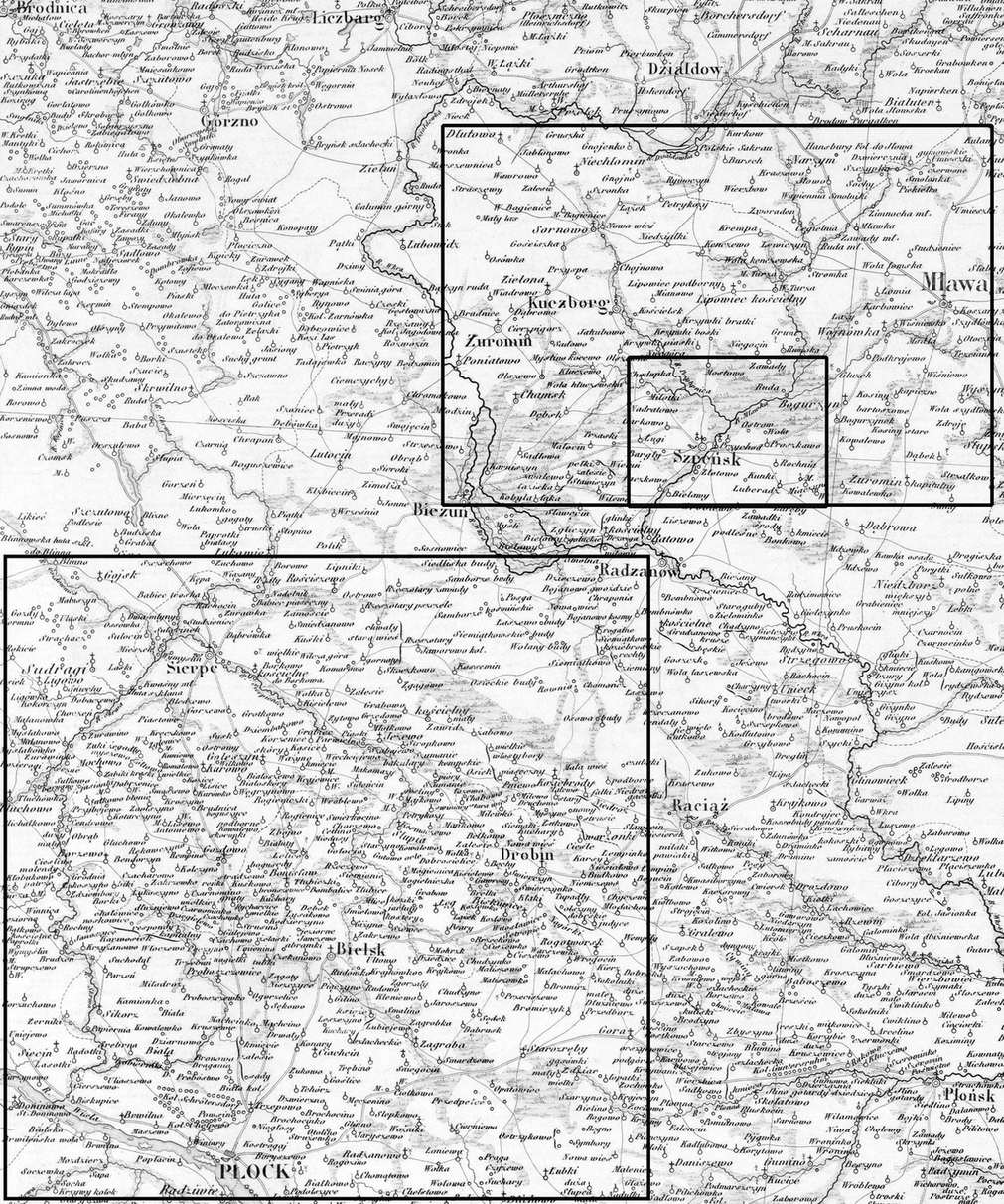
In Prussia Peter had changed his place every two years. In Poland the radius becomes smaller: four places of residence between Koboszyn, Miaczyno Małe, Rumoka and Wisniewo lie about ten kilometres apart and draw closer to the town of Mława.
- 1829 · KoboszynAs a distiller and innkeeper near SzrenskA tiny village: nine houses, 115 inhabitants, but with its own distillery. In November the daughter Paulina Joanna is born.
- 1831 · Miaczyno MałeTwelve houses, three of them of stone, 151 inhabitants, a millThe only mention of Peter as an innkeeper. The eldest daughter from the first marriage, Augusta Henrietta, marries the miller Fryderyk Ladwich here in November 1831.
- 1834 – 1837 · Rumoka25 houses, 408 inhabitantsBirth of the daughter Karolina in 1834 at Rumoka, baptism at Lipowiec Kościelny. In 1836 the son Julian is born here — the next direct ancestor. The daughter Ludovika marries the master weaver Andrzey Perłowski in 1837.
- 1842 · WisniewoLast place of residence, near the district town of MławaHere Peter dies on 10 February 1842. The death certificate calls him “gorzelany tamże” — distiller in that place — and records that his parents are no longer alive and are “not known by name and occupation”.
Three marriages
Three wives, eight children, two periods as a widower
- 1808 – 1825Justina, also Augusta, née Böhmfeld · * 1785, † 21 July 1825 at Schakenhof of “Auszehrung” (consumption).
Daughter of the distiller Johann Böhmfeld — the same guild in which Peter later earned his bread. Four children. When Augusta died, the eldest daughter was fourteen years old. - 1826 – 1829Louise Ottke · * around 1793, † between 1827 and 1829.
33 years old at the marriage on 22 January 1826 at Schakenhof near Bischofswerder, only daughter of the “former soldier” Johann Ottke from Stangenwalde. After the stillbirth of a son in November 1826 she dies. Her death certificate has so far not been found — here a gap yawns in the biography, into which the third marriage also falls.
49 years old is how the marriage certificate describes Peter — the most reliable age detail of all and the evidence for the year of birth 1778. - around 1828 – 1842Johanna Sophia Ilsabe Greifhahn · * 21 July 1798, baptised on 24 July at Stralsund, † after 28 October 1863.
Daughter of Joachim Wilhelm Greifhahn from Demmin and of Sofia Dorothea Frank from Klein Cordshagen, who married at Stralsund on 12 October 1797. At the marriage Peter was 50 years old, Johanna 20 — and at least three minor children lived in the household.
Her surname was mutilated by the Polish records into Grzyfanchow, Hanow and the like, which long made research difficult. Her signature reads “Bommert”.
The widow after 1842. At Peter’s death Johanna was pregnant again. Five months later she stood at the head of a household with five minor children, among them an infant: Florentyna Albertyna, born on 3 July 1842, who died after four months. In January 1843, after a waiting period of one year, she married the linen weaver Florian Ludwikowski, 53 years old, from Freudenthal in Preußisch Eylau, in the Protestant church at Mława.
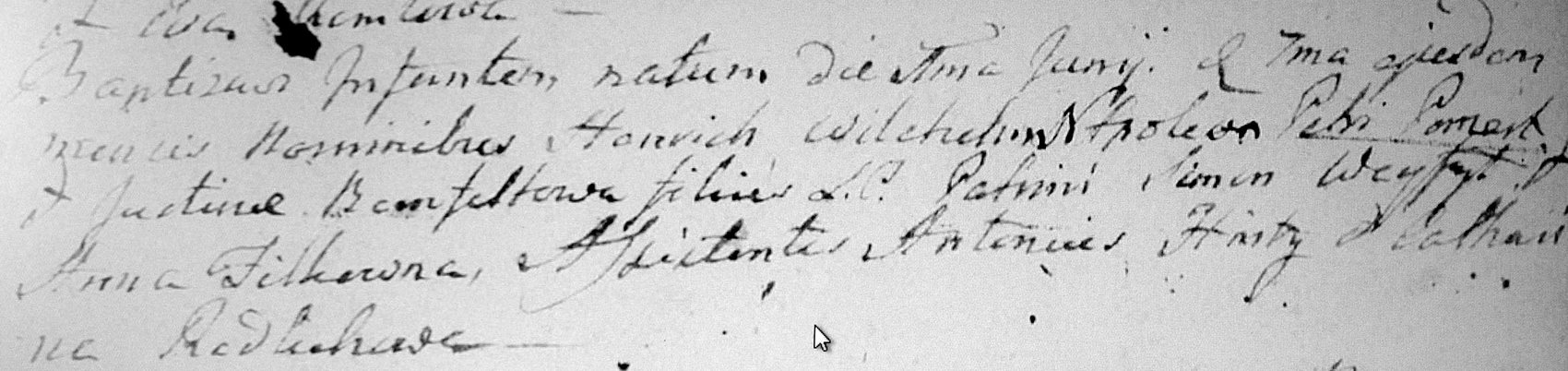
A break in the names after four generations. The author records that Peter breaks “radically with the tradition of the first generations”: the leading name Friedrich — borne without interruption through four generations — ends here, perhaps because it was associated with “too Prussian” a ring. The sons are called Henrich Wilhelm Napoleon, Andreas, Julian; the daughters Augusta Henrietta, Ludovika, Paulina Johanna, Karolina, Justina, Florentina Albertina. The models are German, Prussian, French and Roman rulers — for the girls probably noble ladies.
Testing a tradition
The French officer who never existed
Heinrich Bomert began the family history with a legend of origin: somewhere near Paris a family de Bonmert was said to have lived; a son was said to have studied medicine and to have disappeared, only to return two years later as a lieutenant in Napoleon’s army. In the winter of 1813 a wagon column was said to have got stuck in a Polish estate near Sierpc, a gravely wounded French officer was said to have been hidden there, nursed back to health and married by the daughter of the estate owner. From him, so the legend goes, come the name “de Bonmert” and the family in Poland.
The author searched for it for years — sheet by sheet in all the Catholic parishes of the stated area, in Huguenot archival material, in the Paris university archive. The result is disheartening and clear: in Paris no medical student of the name de Bonmert could be traced, no such physician or officer in Napoleon’s following, no Huguenot, and no such name at all in the whole of France at that time.
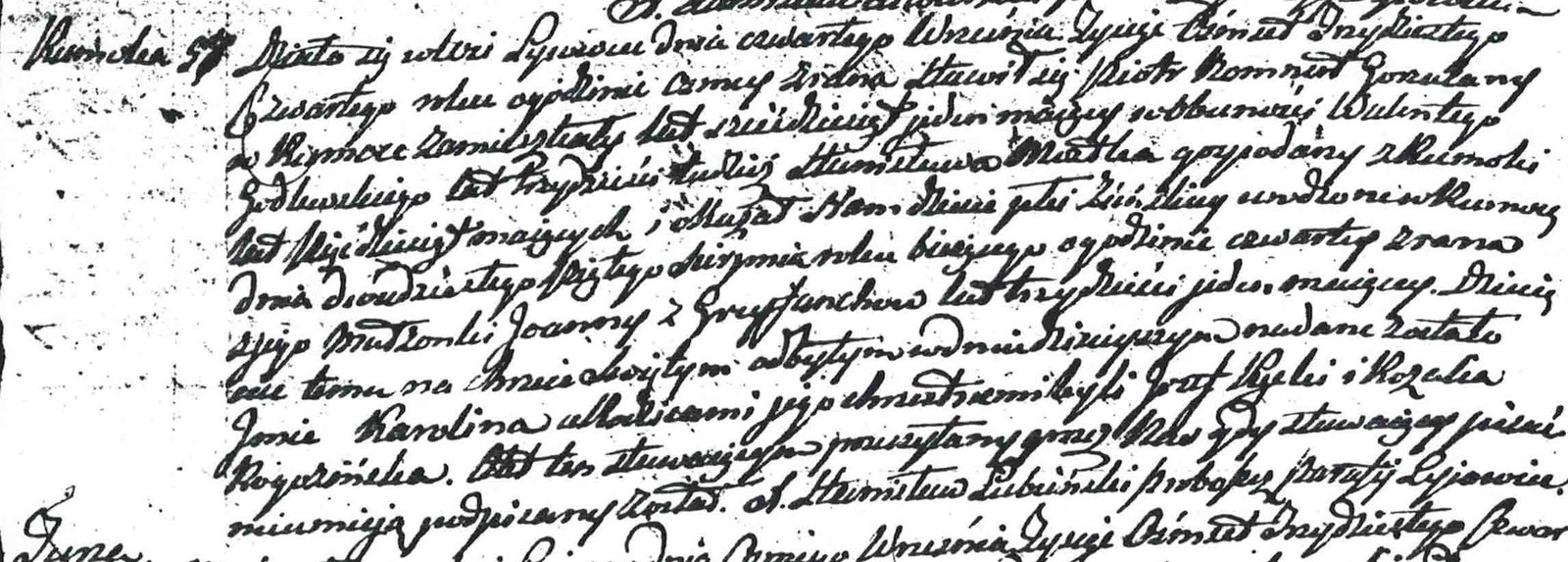
What remains are two faint traces. North of Paris lies a place called Saint Bomer or Saint Bomert, named after the founder of a monastery of the eighth century, a monk called Baudomirus — the place name could have served for “from near Paris”. And in the birth certificate of the great-aunt Karolina of 1834 at Rumoka the father’s name is in fact readable as “Piotr Bomnert”, not as “Bomert”, because of an odd number of strokes for the two “mm”.
As the originator of the legend the author names not the credulous Heinrich, but his cousin Julian (II.), a relative interested in renown in noble circles.
And the core? Peter’s participation in the Russian campaign is considered certain, his role as a field surgeon is plausible, his choice of name for his son Napoleon is a fact. The true hero, writes the author, is “the small but strong musketeer Peter without a horse” — not the officer on paper.
- Searched in
- Catholic parishes in the area of Sierpc · Huguenot archival material · university archive Paris
- Found
- Nothing. No student, no physician, no officer, no Huguenot of this name.
- Remains
- Saint Bomer near Paris (eighth century, the monk Baudomirus) · the reading “Bomnert” in the certificate of 1834 · the parents’ admiration for Napoleon
- Originator
- Julian (II.), cousin of Heinrich, in the assessment of the author
A case of its own
Anna “Maria” Bommert — impostor, thief and character in a novel
Peter’s brother Gottfried Friedrich (IV.) was a butcher at Neudorf near Graudenz. His third daughter, born in 1805, was advertised in the official gazettes of Marienwerder (Kwidzyn) in 1830 as a wanted person — as a thief, with a personal description accurate to the centimetre.
On the ages given in the wanted notices. Both wanted notices are reproduced verbatim, but their details are police statements and may be wrong: in 1830 Anna Maria is given as 26 years old, in 1841 as thirty-five. The manuscript holds to the year of birth 1805 documented at Neudorf (p. 59) and lets the divergent details of the wanted notices stand beside it instead of smoothing them out.
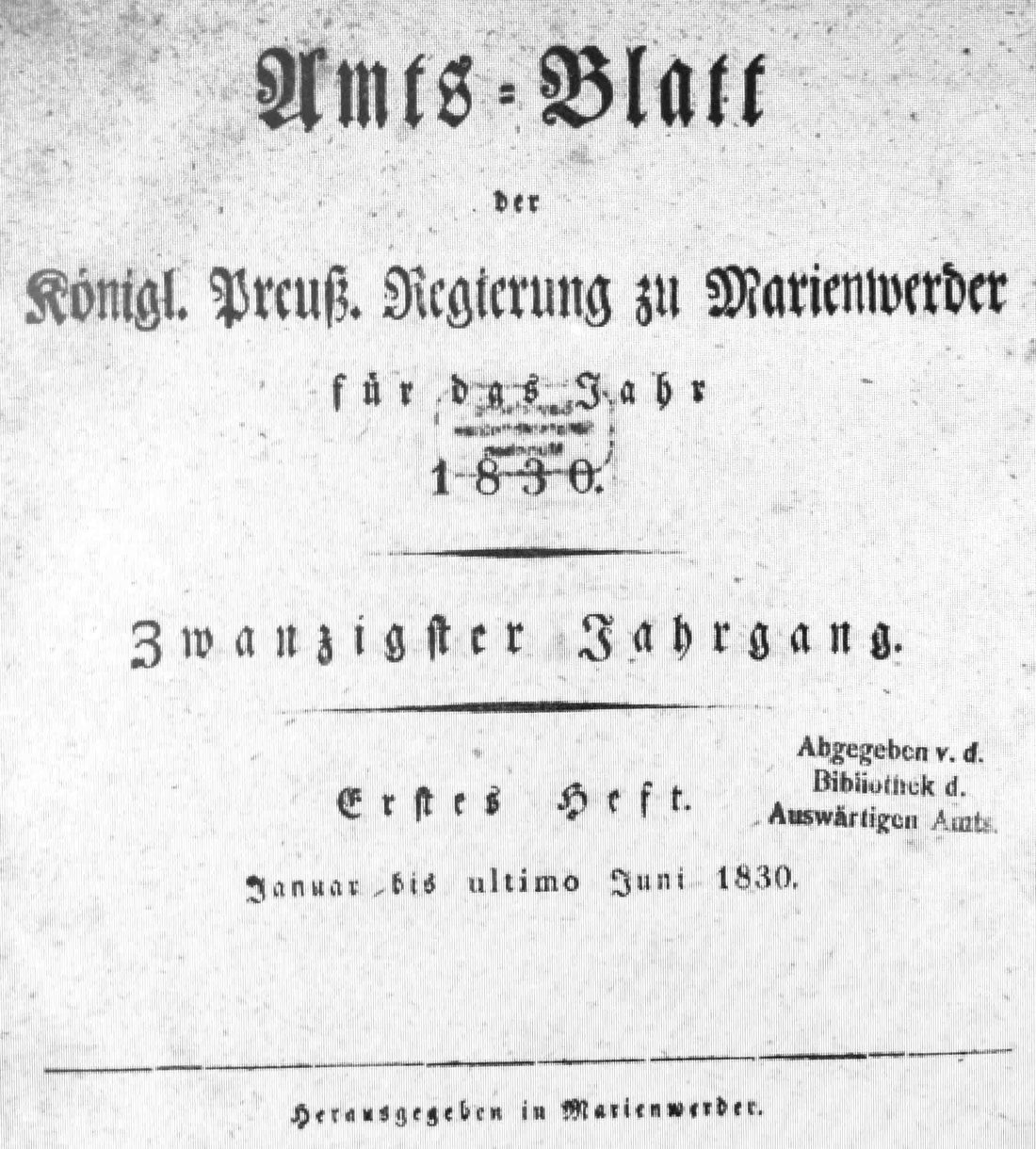
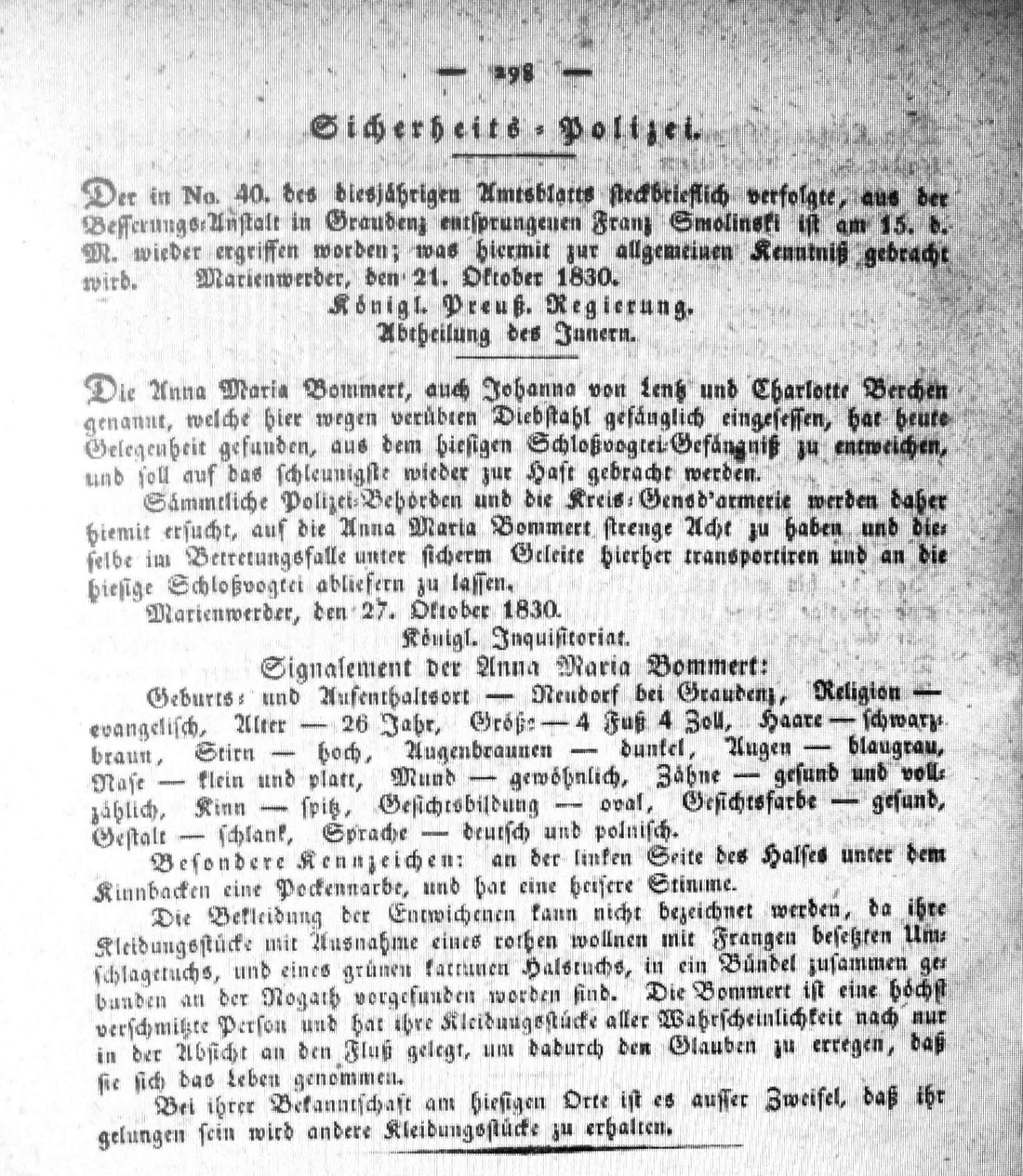
The Signalement of 1830
- Origin
- Place of birth and residence Neudorf near Graudenz, Protestant, 26 years old
- Height
- 4 Fuß 4 Zoll. In Prussian measures — the Fuß at 37.66 cm, the Zoll at one tenth of a Fuß — that is about 1.66 metres.
- Appearance
- Hair black, forehead high, eyebrows dark, eyes blue-grey, chin pointed, face oval, complexion healthy, figure slim
- Language
- German and Polish
- Note
- “Teeth healthy and complete”, “mouth ordinary” — and a “small and flat nose”. The author comments: a small, flat nose had never existed in the family. Really a Bommert? Or was this identity theft?
Ten years later
The second description
It was not her last imprisonment, and interesting news came back from Berlin. The description of 1841 shows three considerable changes: her hair had become thin and required a wig. More serious — the woman was missing all the teeth of the upper jaw, which ten years earlier had still been described as complete. New is a one-sided difference in shoulder height.
The author reads this medically: the shoulder position is said to be typical after a violent fall with a rupture of the acromioclavicular joint, and the hoarse speech already described could point to a way of life with weather and alcohol. “One does not need much imagination to give a prognosis of her further life. A pity.”
After her last escape she was apparently never caught again in Prussia. The Berlin judiciary suspected that she had turned towards Poland and stayed for a longer time in Warschau (Warszawa); a criminal later imprisoned at Graudenz named Carl Friedrich Krüger stated that he had had a love affair with the Bommert in Warschau (Warszawa).
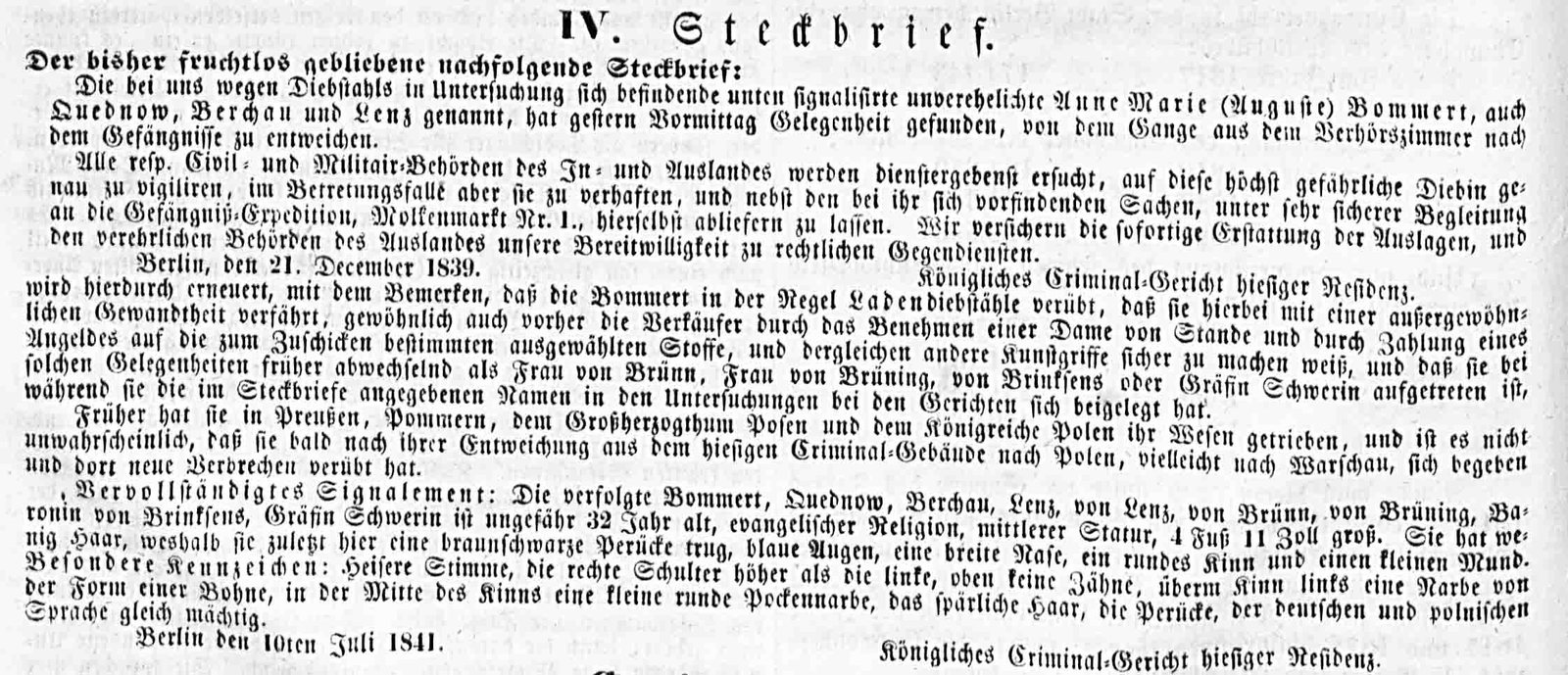
Two wanted notices, two sets of measurements. The wanted notice of 1830 gives 26 years and a height of four Fuß four Zoll, converted about 1.66 metres. The wanted notice of 1841 begins with the words “the pursued Bommert” and gives further names: Luednow, Berchan, Lenz, von Lenz, von Brünn, von Brüning, Baronin von Brünings, Gräfin Schwerin. It states her as “about 33 years” old, while the author reckons her at 35 years for that year, and gives a body height deviating by several Zoll. The two sets of details cannot be brought together; striking is that the same distinguishing marks recur both times, only in a different form — the flat to broad nose, the hoarse voice, and in 1841 additionally the wig, the absence of the upper teeth and the higher-standing right shoulder.
„Anna Maria war ganz offenbar eine hochintelligente, praktisch veranlagte, sehr starke Persönlichkeit mit großer krimineller Energie ausgestattet, die ihre Anlagen und Fähigkeiten optimal koordinieren und entfalten konnte. Die Umwelt, in der sie groß wurde, konnte ihr aber nicht das bieten, um ihre Fähigkeiten auf ordentlichem Weg in einen sozialen Aufstieg umzumünzen.“ The author on Anna Maria Bommert
“Anna Maria was quite obviously a highly intelligent, practically minded, very strong personality endowed with great criminal energy, who was able to coordinate and unfold her gifts and abilities optimally. The environment in which she grew up, however, could not offer her what was needed to convert her abilities on an orderly path into social advancement.”
Does she belong to it? The author answers the question expressly with yes — and not only with yes: in her will to survive, in her flexibility and inventiveness and spontaneous creativity she is, he says, “by no means only a member absolutely belonging to the family, but in these traits at the same time virtually a model, and yet, with regard to far-sightedness, morality and responsibility, also a figure of horror.” What remains open are her stations at Bromberg (Bydgoszcz), Thorn (Toruń) and Elbing as well as the question whether she returned in the end to Congress Poland and Warschau.
The children
Nine children from three marriages
| No. | Name | Birth | Place | Further path |
|---|---|---|---|---|
| 1.1 | Augusta Henrietta | 29.01.1811 | Danzig (Gdańsk) | Baptised on 3 February 1811 in the Danzig military church register. In 1827 a baptismal sponsor at Bischofswerder. Marries the miller Fryderyk Ladwich at Szrensk in 1831. |
| 1.2 | Ludovika | around 1816 | Graudenz (Grudziądz) | Year of birth calculated. Marries the master tailor Andrzey Perłowski from Narzym at Lipowiec Kościelny on 30 April 1837. |
| 1.3 | Andreas / Andrzey | around 1817 | Groß Schönwalde | Year of birth calculated. As a mason at Jezewo and Zarzyce; marries Wiktoria Krajewska in 1851. His son Teofil founds a branch of the family near Zbikow close to Warschau. |
| 1.4 | Henrich Wilhelm Napoleon | 1818 | Groß Schönwalde | Further news is lacking; he is likely to have died young. |
| 2. | From the second marriage no surviving child came forth. After the stillbirth of a son in November 1826, Louise Ottke died between 1827 and 1829. | |||
| 3.5 | Paulina Joanna | Nov. 1829 | Koboszyn | Marries Josef Sachs at Jezewo in 1854. She is a housekeeper with the teacher Edward Stock in the colony of Maszewo and dies in 1863 one day after the birth of her daughter Weronika. |
| 3.6 | Karolina | 25.08.1834 | Rumoka | Baptised at Lipowiec Kościelny. Two marriages, in both of them a blacksmith: Marcin Stankiewicz and another. Later persistently gives Siemiątkowo as her place of birth. |
| 3.7 | Justina | around 1835 | unknown | Birth certificate not found to this day. In 1857 she gives birth at Gilino to an illegitimate son Josef — whose descendants found a new line bearing the name near Żyrardów; his brother Ludwik a further branch at Warschau-Wola (Warszawa-Wola). |
| 3.8 | Julius / Julian | 23.10.1836 | Rumoka | Our direct ancestor. Still a labourer in 1863, he becomes a miller and mill owner soon afterwards. Marries Anna Posciadlowska from Parzeń at Płock in 1863; his mother Johanna is present at the wedding. |
| 3.9 | Florentyna Albertyna | 03.07.1842 | Wisniewo | Born five months after the death of the father; died in the same year at the age of five months. A cause of death is not given. |
A rise into the village middle class. “In the children one sees an even development among the descendants from the first marriage: they have settled well — the eldest married a miller, the second a master tailor, the eldest son became a mason. After the first 100 years in poverty it could hardly have turned out more solid.” The children from the third marriage developed more mixed.
On the ages given. The Polish records give Peter as 61, 72 and 70 years old, while the Prussian marriage certificate of 1826 lists him at 49 years. The details in the Polish entries are 5 to 14 years too high — they were made by appearance, not from papers. Only the Prussian statement is reliable: year of birth 1778.
At the end stands the granddaughter with the first name “Ciel”
What remains of the legend of origin is a first name: a granddaughter of the legendary Frenchman was given the name “Ciel” after him — heaven. The appendix sets out what the manuscript gathers on origins, estates and the years concerning Poland.