Appendices 3 to 9 · Background
The call to the East — and what came of it
The family part of the appendix documents what happened. The general part explains why it could happen: how states courted settlers, what estates there were in the village and what a contract meant — and how the Polish state was partitioned three times and defended three times between 1768 and 1863.
- Appendix 3
- The fictional character Anna Maria Bommert in “Die Gartenlaube”, 1856
- Appendix 4
- The “call to the East” — the Prussian invitation patent of 20 September 1711 and the four estates of the settlers
- Appendix 5
- On the village social structure: Knecht (farmhand), Einlieger (lodger), Instmann (farm labourer bound to the estate), Kätner (smallholder), Kleinbauer (small farmer), Vollbauer (full farmer), Hofgut (estate farm) and Vorwerk (demesne)
- Appendices 6 to 8
- Poland as a historical nation; the partitions of 1772, 1793 and 1795; the uprisings of 1768, 1794, 1831 and 1863
- Appendix 9
- The social condition of the working class and of the lower military ranks in nineteenth-century Prussia — announced, not yet worked out in the manuscript
Appendix 3
“The Baroness of Brünn” — a case in the Gartenlaube
Anna [Maria] Bommert, born in 1805 in Neudorf near Graudenz (Grudziądz), daughter of the butcher Gottfried Friedrich (IV.) Bommert and his wife Anna Kurzynowska, has, in the author’s words, “gone down not only in Prussian legal history as ‘the Baroness of Brünn’ or ‘Countess Schwerin’, a petty criminal operating in higher circles and a particularly sly thief and vagabond”.
Her case also occupied legal circles of the Empire. In the Grand Duchy of Baden and in Württemberg it was debated whether the culprit should be convicted under the offence of theft or of fraud — the difference was considerable: here an almost lifelong term of penal servitude, there a fine of eighteen Taler.
What aroused the attention and the amusement of contemporaries was the method: disguise and imposture as a lady from the noble circles so highly esteemed in Prussia, ingenious thefts, the manhunt by wanted notice, imprisonments — and spectacular escapes from two Prussian prisons.
Thus she became a fictional character. In the Leipzig family magazine “Die Gartenlaube” of 1856 she appears as “Anna Maria Bommert” — and thereby carried the family name beyond Prussia into a dubious fame. The complete reprint of the issue stands in the manuscript.
Source
Full digital text edition at Wikisource:
For context. The introduction to the appendix formerly dated the Gartenlaube to “the middle of the eighteenth century”. The manuscript meanwhile names the nineteenth century, and is right to do so: the magazine has appeared since 1853, the issue reproduced here is from 1856, and the wanted notices for Anna Maria Bommert date from 1830 and 1841.
What remains open. Whether she was “really a Bommert” the author himself doubts in one place — on account of the small, flat nose, which had never existed in the family. In another place he expressly affirms the connection. The question remains posed.
Appendix 4
The “call to the East”
Central Europe suffered severely under the Thirty Years’ War, the northern Rhineland regions extending as far as the Netherlands even under an eighty years’ one. Poland was moreover caught in a permanent war lasting the whole of the seventeenth century and finally, in the Great Northern War between Russia and Sweden of 1700 to 1717, stood “on the edge of its existence”. The basis of the eastern settlement in the first third of the eighteenth century was the underpopulation created by the wars: much untilled, waste or abandoned land.
What drove people to set out was, in the author’s assessment, not primarily the persecution of religious minorities. To be sure, the formation of nation states in France, Switzerland and Germany led to the persecution of religious groups — but for this family he expressly names economic reasons: poverty.
From the point of view of the states, the will of the state stood before every admission. Prussian and Polish recruiters were on the road everywhere in Central Europe at the beginning of the eighteenth century on behalf of their governments — and met with willing ears. The categories sought were comparable to identical in Poland and Prussia; the author therefore regards the better documented Prussian recruitment in Switzerland as a model for Polish demand, and he has a particular reason for doing so: ancestors who had married into the family had in fact reached the East through a Prussian colonisation.
On 8 July 1709 Peter I. defeated the Swedish army at Poltava; Sweden’s supremacy in the Baltic region collapsed. Two years later almost all Swedish fortresses on the southern Baltic coast had been taken. Prussia, which had cultivated good relations with Russia, could again think of settling its devastated eastern territories.
Recruitment as intent
„… und würde das beste Mittel, frembde in hiesiges Land zu locken, darinnen bestehen, dass nach Euer Königl. Maytt. allergnädigsten Eigenhändigen resolution, denen neukommenden so gute und favorable conditiones und Freyheitten, welche sie an anderen orten nicht leicht finden könten, an frey-Jahren, Besatz von Vieh und anderen Nohtwendigkeiten, auch Freyheit von Unterthänigkeit und dergleichen gegeben …“ Quelle aus der Zeit vor dem Einladungspatent
“… and the best means of luring strangers into this country would consist in this: that by Your Royal Majesty’s most gracious handwritten resolution, such good and favourable conditions and freedoms be granted to the newcomers as they could not easily find in other places — in free years, a stock of livestock and other necessities, and also freedom from subjecthood and the like …”
The invitation patent of 20 September 1711
Free years according to means — a graded reckoning
The patent, which in 1712 set off the migration of the Swiss settlers, promised conditions that the immigrants did not find in their homeland. Its main part set out to which of four possible estates they would belong according to their social position, their occupation and their property. The years of exemption from dues were made dependent on how much money the newcomers brought with them.
Six free years
Whoever covered the long way without Prussian help and procured stock, livestock, implements, seed and bread grain as well as fodder from his own means: land and buildings plus six years of complete exemption from all financial dues.
Three free years
Whoever could bear the travelling costs himself but had no further means for stock and grain: three free years.
One free year
Whoever immigrated wholly without means and whose travelling costs and complete stock the state financed was welcome — and received one year of exemption from dues.
The author names the injustice of this system openly: wealthy immigrants who claimed only little money for their journey and settlement were granted larger subsidies than the destitute. It went unconsidered that the cause of poverty in agriculturally shaped countries was not only poor husbandry but also misfortune.
The second group named in the patent were the Kossäten or Kätner (smallholders), called “Gärtner” in East Prussia. To them no land of their own was promised, but a house, a garden and small fields for subsistence farming. Unmarried persons were to receive no land; after the transport they were hired at state expense as farmhands and maidservants on royal demesnes, at a wage raised above the servants’ ordinance — three to four Taler for the farmhands. This was meant to counter the shortage of servants, which only grew worse when waste farms were reoccupied.
A supplement to the patent assured every able farmer at least one Hufe (hide) of land, along with exemption from military service and from obligations for the billeting and provisioning of soldiers.
- Date
- 20 September 1711, after the Great Plague
- Purpose
- “Reoccupation of waste farms and villages”
- Trigger
- The migration of the Swiss settlers of 1712
- Categories
- Four estates, graded according to occupation, property and number of persons
- Transfer
- The author transfers the categorisation to Poland, because the decentralised Polish settlement activity by noble landowners is less well documented — and because the categories were “comparable to identical”.
The family’s own case. “We do not know with what professional qualifications our emigrants set out,” writes the author, “as long as we also have no precise knowledge of their origin.” Conclusions are permitted only by the destination: the place Neu-Marsau (Marzy Nowe), the occupations of the second and third generation and the patterns of movement. That is precisely what the chapters provide.
Appendix 5
On the village social structure
From the farmhand to the full farmer it is a ladder, and this family has climbed it slowly — the first two generations not at all, the third and fourth a stretch, the fifth distinctly. The appendix defines the rungs.
Farmhand and maidservant
In the peasant’s household, without a household of their own. Per Hufe one reckoned with one middle farmhand and one maidservant; whoever had two Hufen kept a head farmhand, two maidservants and a boy.
Einlieger
One who owns no house of his own and therefore lives in rented rooms (lodger). The term arose from landless labourers who lodged with peasants and worked for them in return.
Instmann
Migrant agricultural labourer with a fixed contract, mostly for two or more years. He rented living quarters, a garden and a little land. “Too little to live on, too much to die of.”
Eigenkätner
The owner of a small holding with house and garden. He pays a small ground rent, but counts as a proprietor and can bequeath, mortgage and sell his property.
- Gartennahrung
- The combined ownership of a house and of usable land and soil under garden right. It did not suffice for a viable holding, but it could feed a family.
- Kleinbauer
- Three-quarter, half Hufe and the like — not a full farmer with all the rights of the old village community. When a Kätner took land on lease in addition and thereby received the right to the common pasture, the transition to small farmer was fluid.
- Vollbauer
- The tenant of a whole farmstead. In Stwolno Niemieckie this station was bound to a purchase money of 6,400 gulden.
- Hofgut und Vorwerk
- Estate farms in noble or royal hands, situated apart from the villages, often branch establishments of large estates. They could take in much farm service — farmhands, maidservants, Einlieger and migrant labourers.
An Instmann performed several unpaid days of corvée labour and otherwise worked for the customary local or contractually fixed wage, as often as the estate owner needed him. Beyond that he was free to provide for himself — as a day labourer or craftsman. Often the wife was bound into the contract as well: she had to go along as a worker.
The degree of freedom was nevertheless greater than for the serf Polish peasant. He too sat on no land of his own, but was bound to the noble landowner and to the soil — bound to an arbitrariness that extended as far as the right to kill. He too worked a small garden for himself, but the fruits belonged to the landowner, who could take them at any time.
The children of the Instmann were especially disadvantaged. With the constant changes of residence, continuous schooling or vocational training was not to be thought of. Once caught in this life of temporary work under short-term contracts, advancement and an advantageous marriage were “very difficult, almost impossible”. Child labour was certainly not merely customary but a condition of survival.
By way of comparison: a leasehold farm
In order to give some idea of conditions almost three hundred years ago, the author reproduces the probate inventory of a Mennonite leasehold farmer of 1744, handed down by Horst Penner in “Die ost- und westpreußischen Mennoniten” — an average property, as Penner writes. From the register:
„Der Hof und alle dazu gehörigen Gebäude, das Land bestehend in 2 Huben 29 Morgen 139 Ruthen, Rücken und Brücken, Bäumen und Gärten, den großen Puffwagen nebst Auslittern und Zubehör, einen Pflug, zwei große eiserne Eggen, einen großen Haken, einen Tisch in der Stube, auch alle in der Stube befindlichen Bänke; auch den Sieger (Uhr), das große Kleiderschaff in der Stuben und das Winkelschaff, auch die beste Stute …“ Nachlassverzeichnis 1744, wiedergegeben im Manuskript
“The farm and all the buildings belonging to it, the land consisting of 2 Hufen 29 Morgen 139 Ruten, ridges and bridges, trees and gardens, the great Puffwagen together with its outrigging and accessories, a plough, two large iron harrows, a large hook, a table in the parlour, and also all the benches present in the parlour; also the Sieger (clock), the great clothes cupboard in the parlour and the corner cupboard, also the best mare …”
What the comparison shows. Two Hufen of land, a full wagon, implements, furniture, a clock — this property was the precondition for a lease. The family’s Instmann owned no cow in the cadastre of 1772/73. Between the two lies not a gradual but a structural difference.
Appendix 6
Poland — a historical nation
The author justifies this appendix not only by the injustice of the partitions but by his own roots: it was “above all our Slavic roots, ancestors of numerous women of the Bomert family”, that made an engagement with Polish history necessary — and it was the deficient knowledge of Polish historiography, which more or less all family members share.
As a basis he deliberately chooses an author who left him with a “somewhat more objective impression” than others: Norman Davies, “Im Herzen Europas — Geschichte Polens”, after the English edition “Heart of Europe. A short History of Poland” (Oxford 1984, 1986), German edition in its fourth impression 2006.
From the reproduction in the appendix
The great Polish plain, which east of the Oder and the Vistula (Wisła) merges into the boundless steppes of Eurasia, was one of the main routes of invasion of Europe’s prehistoric migrants — from the Old Stone Age to the dawn of historical time in the tenth century of the Christian era a gathering ground of ever new waves of nomads, plunderers and settlers.
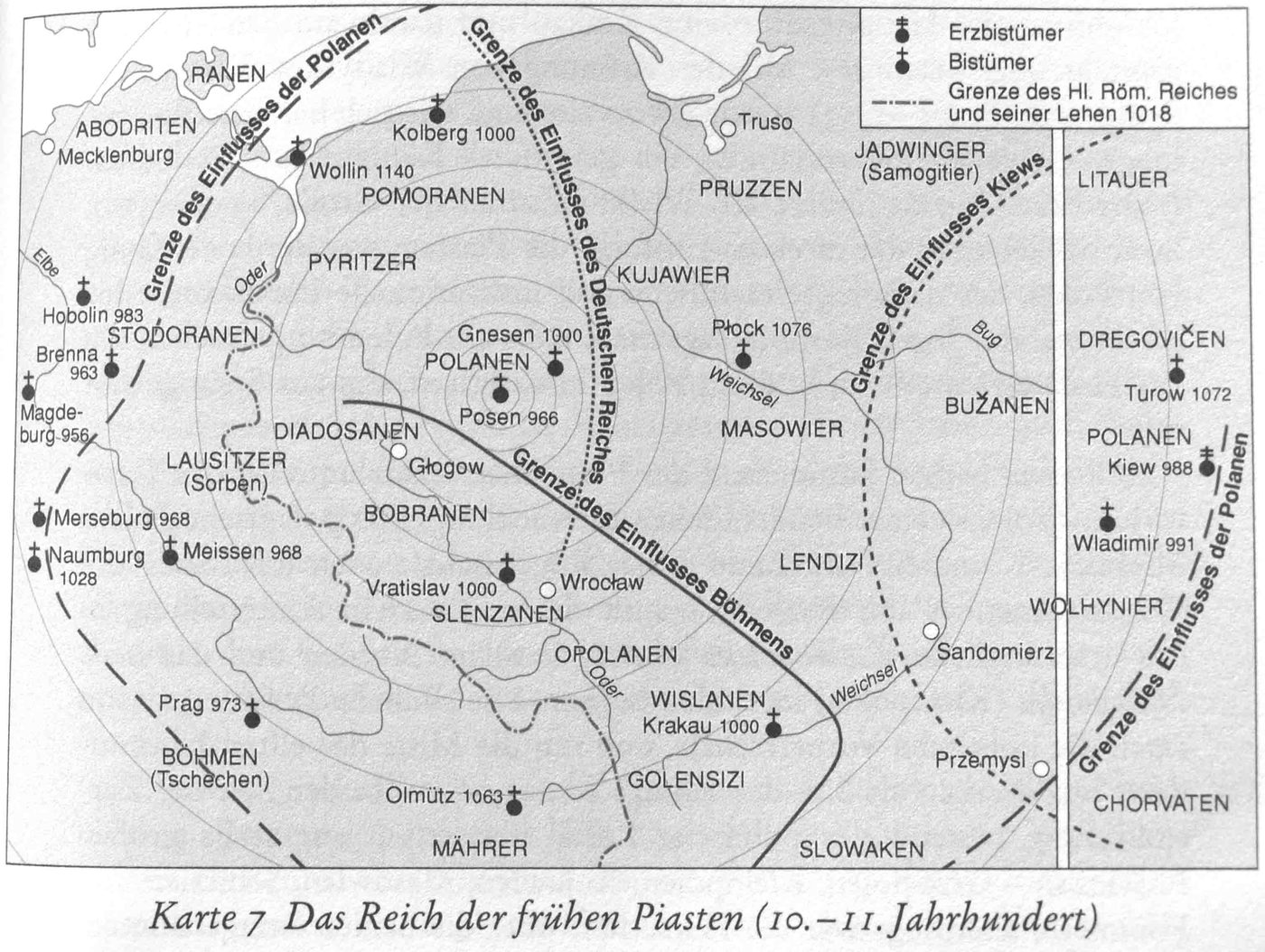
The name Polska appears only at the threshold of historical time, in the tenth century, and even then only as the territory of a single small Slavic tribe: the Polanie, the “people of the open fields”, who settled on the banks of the Warthe (Warta) near present-day Posen (Poznań).
The house of the Piasts emerges from the mists of prehistory with the year 965, when Duke Mieszko I. accepted Catholic baptism, married a Czech princess and brought learned scribes to his court. His son Bolesław Chrobry — the Brave, 992 to 1025 — whose armies reached as far as Prague and Kiev, became the first in a series of crowned Polish kings.
„Die Gepflogenheit, die eine auserwählte Gruppe zu ‚Autochthonen‘, ‚den Ureinwohnern‘ oder zur ‚einheimischen Bevölkerung‘ zu erklären und alle anderen als ‚Fremde‘, ‚Ausländer‘ oder ‚Eindringlinge‘ zu bezeichnen, ist für den Laien ebenso irreführend, wie es den Fachmann nicht überzeugt.“ Aus der Wiedergabe des Anhangs, nach Norman Davies
“The habit of declaring a chosen group ‘autochthons’, ‘the original inhabitants’ or ‘the native population’ and of designating all others as ‘strangers’, ‘foreigners’ or ‘intruders’ is just as misleading to the layman as it is unconvincing to the expert.”
Why this sentence stands in a family chronicle. It is the methodological foundation of the whole volume. Whoever seeks origins is in danger of asserting an origin. The appendix on the prehistory of Central Europe is the rejection of precisely that temptation — the same attitude with which the author dismantles the French officer legend.
Appendix 7
The breaking up of the Polish state
“The thunderclaps of the extraordinary political events in the years of the partitions made the earth tremble in Poland; the quake was felt throughout Europe.” The appendix traces how it came to that — and what the partitions meant for the population of German descent.
-
From the Great Northern War to the Silent Sejm
1697 to 1717
- 1697 – 1763The “Saxon Night”Saxony and Poland-Lithuania are joined by personal union: the Saxon elector is at the same time king of Poland. The republic of the nobility, praised in the sixteenth century for its religious tolerance, now becomes the very embodiment of backwardness.
- 1700 – 1717The Great Northern WarPoland is the main theatre of war for Swedish, Russian and Saxon-Polish armies. The country grows poor and never recovers. Augustus the Strong throws Poland’s whole weight into the service of Russia — “this wholly unnecessary and unpatriotic commitment” still counts today as the starting point of the partitions.
- 1709PoltavaPeter I. defeats the Swedish army; Sweden’s supremacy in the Baltic region collapses, Russia moves permanently to the Baltic.
- 1715 – 1717Civil war and the “Silent Sejm”The nobility pressing for freedom joins together in the Confederation of Tarnogród. The “Warsaw Pacification Treaty” of 3 November 1716 and the diet of 1 February 1717 end the struggle — and Russia becomes, under international law, the guaranteeing power for Poland. The “Russian boot” did not leave the country again until 1918.
-
Three partitions, three decades
1768 to 1795
- 1764Stanisław August Poniatowski becomes kingElected once again with Russia’s support. His reforms strike a Catholic-centred noble opposition as “too little, too late and too inconsistent”.
- 1768The Confederation of BarThe historically most significant confederation of Polish lesser nobles in defence of their “Golden Freedom”, which immediately begins a years-long uprising against the Russian presence and in doing so turns primarily against its own state.
- 1772The first partitionAfter a five-year civil war the Russian alliance prevails. Prussia, Russia and Austria seize their share. The district of Schwetz passes under Prussian rule.
- 1791The constitution of 3 MayA resolution of the diet that amounted to a coup d’état, since the majority of its opponents were still away for the Easter holidays: hereditary kingship, prohibition of noble confederations and of the Liberum Veto.
- 1793The second partitionA Polish noble clique had called in a Russian army to help it defend its “Old Freedoms”; Prussia interfered on that side and had hoped for Danzig (Gdańsk) in return for its support of the reform.
- 1794The Kościuszko uprisingHopeless from the outset, put down by the coordinated deployment of Prussian and Russian military forces.
- 1795The third partitionPoland disappears from the map for more than a century.
-
Prussia in the annexed West Prussia
1772 to 1806
- 1772The classification commission„Die Adligen in diesen Provinzen, was eigentlich würckliche oder Stockpolen sind, sollen 10 pro Cent geben …“ (“The nobles in these provinces, who are actually real or stock Poles, shall give 10 per cent …”) — the instruction for the commission that fixed the tax burden of the Polish elites.
- 1780Friedrich II., general instruction„Die Polen, die dann hier nicht wohnen wollen, müssen ihre Güter verkaufen, und da muss man denn sehen, gute und bemittelte Leute aus dem Reiche und der Gegenden hereinzuziehen … weil die als gute Bürger ihnen lieber und immer besser sind, als das polnische …“ (“The Poles who then do not want to live here must sell their estates, and then one must see to drawing in good and well-off people from the Empire and the neighbouring regions … because as good citizens they are dearer to them and always better than the Polish …”)
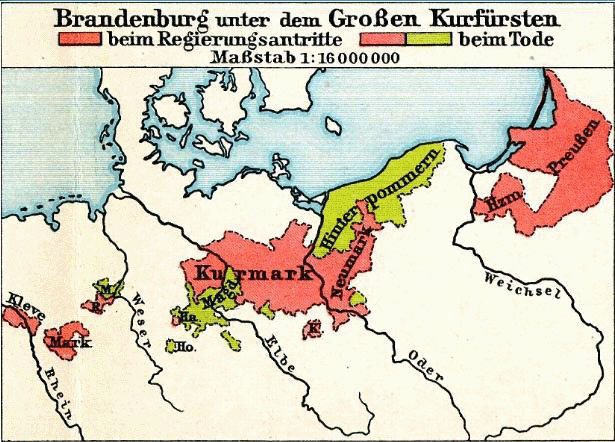
The author stresses that nothing had changed in this fragmented situation even after the acquisitions of Frederick the Great up to the first partition of Poland in 1772. The strength for expansion and Prussia’s rise to a great power rested on its inner development into economic, military and political strength — “a time that had been lost for the Poles and so had to become a plaything”.
For the family the change of sovereign had immediate consequences, and they were ambiguous. The Lutheran and Mennonite population could breathe again: the conditions of the non-Catholic religious groups improved. At the same time the Prussian administration became rigid, confessional conflicts sharpened, and the unloved military service began — that service in which Peter (III.) Bommert, the last forefather of this volume, began his career.
The relationship remained strained. The partitions were conceived by their predominantly German authors as a power-political resolution of conflict without war; Polish society increasingly perceived them as foreign rule. The lack of communication, persistent confessional oppositions and a language policy that sought to enforce German strengthened this impression. For the author the section is the explanation of why the family was later scattered “to all the winds”.
Appendix 8
The struggle for freedom — four uprisings
“Poland was a political geotectonic fault line in the east of Europe”: to the east the underdeveloped giant Russia, to the west the in some respects more progressive Prussia. The Polish people was occupied by both powers — “it was only a question of time until smaller or larger political quakes followed in the form of uprisings”.
1768
The Confederation of Bar
The first great uprising of the lesser nobility against the Russian presence — and against its own king. After five years of civil war the Russian alliance prevailed in 1772, and the first partition followed immediately. For the district of Schwetz the uprising meant, in the author’s estimation, no immediate involvement in fighting, but a hardening between the Catholic Polish and the non-Catholic population of German descent.
1794
The Kościuszko uprising
Triggered by the second partition, which “made the national barrel overflow”: rigid Prussian administration, confessional conflicts and divergent ideas of order. Hopeless from the outset, the uprising was put down by the coordinated deployment of Prussian and Russian military forces.
1830 / 1831
The November uprising
Rumours led an existing conspiracy of officers and students to attack the Belvedere Palace in Warsaw (Warszawa) on 29 November 1830; the population stormed the arsenals. On 1 December the “Democratic Society” constituted itself, a provisional government opened negotiations with the tsar — Nicholas I. demanded capitulation. In December Prussia closed its borders to Polish soldiers and arms deliveries, but allowed Russian troops to reorganise on its territory. In September 1831 Warsaw was taken; 20,000 insurgents who escaped deportation to Siberia were permitted to emigrate to France.
1863
The January uprising
It falls exactly at the end of this volume: 1863, the year in which Peter’s youngest son, the journeyman miller Julian Bomert, marries in Płock and the mother is present at the wedding. The uprising of 1863 ends the period that this volume describes — and the epoch in which the family lived in Poland.
Was Peter involved? The author examines the question himself and answers it in the negative for the November uprising of 1830: Peter, then fifty-two years old, lived far from Warsaw (Warszawa), and the rising remained essentially confined to the Warsaw area. “Very improbable.”
And the family? Peter’s emigration to Russian Poland falls in a phase in which Poland was rebuilt after 1815 as a kingdom with its own constitution and foreigners were recruited with six years of exemption from taxes. The family thereby bought itself an economically favourable position — in a country politically and culturally precarious for Germans, who at the same time drew advantages from the Russian annexation. The author names this contradiction without gloss and pursues it further in the following volume.
Appendix 9
The social condition of the working class and of the lower military ranks
The author announces a ninth appendix that is to describe the circumstances from which the fourth generation comes: the wages, dwellings and working hours of the Prussian working class and the condition of the lower military ranks from which the army recruited itself — that station in which Peter (III.) Bommert began his career as a musketeer.
What follows is so far only the subject. The appendix itself has not yet been written in the manuscript; it is named here so that the order of the volume remains complete, and will be supplied as soon as it is available.
Status
The details in this volume on wages, board and clothing come until then from the records themselves — the cadastres and the military parish registers of the chapters.
What is written small in the records
The appendices supply what the chapters continually need: Hufen and Morgen, Reichstaler and Groschen, Instmann and Kätner, free years and entry money. The register explains the terms, the measures, the coins — and the names under which this family appears in the sources.