About this edition
About the volume
The source is a manuscript of seventy pages, written in July 2012 in Baunatal and kept as a PDF file in the folder of the family research. This edition reproduces it as a website: unchanged in its wording, divided according to the author's headings, with a chronology, a register and an image index added.
- Author
- Bogdan Bomert, born in 1933 in Warschau (Warszawa), died on 22 February 2020 in Baunatal
- Date of writing
- Baunatal, July 2012
- Extent of the source
- 70 pages, 34 image numbers, 13 enclosures
- This edition
- Four chapters, two appendices, one register
The author
He writes of himself as Bogdan, but he was born as Bohdan
The author of the manuscript came into the world in 1933 in Warschau (Warszawa), as the second child of Adam and Władysława Bomert. Throughout the manuscript he speaks in the first person and calls himself Bogdan; the certificate that he encloses as enclosure 4 is a later copy from the registry office and already bears this name. In the first chapter he himself tells how the change came about: „In den Nachkriegsjahren als wir in der Gegend blieben, in der wir auch den Krieg verbracht hatten, kam es mir vor als würde der Name Bohdan deutsch klingen (welch Naivität) und deshalb habe ich ihn in Bogdan geändert. Und so ist es bis heute geblieben, obwohl dem Papa Bohdan sehr gefiel — er möge mir dies verzeihen, ich war jung und eingeschüchtert und die Deutschen waren nach dem Krieg nicht willkommen, daher diese Entscheidung.“
In the post-war years, when we stayed in the area in which we had also spent the war, it seemed to me that the name Bohdan sounded German (what naivety), and therefore I changed it to Bogdan. And so it has remained to this day, although Papa liked Bohdan very much — may he forgive me for this, I was young and intimidated, and the Germans were not welcome after the war, hence this decision.
The text was written in July 2012 in Baunatal, at the age of seventy-eight. It is not an archival report. It is one man's recollection of his parents, of three families, of a village in Masovia and of the years in which he was nine, eleven and sixteen. The author says himself what his text rests on: on his own memory, on the recollections of his sister Gizela and on a few papers that survived the war. He died on 22 February 2020 in Baunatal.
The source
One file, seventy pages, two titles
The source lies as a PDF file Saga Bomertow.v2.deutsch.pdf in the folder Chronik Bogdan Bomert of the family research. It comprises 70 pages: a title page, a dedication page, 48 pages of narrative, one page of closing word and 22 pages of appendix with eleven certificate copies, one map, twelve facsimile leaves and a text about a sound recording.
The manuscript carries two titles. On the title page stands „Saga Bomertow“ (the saga of the Bomerts), with the subtitle „Die Geschichte der Familie von Adam und Władysława“ (the history of the family of Adam and Władysława). The volume title of this edition, Chronik Bogdan Bomert, by contrast names the author; it follows the designation under which the document is filed in the family research.
The file is the German-language version. Individual words and sentences stand in Polish in the text, just as the author had them in his ear: Bimber, Kukuruznik, or the shout “Kuda germaniec?”. Place names appear in the spelling of the author, sometimes German, sometimes Polish — Bromberg and Bydgoszcz, Danzig and Gdańsk, Posen and Poznań. This edition has kept the spelling of the source.
Structure
Four chapters, two appendices, one register
The chapters follow the headings of the author and the pages of the source. The two appendices reproduce the certificates and records that the manuscript gathers at its end. The register adds what the text mentions in scattered places: all dates, all persons, all places and every image with its number and its manuscript page.
Chapter 1
The time before 1933
Władysława and Adam, the two families in Zeńbok and Wola Brwileńska, the move to Warschau, the children Bohdan and Halina.
Chapter 2
The years 1939–1945
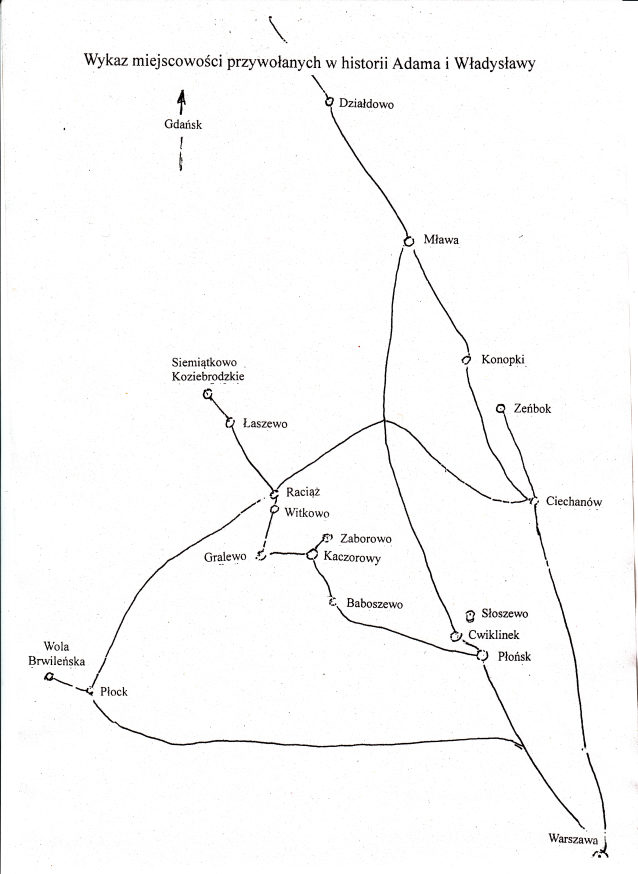
Działdowo, Słoszewo, Ćwiklinek, Łaszewo, Gralewo: the war in Masovia, the twins, the three hanged men and Easter 1944.
Chapter 3
The end of the Second World War
The arrival of the Russians in January 1945, Konopki, the return of the mother, five years in Zaborowo, the school-leaving examination in 1951.
Chapter 4
Life in Danzig
The labour battalion in the Rozbark mine, the Danzig (Gdańsk) shipyard (Stocznia Gdańska), the white tango of 27 May 1956, the three weddings of the children.
Appendix I
Certificates and documents
Appendix II
Gizela's recollections
The sources
What the author says about his sources
„
Alle Fakten, Orte und Umstände, die ich hier beschreibe stammen entweder aus meinem Gedächtnis oder aus Erzählungen von anderen, z. B. meiner Mutter, Tante Danuta und anderen.
All the facts, places and circumstances that I describe here come either from my memory or from accounts of others, for example my mother, Aunt Danuta and others.
Whoever reckons with this provenance reads the following chapters differently. Dates do not always stand where one expects them; in some places one recollection contradicts another. This edition has not smoothed such places. Where the text knows two versions of an event, both stand; where it names no date, this edition names none either.
This edition
What has been added — and what has not
The wording of the chapters is unchanged. Only the form has been changed: the source sets its paragraphs in broad blocks across the full width of the page; here they are set as running text with subheadings, so that they remain readable on a screen.
Five things that the source lacks have been added. First a structure: start page, four chapters, the page about the descendants and the three families, two appendices, register, with links from page to page. Second the subheadings above each section, which come from the text but do not stand in it. Third the indication of the manuscript page on every image and at every section, so that every sentence can be traced back to its leaf. Fourth the register with chronology, index of persons and index of places. Fifth the image index, which assigns the 34 image numbers of the manuscript to their pages.
What has not been added is an interpretation. This edition does not retell the story, it does not correct it and it fills no gap with conjecture. Where the source knows no date, the words “wahrscheinlich” or “vermutlich” (probably, presumably) stand here — there where the author himself uses these words.
Two details of this edition stand outside the manuscript: the date of death of the author and the resolution of a place name that was not written by him but by the eighth enclosure. Bogdan Bomert died on 22 February 2020 in Baunatal; the manuscript itself ends in July 2012. The register marks both: the date of death as a supplement by the family, the place name as information from the family.
Register
All dates from 1909 to 2020, all persons with their kinship terms, all places and every image reference — each with the page on which the author names them. The date of death of the author is the only entry that carries no page reference but the note Nachtrag der Familie (supplement by the family).
Spelling
Proper names follow the source, also where they vary: Bohdan and Bogdan, Bomert and Bohmert, Działdowo and Soldau, Warschau and Warszawa.
Open questions
What the manuscript does not know
- The date of death of the fatherThe author writes that his father was shot in the forest at the age of thirty-two. He names no date — at best it can be narrowed down to the time between the arrest in April 1944 and the end of the war.Manuscript, pages 3, 25 and 47
- RenataOf the twins of 1940 the manuscript presents only the birth certificate of Gizela as an enclosure. Renata, who died in the winter that followed, has no certificate of her own among the enclosures.Manuscript, enclosures 1 to 11
- The sound recordingEnclosure 13 is a sound recording of the “Ave Maria”, which the author made at the age of 74. The source is a PDF file; the recording itself is not contained in it.Manuscript, pages 49 and 70
- The further fortunesThe author explicitly calls the continued stories of the three families a task of their own and breaks off there: „Die weiteren Lose der drei Familien, das sind schon drei andere Geschichten. Vielleicht wird sich jemand dieser Aufgabe stellen.“ (The further fortunes of the three families, those are already three other stories. Perhaps someone will take on this task.)Manuscript, page 48 What the source nevertheless records about the three families stands on the page The descendants.
One inconsistency shall be named expressly, because it is noticeable in reading. In the second chapter the author reports Easter Sunday of the year 1944, 9 April, as the day on which his father had his birthday and said „Heute ist Ostern, mein Geburtstag und unser 10. Hochzeitstag“. The wedding of the parents took place, according to the same manuscript, on 10 April 1937 — it would have been the seventh wedding anniversary. Both statements stand in the text and both stand here as he wrote them.
Today is Easter, my birthday and our 10th wedding anniversary.
Closing word
The last lines of the manuscript
„
Sollte ich in meiner Erzählung jemand oder etwas vergessen oder etwas anders dargestellt haben, als dies in Wirklichkeit passiert ist, dann bitte ich alle um Vergebung. Das menschliche Gedächtnis (und meins allen voran) ist manchmal nicht sehr zuverlässig und das benutze ich als meine Entschuldigung.
Should I have forgotten anyone or anything in my narrative, or have described something differently from the way it actually happened, then I ask forgiveness of you all. Human memory (and mine above all) is sometimes not very reliable, and that I use as my excuse.