Chapter 2 · pages 9 to 27 of the manuscript
The years 1939–1945
„Gralewo — das Dorf, in dem wir glücklich waren und in dem uns ein schreckliches Schicksal ereilte.“ (Gralewo — the village in which we were happy and in which a terrible fate befell us.) This chapter tells of both: five years of business, ponds and fair-time joys, and the two days in April 1944 after which the parents were gone.
- Settings
- Łaszewo, Słoszewo near Płońsk, Ćwiklinek (Ćwiklinek), Płońsk, Gralewo (Gralewo) near Raciąż
- Events
- execution of ten Poles on 11 August 1943 in Gralewo; arrest of the parents on 14 April 1944
- The father's place
- Nowy Dwór Mazowiecki, afterwards shot — the exact date is unknown
- The mother's place
- women's concentration camp Ravensbrück
- Images
- Image no. 10 to 24
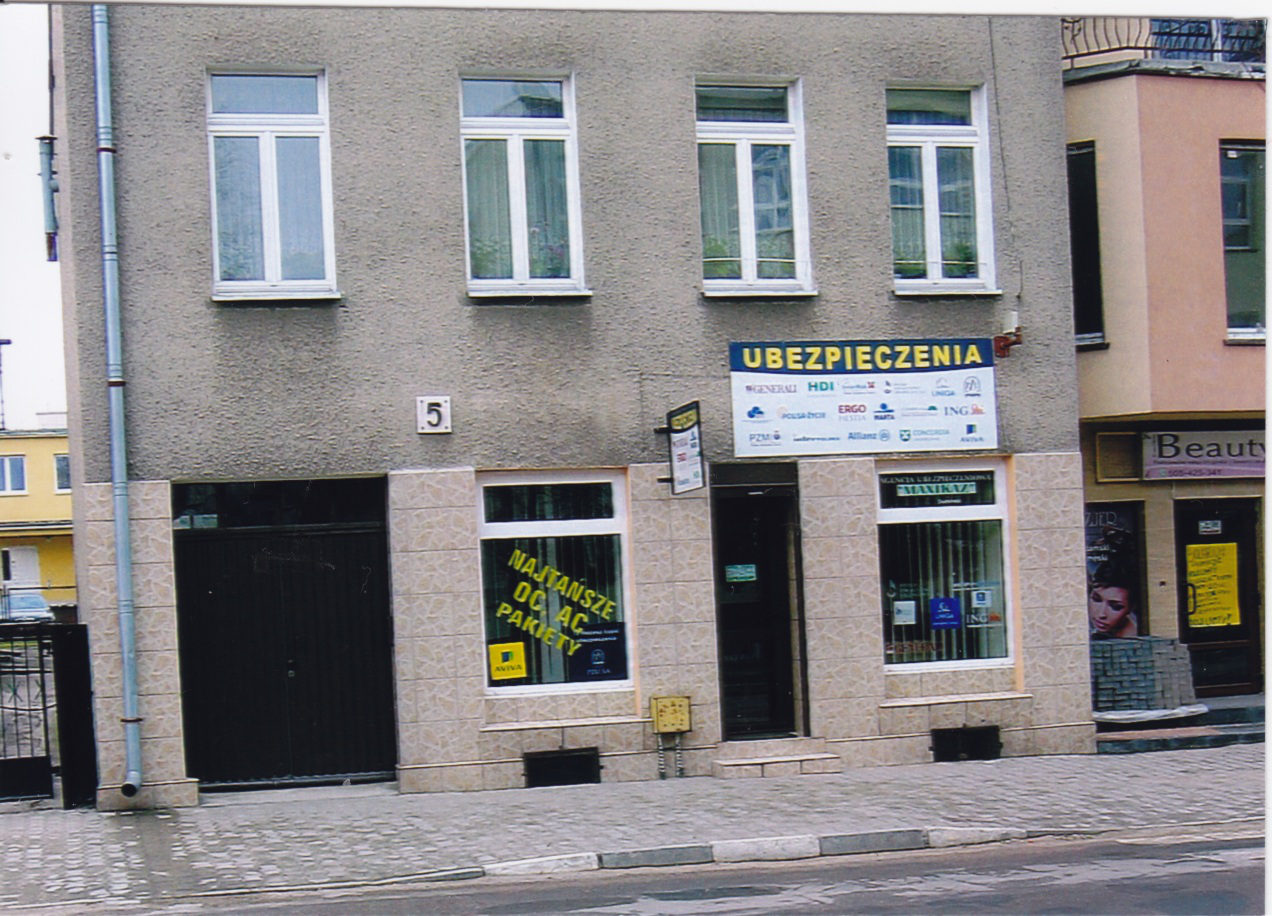
Summer 1939
To the grandmother, in a one-horse carriage
„Im Sommer 1939 hat unser Vater mich und Halina aus Furcht vor dem nahenden Krieg zur Oma Josephine nach Łaszewo gebracht, in einem Einspänner, wie ich mich erinnere.“ (In the summer of 1939 our father, out of fear of the approaching war, brought me and Halina to Grandma Josephine in Łaszewo, in a one-horse carriage, as I remember.) Thus the author begins his second chapter — with a precaution, not with a date. When the parents themselves arrived in Łaszewo, before or after the beginning of the war, he no longer knows.
The first news that he has about the time afterwards is a death: „Aus den Erzählungen von Oma Josephine weiß ich, dass gleich zu Beginn des Krieges der älteste Bruder unseres Vaters, Onkel Ludwig — gemeinsam mit seiner Frau Wanda aus dem Hause Mac — exekutiert wurde. Er war das erste Opfer dieses Krieges aus unserer Familie.“ (From Grandma Josephine's accounts I know that right at the beginning of the war the eldest brother of our father, Uncle Ludwig — together with his wife Wanda from the house of Mac — was executed. He was the first victim of this war from our family.)
In 1940 the family came to Słoszewo, about five kilometres from Płońsk, to Aunt Jadwiga, the father's sister. From Aunt Danusia the author learned that Aunt Jadwiga was the head of the village. She had good contacts in the offices of Płońsk, and with the help of gifts — geese and ducks — she achieved that the father was able to open his shop in Ćwiklinek.
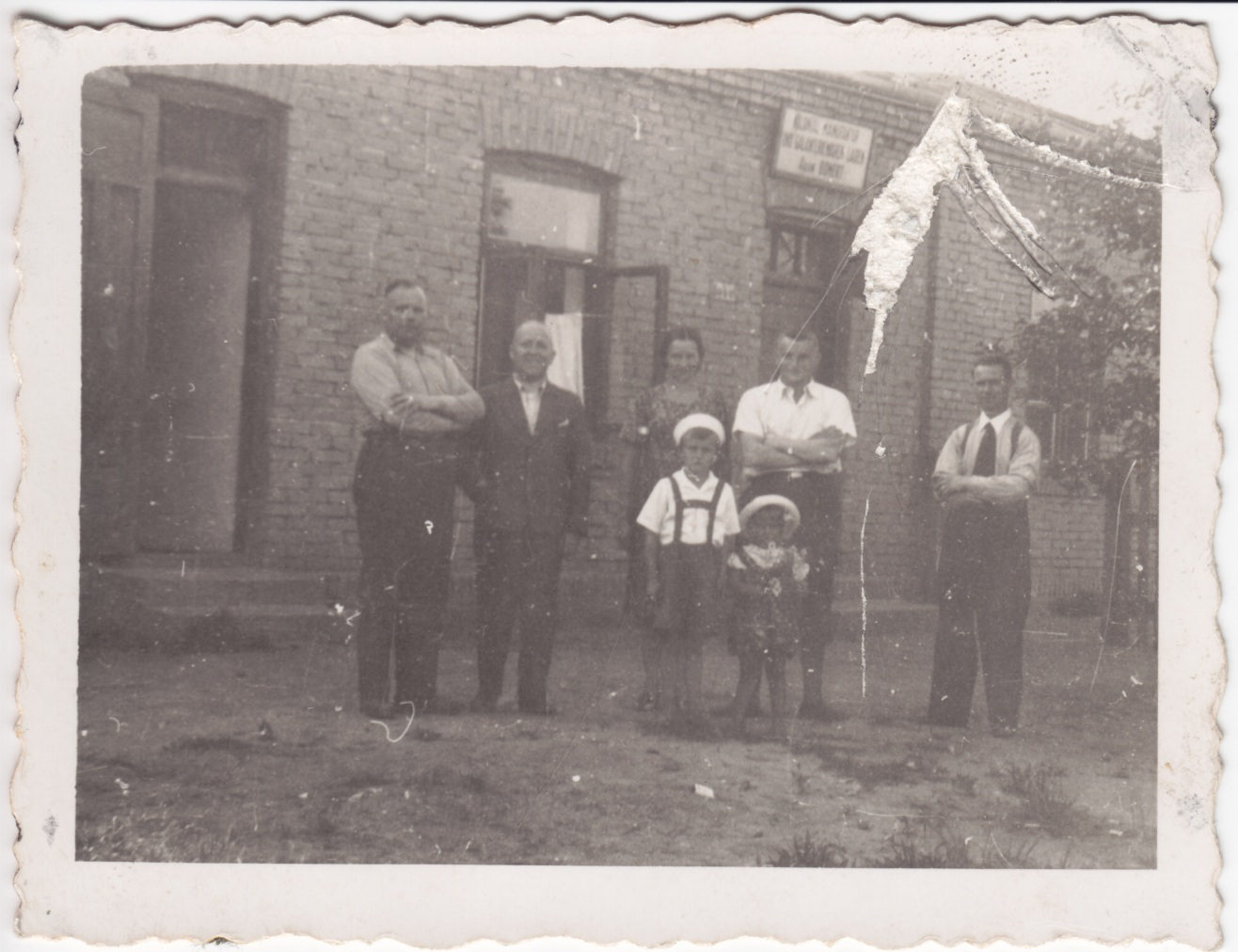
1940 to 1942
A grocer's shop with its own dairy
„Ein Kolonialwarengeschäft — so wurden damals Lebensmittelläden bezeichnet. Vielleicht gab es auch Textilwaren, aber daran erinnere ich mich nicht mehr.“ (A grocer's shop — that is what food shops were called in those days. Perhaps there were also textiles, but I no longer remember that.) The author describes his parents' business as precisely as one describes a place where one was last at the age of five.
In the long building on the left, seen from the street, lay the flat: one room with a kitchen. Beside it the shop, then the dairy with the cheese-making. The cheese ripened on shelves in the cellar. At the edge of the yard stood a small building for the purchase of eggs; for transporting the goods there was a three-wheeled van.
In the late autumn of 1940, on 29 October, the twins were born — Gizela and Renata. „Schon von Anfang an war die kleine Renata sehr schwach. Die Mama hat dem Kind ihr eigenes Blut gespendet. Doch es half nichts. Im Winter verstarb Renata. Ich weiß noch, dass es Winter war, weil wir mit einem Schlitten zum Begräbnis gefahren sind. Am Grab sah ich meinen Vater zum ersten Mal weinen.“ (From the very beginning little Renata was very weak. Mama gave the child her own blood. But it did not help. In the winter Renata died. I still know that it was winter, because we drove to the funeral on a sledge. At the grave I saw my father weep for the first time.)
For these events the manuscript contains a separate commentary with the words of the surviving sister. It begins with an accident in the bath and ends with a dream — and it is the oldest passage of the volume that was not written by the author himself.
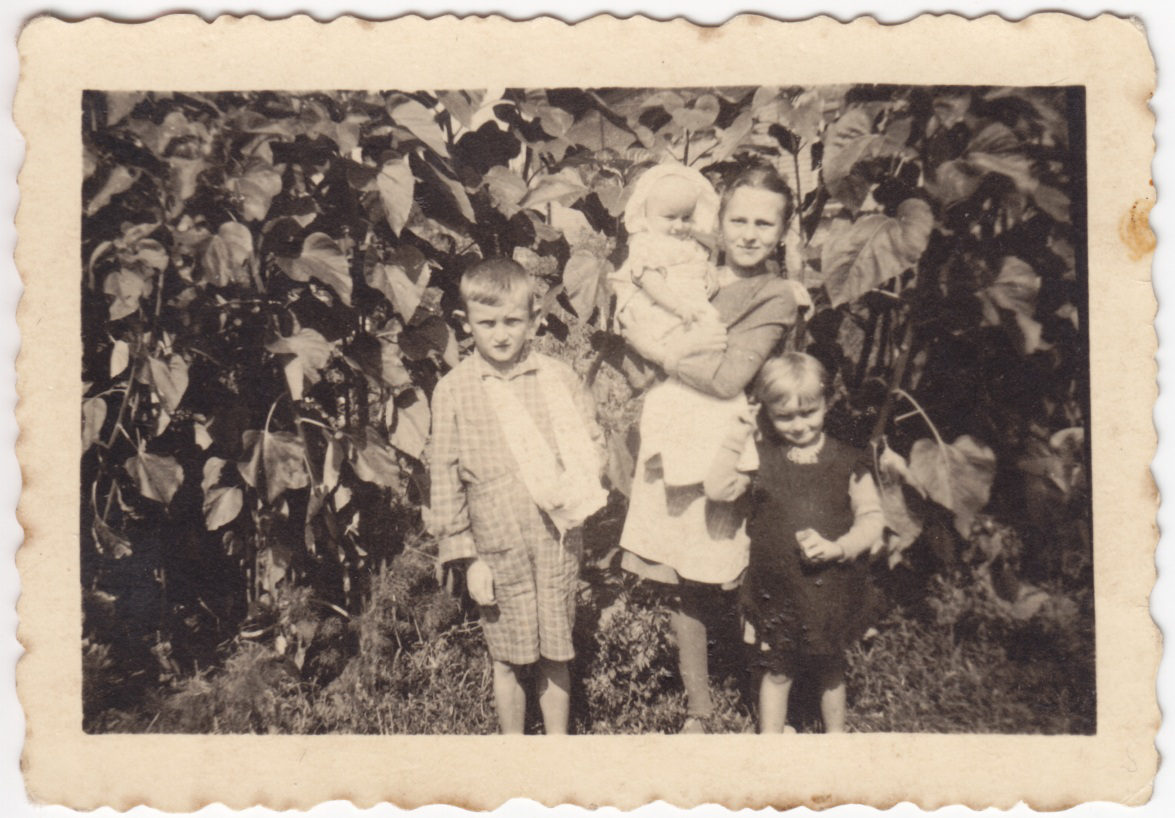
„Ich bin als Zwilling geboren. Als wir 6 Wochen alt waren, sind unsere Eltern auf ein Fest bei Bekannten gegangen. Unser Kindermädchen hat uns in zu kaltem Wasser gebadet und wir bekamen beide eine Lungenentzündung, und meine Schwester starb. Mit dem Begräbnis hat man auf mich gewartet, damit wir als Zwillinge beerdigt werden. Aber obwohl beide Eltern abwechselnd Tag und Nacht über mich gewacht haben, hat der Arzt gesagt, es gebe keine Hoffnung und ich würde früher oder später sterben. Papa war an der Reihe und ist neben meinem Bettchen eingeschlafen, im Traum kam ein Engel zu ihm und sagte, er solle Grütze kochen und mir von dem Schaum, der beim Kochen entsteht, jede Stunde einen Teelöffel geben. Auch wenn ich anfangs alles erbrechen würde, soll er mir trotzdem weiterhin jede Stunde einen Teelöffel geben. Und so habe ich überlebt.“
Gizela Bomert in her recollections, quoted by the author in the commentary on page 12 · complete in Enclosure 12
I was born a twin. When we were 6 weeks old, our parents went to a celebration at the home of acquaintances. Our nanny bathed us in water that was too cold, and we both got pneumonia, and my sister died. The funeral was held back for me so that we could be buried as twins. But although both parents watched over me day and night in turn, the doctor said there was no hope and that I would die sooner or later. Papa was taking his turn and fell asleep beside my little bed; in the dream an angel came to him and said he should cook groats and give me a teaspoonful of the foam that forms during cooking every hour. Even if at first I threw everything up, he was still to go on giving me a teaspoonful every hour. And so I survived.
Płońsk
The German school and a broken arm
„Nach einiger Zeit haben die Eltern beschlossen, dass ich in die deutsche Schule gehen soll, weshalb ich nach Płońsk kam und zunächst bei Frau Czekalińska und später bei Onkel Heniek gewohnt habe.“ (After some time the parents decided that I should go to the German school, which is why I came to Płońsk and lodged first with Mrs Czekalińska and later with Uncle Heniek.) Uncle Heniek, the father's brother, lived with his wife Karola in the town; the school lay in the same street as his little house.
Two incidents from this school the author has kept. At the beginning the teacher found a Polish schoolbook on him and took it away from him without saying anything to anyone. Another time, because he could not find the toilet, he found a urinal, climbed up it with difficulty and relieved himself there — „als dies entdeckt wurde, gab es eine große Untersuchung, um den Schuldigen zu finden“ (when this was discovered, there was a great investigation to find the culprit). He owned up in his fright; because one saw how frightened he was, he was not punished.
Once, instead of going to school, he went to a girl who lived on the way and pleased him very much. Uncle Heniek discovered it at once. At the weekends he always returned to his parents in Ćwiklinek; sometimes they came to fetch him, sometimes he walked the distance on foot: „damals war das ungefährlich — niemandem würde einfallen, dass so ein kleiner Knirps sich verlaufen oder ihm etwas passieren könnte“ (at that time it was not dangerous — it would not occur to anyone that such a little lad could lose his way or that something could happen to him).
He fell from a cherry tree at the roadside so unhappily that he broke his left arm. One month in plaster; a few days after it was taken off he ran into a cyclist while flying a kite, fell down and broke the same arm a second time. „Die Heilung dauerte fast drei Monate.“ (The healing took almost three months.)
- Lodging
- first with Mrs Czekalińska, then with Uncle Heniek and Aunt Karola
- Weekends
- return to the parents in Ćwiklinek, on foot or fetched
- At home
- Halina and Gizela stayed with the parents the whole time
- Career
- two fractures of the same arm within a few days, together almost four months
Uncle Heniek is the father's brother, whom the author calls the chronicler of the family. In 2000 he was with Jürgen and Egon in Płońsk and photographed the house of the two — „es war in einem erbärmlichen Zustand“ (it was in a pitiable condition).
Autumn 1940 to the end of the war
Łaszewo — the four years with Grandma Józefina
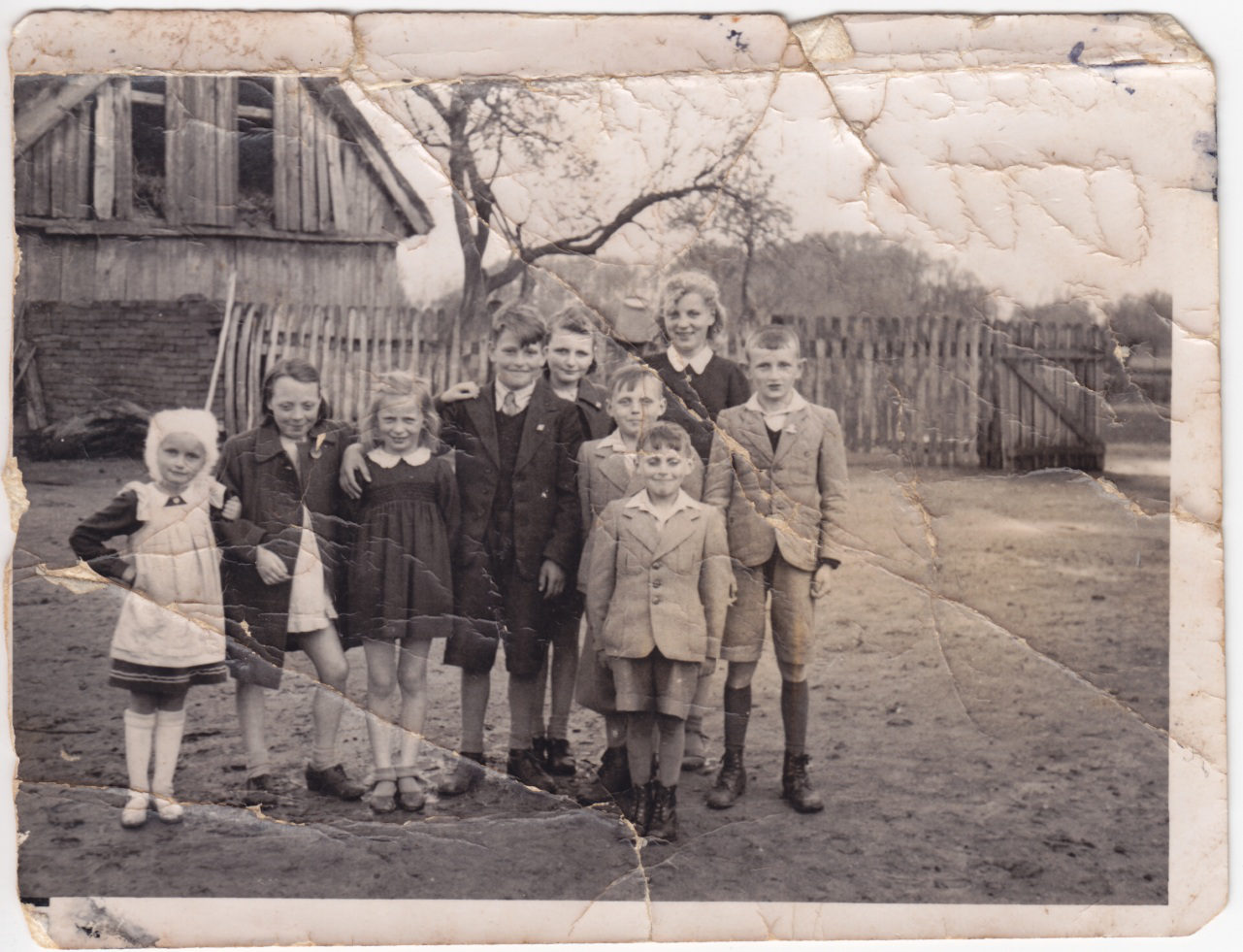
In the autumn of 1940 the author came to Łaszewo and there attended the primary school. Of his classmates he remembers Harry Kolm and his sisters Miriam and Edith, as well as the two Riemer sisters. The families were related to one another — and in one case so closely that it affects the whole village.
A kinship
The Kolm family
„Bei dieser Gelegenheit möchte ich erwähnen, dass die Familie Kolm mit der Familie Bomert verwandt ist. Die erste Frau von Kolm war die Schwester unserer Oma Józefina Bomert. Aus dieser Ehe stammen Bruno, Lenchen und Genia. Kolm heiratete erneut, und es folgten Edith, Miriam, Harry und Richard. Wenn ich mich nicht irre, dann ist Familie Riemer auch ähnlich mit unserer Familie verwandt.“ (On this occasion I should like to mention that the Kolm family is related to the Bomert family. Kolm's first wife was the sister of our Grandma Józefina Bomert. From this marriage came Bruno, Lenchen and Genia. Kolm married again, and there followed Edith, Miriam, Harry and Richard. If I am not mistaken, the Riemer family too is related to our family in a similar way.)
Religious instruction took place in the Protestant church that stood beside the Kolms' property. When the author was in Łaszewo again some years after the war, the church had already been torn down. For a time the instruction was therefore held in Siemiątkowo Koziebrodzkie, where Aunt Irena Meyer lived with her children — her husband was with the Wehrmacht, and a few streets further on his parents lived with a windmill which the author often visited, „weil mir diese Apparatur sehr gefiel“ (because I liked this apparatus very much).
Probably 1942
Gralewo — the house that belonged to the church
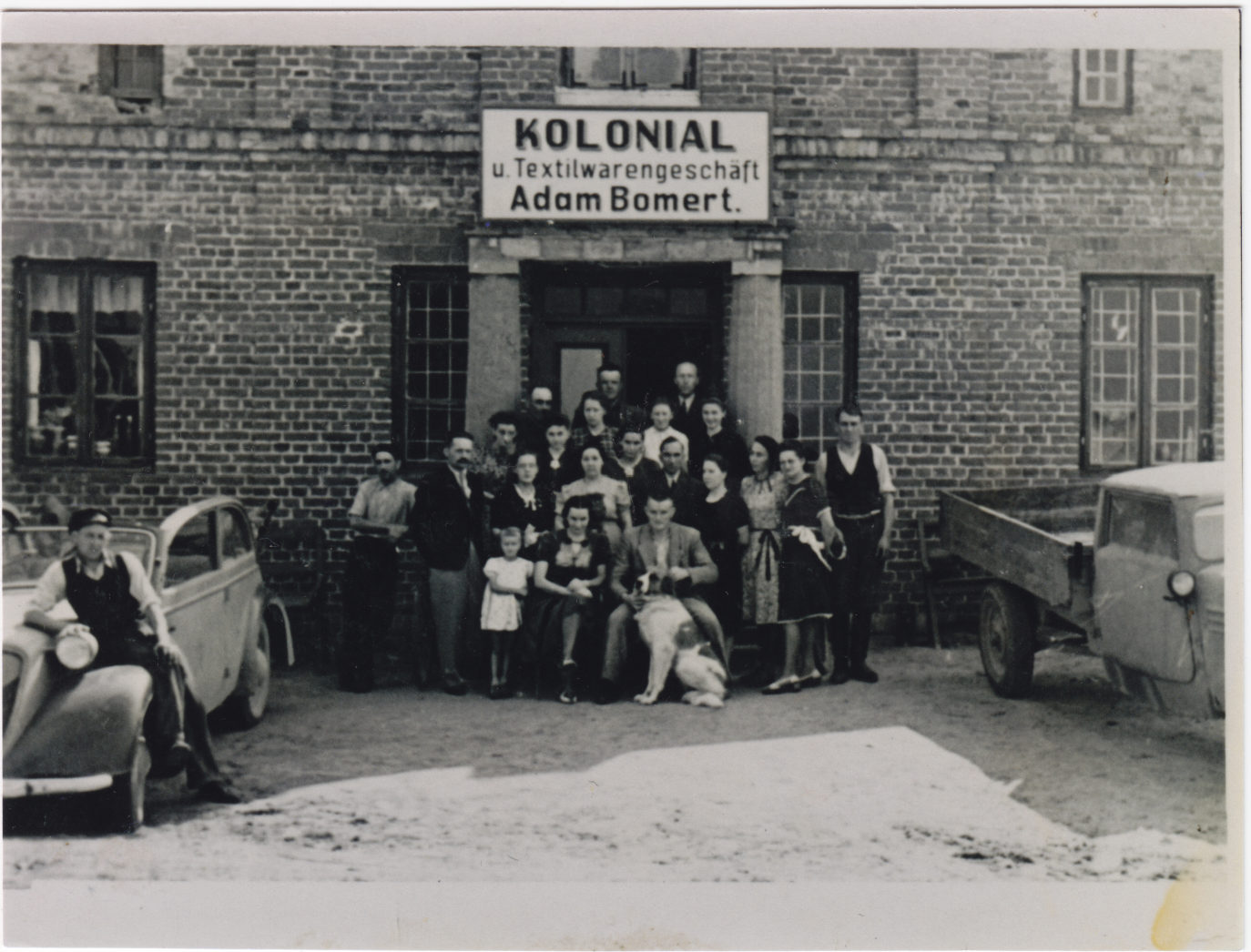
When the author was already living with Grandma Józefina in Łaszewo and going to school, the parents moved to Gralewo, a small village about five kilometres from Raciąż. They moved into a large house that belonged to the church, and there founded a large grocery and textile business.
In the first, large room there were foodstuffs and industrial goods — among other things petroleum. In the second, smaller room lay the textiles; the bales of material for clothing were stacked on the shelves up to the ceiling.
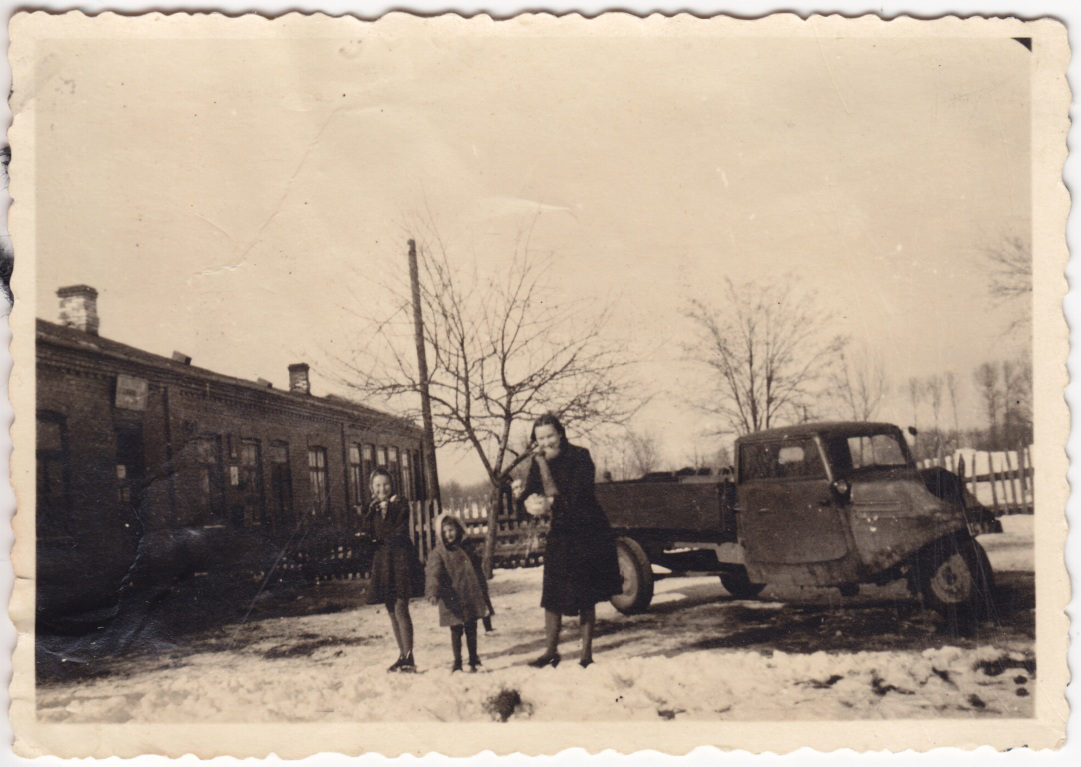
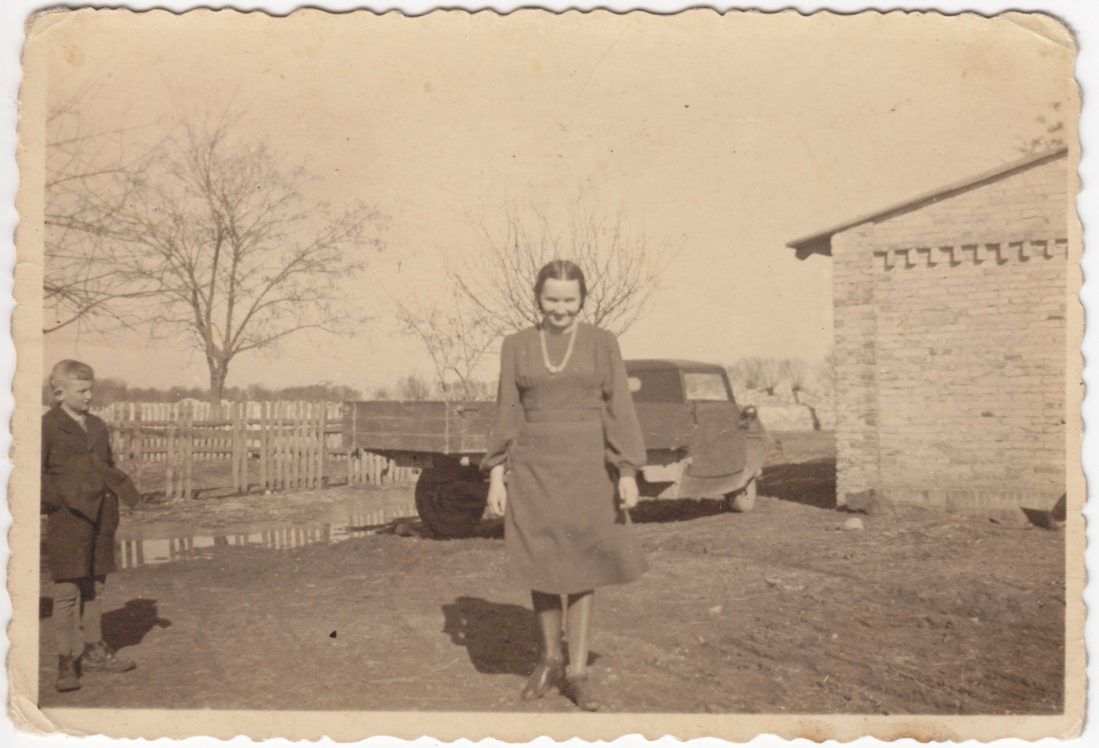
„Unser Vater beschäftigte sehr viele Personen — sogar jemanden, der Papas Tauben züchtete; er hieß Święcki —, um sie so vor dem Abtransport nach Deutschland zum Arbeiten zu schützen.“ (Our father employed a great many people — even someone who bred Papa's pigeons; his name was Święcki — in order in this way to protect them from being taken away to work in Germany.) The author does not give the number of the pigeons, only that there were „zig Sorten“ (dozens of sorts). To be seen in the photograph are besides the three-wheeled van from Ćwiklinek and the Studebaker car, „der Stolz unseres Vaters“ (the pride of our father). The dog was called Zenta.
The father
A marksman, an angler, a violin player without an ear for music
The most extensive portrait of the volume is devoted to Adam Bomert — and it is not an obituary but a collection of qualities that a son remembers.
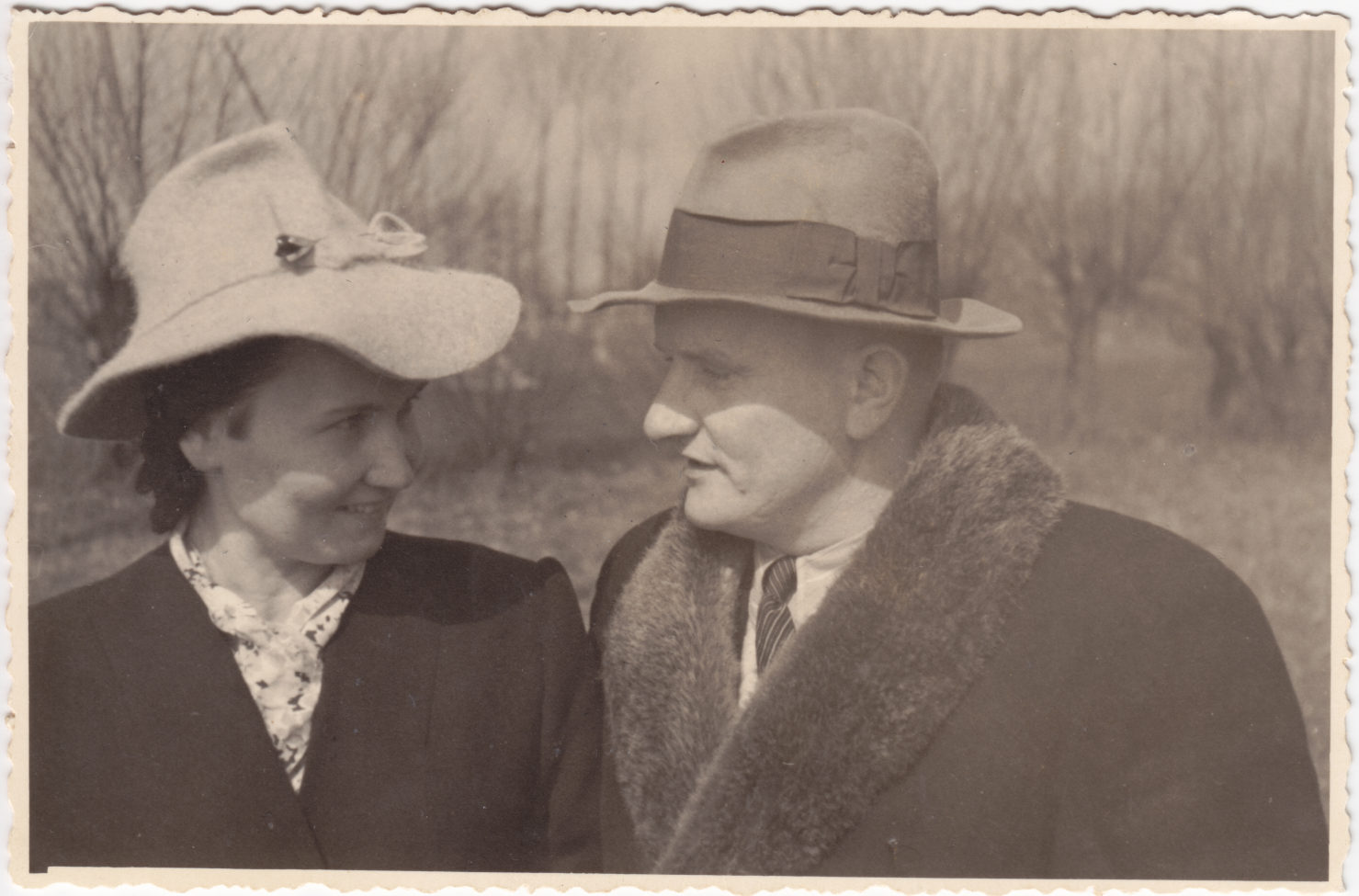
„In guten Zeiten kosteten unsere Eltern das Leben voll aus — sie führten ein für ländliche Verhältnisse reiches gesellschaftliches Leben.“ (In good times our parents tasted life to the full — they led a rich social life by country standards.) The father liked to play cards, „nicht selten auch die ganze Nacht“ (not seldom the whole night through as well), and fished with a persistence that the author knows only from accounts: sometimes he is said to have spent up to 36 hours at a stretch over the rod.
He was an excellent shot. With an air rifle he hit a starling that sat on the cross of the tall church tower. Once the author held up a matchbox, and the father, standing free, shot a hole in the middle from 15 to 20 metres. „Die Mama war natürlich erschrocken, aber Papa hat immer seinen Kopf durchgesetzt.“ (Mama was naturally startled, but Papa always had his way.)
On a drive with the calash from Łaszewo he instructed the coachman to stop at a rye field, walked a few steps back and pulled out a „Paar“ (pair) of rye ears — two ears on one stalk. „Ein bemerkenswertes Auge.“ (A remarkable eye.) Remarkable too was his violin playing, and indeed „weil ihm jegliches musikalische Gehör fehlte, wie man sich erzählte. Als er versuchte zu singen, flohen sogar die Mäuse. Als begabter Mathematiker mit einem hervorragenden Gedächtnis spielte er wie aus Noten.“ (because he lacked any musical ear whatever, as people related. When he tried to sing, even the mice fled. As a gifted mathematician with an excellent memory he played as if from sheet music.)
He could imitate bird calls and did so at a performance from the back room, thematically fitting, to the profit of the evening. And he was physically imposing: „Er konnte, mit dem Kopf auf einem und mit den Fersen auf einem anderen Hocker gestützt, eine erwachsene Person auf sich halten.“ (He could, with his head resting on one stool and his heels on another, hold an adult person on himself.)
11 August 1943
Ten hanged men in the middle of the village
„In den Ferien 1943 kam es zu einem tragischen Ereignis in Gralewo. Mitten im Dorf wurden 10 Polen durch Hängen exekutiert. Papa wurde dazu gezwungen, diese Personen mit seinem Dreiradwagen aus Płońsk oder aus Pomiechówek an den Exekutionsort zu bringen. Der Grund für die Hinrichtung war, wie ich erfahren habe, das Anzünden von zwei Getreideschobern eines deutschen Bauern. Dieses tragische Ereignis fand am 11. August 1943 statt.“ (In the holidays of 1943 there occurred a tragic event in Gralewo. In the middle of the village 10 Poles were executed by hanging. Papa was forced to bring these persons with his three-wheeled van from Płońsk or from Pomiechówek to the place of execution. The reason for the execution was, as I learned, the setting on fire of two grain shocks of a German farmer. This tragic event took place on 11 August 1943.)
The author was at home in the holidays at that time and wanted by all means to watch, „doch Papa hat es kategorisch verboten“ (but Papa categorically forbade it). He calls himself at this point a „neugierigen Elfjährigen“ (inquisitive eleven-year-old); by his date of birth in October 1933 he was nine. At the same point he clarifies why he knows this date so exactly: he was in Gralewo in August 1943, and so for him it is certain that the arrest of the parents can only have been in 1944 — Halina and Aunt Danuta were convinced until an advanced age that it had been 1943.
„Ihre Eltern haben den Polen geholfen, wo sie nur konnten, und das hatte fatale Folgen für sie.“
Mr Giszczak, head of the municipality of Raciąż, on the telephone to the author — he said it spontaneously, after the author's name. He had it from his mother. The author met Mrs Giszczak on 20 March 2012.
Your parents helped the Poles wherever they could, and that had fatal consequences for them.
Beside this memory stands the other, smaller one: when the author one day in the village was beaten up by other boys and came home crying, the father had no pity. He did not go to the parents of the boys to complain, but only said: „Was gehst Du auch dahin?“ (What did you go there for?) The author himself places the sentence: „Dabei war doch Krieg, das Dorf war polnisch, und ich war der Sohn des einzigen deutschen Geschäftsmannes mit einem großen Geschäft — also einer wichtigen Person. Heute wäre eine solche Reaktion der Eltern undenkbar.“ (Yet it was war, the village was Polish, and I was the son of the only German businessman with a large shop — that is, of an important person. Today such a reaction on the part of parents would be unthinkable.)
Image no. 16 to 22a
Images from that happy time
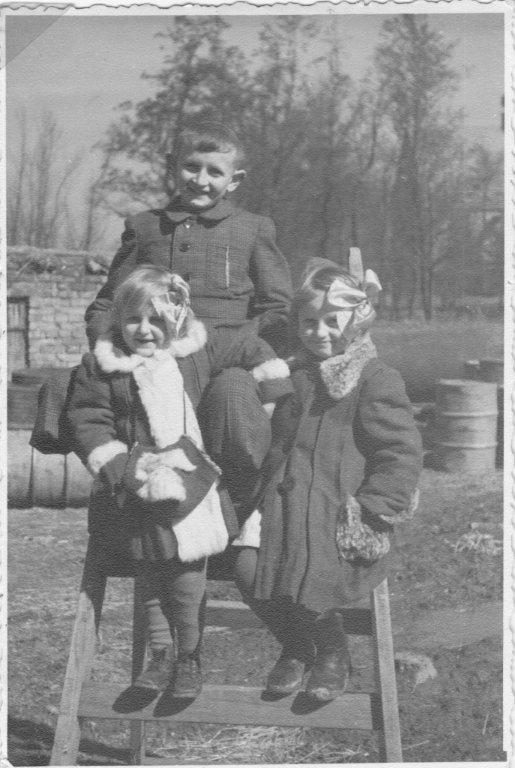
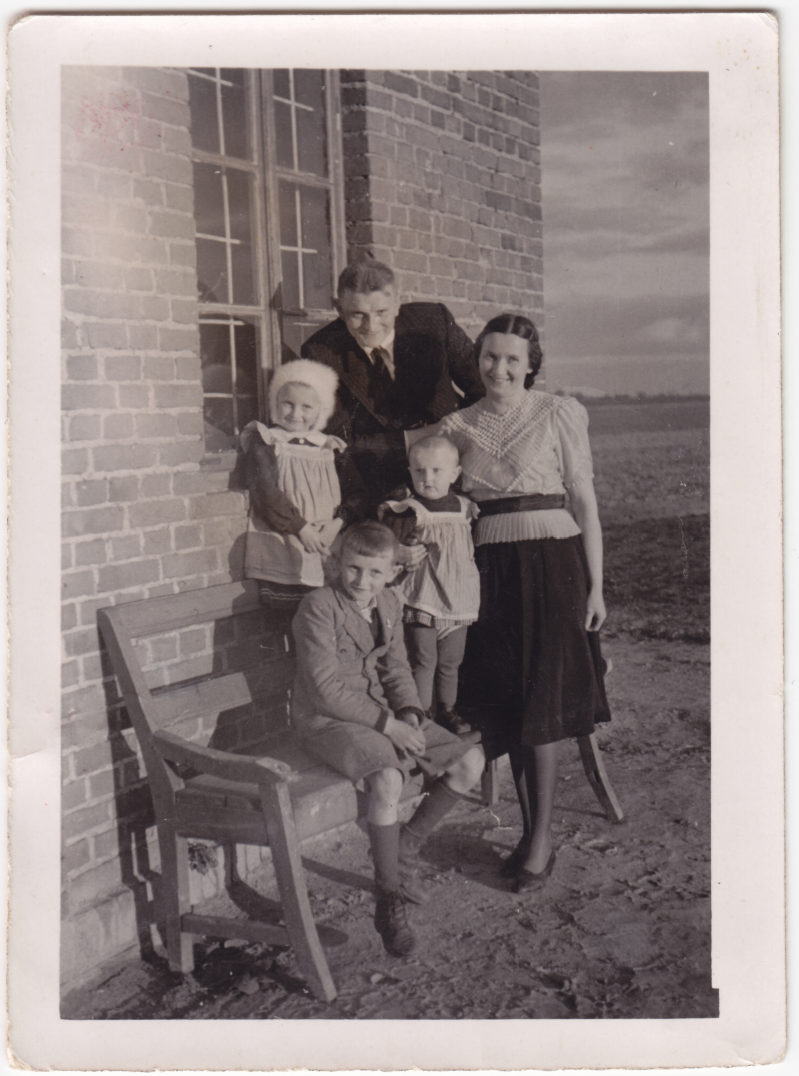
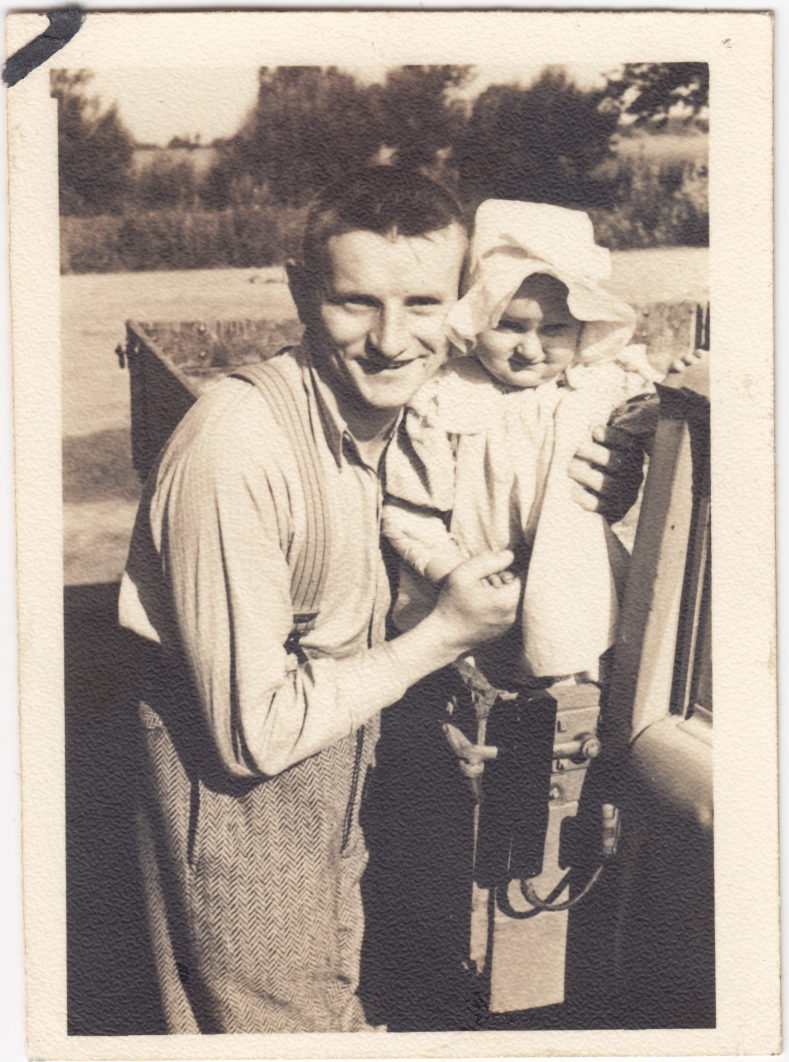
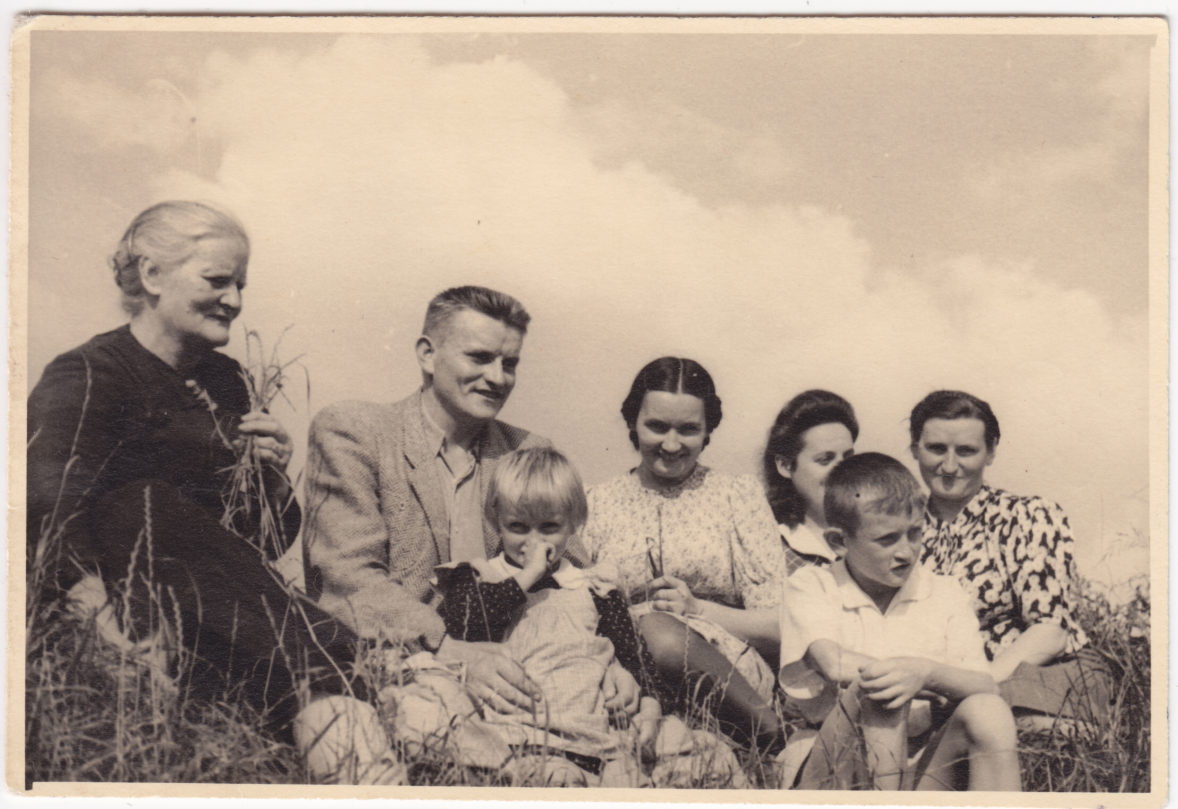
At this point the author places a series of photographs without further explanation: „Hier noch einige Fotos aus jener glücklichen Zeit.“ (Here are a few more photographs from that happy time.) The captions are his own — brief, and in two cases with an exclamation mark.
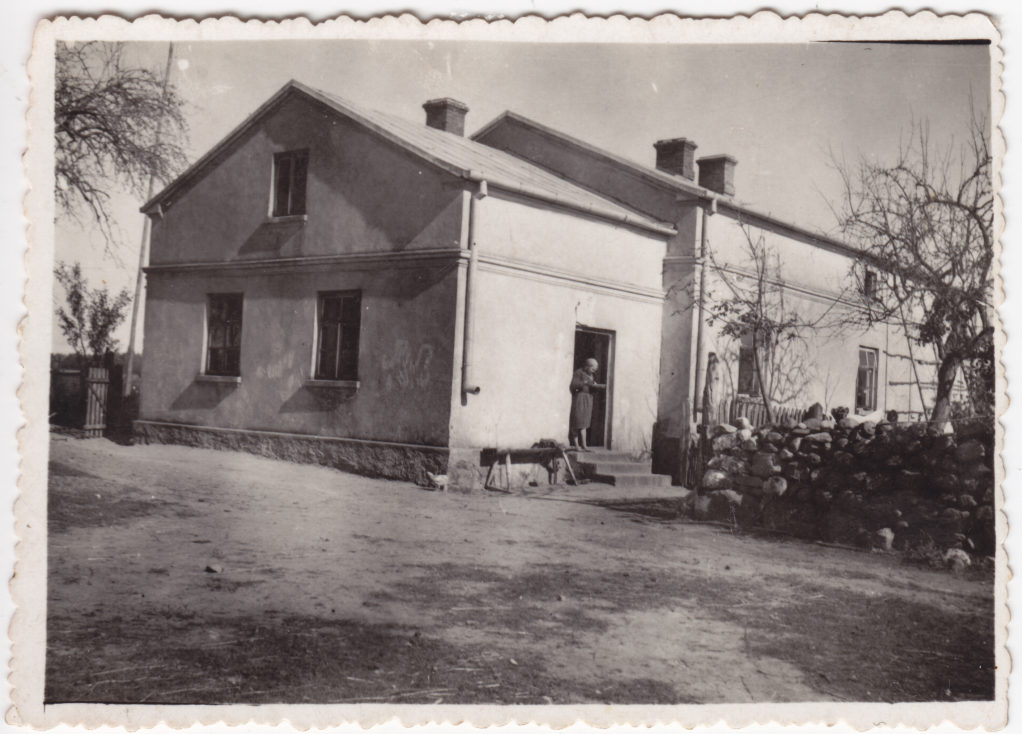
House and ponds
King carp in five ponds
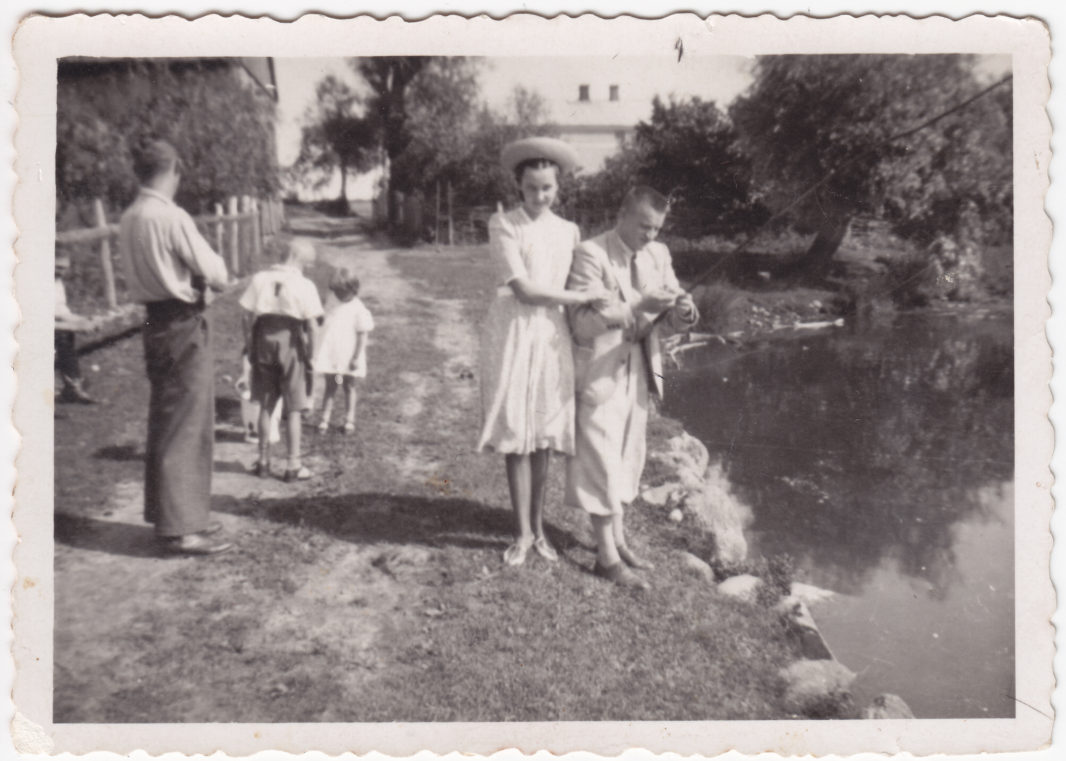
In Łaszewo the father kept a breeding of king carp. For that five ponds were needed. „Diese Teiche hatte Onkel Heniek entworfen, und Papa hat das Anlegen finanziert.“ (These ponds Uncle Heniek had designed, and Papa financed the making of them.) Nearest to the grandmother's house lay the winter pond — quite deep, with the spring, in it the fish spent the winter. Then followed the small pond for spawning and finally three more; the last was long and of varying depth, „zunächst sehr flach, etwa 20 cm, und fortlaufend tiefer werdend bis zu einem Meter“ (at first very shallow, about 20 cm, and becoming progressively deeper up to one metre).
A story of a near-catastrophe attaches to these ponds: little Gizela went into the last pond; the water reached up to her knickers, and she went on, even when it stood up to her neck. „Hätte die Mama das nicht bemerkt, wäre Gizela wahrscheinlich ertrunken — sie hatte überhaupt keine Angst vor dem Wasser. Wie sehr man doch auf Kinder Acht geben muss.“ (Had Mama not noticed it, Gizela would probably have drowned — she had no fear of the water at all. How very much one must watch out for children.)
And a third memory that belongs to this house: „Oft wenn ich in Gralewo war, erzählte mir die Mama Geschichten über Tarzan. Ich liebte diese Erzählungen, und sie förderten meine Vorstellungskraft. Die ganze Atmosphäre im Haus, voller Frieden und Liebe, ging von unserer Mutter aus. Ihr lächelndes Gesicht verlieh allem diese Lebensfreude.“ (Often when I was in Gralewo, Mama told me stories about Tarzan. I loved these tales, and they fostered my imagination. The whole atmosphere in the house, full of peace and love, emanated from our mother. Her smiling face gave everything this joy of life.)
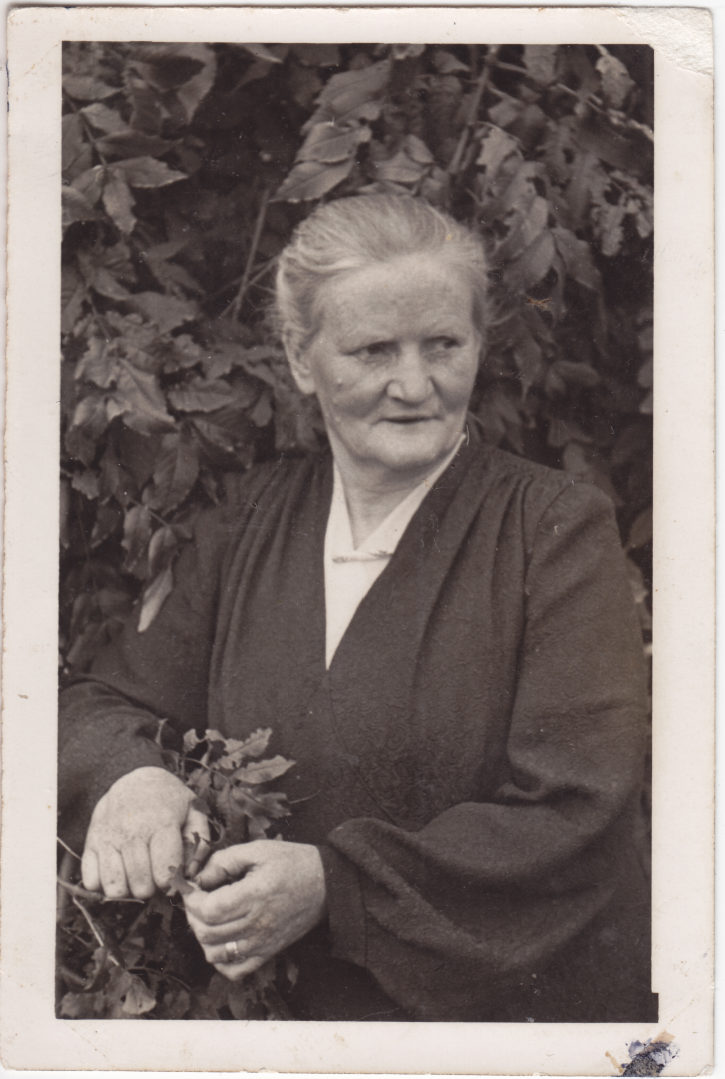
Easter 1944
„Heute ist Ostern, mein Geburtstag und unser 10. Hochzeitstag.“
Today is Easter, my birthday and our 10th wedding anniversary.
When the author came to Gralewo in 1944, the mother was not well, she lay in bed. „Immer öfter waren Anzeichen einer schlimmen Krankheit zu erkennen. Jetzt weiß ich, dass es Krebs war.“ (More and more often signs of a serious illness could be recognised. Now I know that it was cancer.) After only a short time she had to be operated on in Warschau (Warszawa); the operation lasted over three hours and went happily. „Mama kehrte noch vor Ostern 1944 nach Hause zurück.“ (Mama returned home even before Easter 1944.)
At Easter Uncle Heniek came to visit from Berlin. This feast had a special meaning for the family. The author remembers the father's sentence on this 9 April 1944 — and the poem that Uncle Heniek whispered to him and that he then recited: „Unser Papa lebe hoch, als mich lieber die Halina schlage er doch.“ (Long live our Papa, even if Halina would rather hit me.) It did not please the father at all, „und statt Applaus gab’s Anpfiff“ (and instead of applause there was a telling-off).
A question of dates that the manuscript leaves open. The author hands down 9 April 1944 as Easter Sunday, as the father's birthday and as the tenth wedding anniversary. The calendar confirms Easter 1944 on 9 April and the birthday on 9 April 1912. After the marriage on 10 April 1937, however, it would have been the seventh wedding anniversary. The author does not resolve the contradiction; this website gives both dates instead of choosing one of them.
14 April 1944
The raid and the arrest
Some days after Easter the house was attacked by partisans of the People's Army — „Teil des polnischen Untergrunds, der mit den Russen sympathisierte“ (part of the Polish underground that sympathised with the Russians). They fired a shot at every window; fortunately no one was hit. The father hurried through the kitchen up to the attic, where he had stored weapons, and from there threw a grenade into the yard, „was diese dann zum Rückzug zwang“ (which then forced them to retreat). They had succeeded in bending a grille on one of the shop windows and throwing an incendiary device in. Nothing caught fire — for near this window stood the barrel with the petroleum. „Wäre dieses explodiert, wären die Folgen undenkbar gewesen.“ (Had this exploded, the consequences would have been unthinkable.)
The next day — it was 14 April, as the author knows from the accounts of Aunt Julianna — the Gestapo came. Two officers and three further men. The father was away with the car, so they spoke with the mother. They led all the men of the shop's staff into the yard, at that point these were also the husbands of Aunt Stasia and Aunt Jula, and laid them on the ground with bound hands.
When the father came back, the officers went with him to the nearest pond. After a long time they came back, and the father was in handcuffs: „Ich habe es gesehen und erinnere mich genau.“ (I saw it and remember it exactly.) Shortly afterwards a lorry came and took the bound men away. The husband of Aunt Julianna survived the war and came back, the husband of Aunt Stasia did not. After a very long time the parents came out of the room and the Gestapo took the handcuffs off the father so that he could take leave of the children. „Das war schrecklich! Mama war gerade mal zwei Wochen nach der schweren Operation.“ (That was terrible! Mama was only two weeks past the serious operation.)
From the accounts of the mother and of Aunt Danuta the author knows that the mother had been taken to Płońsk and the father to Nowy Dwór Mazowiecki. After some days the mother was transported to the women's concentration camp Ravensbrück. What remained behind were the children with Aunt Zosia, the sister of Uncle Szczepkowski, who lived with them and helped to look after Gizela and Halina.
„Der Grund für die Verhaftung sei an dieser Stelle auch erwähnt. Aus späteren Erzählungen der Mama weiß ich, dass Papa Mitglied der geheimen Organisation Polnische Heimatarmee (Armia Krajowa) war. Ein Mitglied dieser Organisation wurde durch die Gestapo gefasst und verriet, wahrscheinlich unter Folter, noch andere Mitglieder, darunter auch unseren Vater. Papa wusste, was ihm droht, und hätte mit uns fliehen können, aber er hat es nicht getan, da er Angst um seine Mutter und seine Geschwister hatte.“ (The reason for the arrest should also be mentioned at this point. From later accounts of Mama I know that Papa was a member of the secret organisation Polish Home Army (Armia Krajowa). A member of this organisation was caught by the Gestapo and betrayed, probably under torture, other members as well, among them our father. Papa knew what threatened him, and could have fled with us, but he did not do it, since he was afraid for his mother and his siblings.)
„Ich kann mir gut vorstellen, wie Papa jedes Mal, wenn ein SS-Mann zu ihm in den Keller kam, auf die Worte hoffte: Bomert, ab mit Dir nach Hause. Das muss eine furchtbare psychische Qual für ihn gewesen sein. Diese Worte hat er jedoch niemals vernommen; stattdessen haben sie ihn eines Tages — das genaue Datum ist unbekannt — in den Wald gebracht und erschossen.“
About the imprisonment in Nowy Dwór Mazowiecki and the end of the father · Manuscript, page 25
I can well imagine how Papa, every time an SS man came down to him into the cellar, hoped for the words: Bomert, off home with you. That must have been a fearful mental torment for him. Those words, however, he never heard; instead, one day — the exact date is unknown — they took him into the forest and shot him.
In Nowy Dwór Mazowiecki, a place near Warschau, the father was „in unmenschlichen Verhältnissen gefangen gehalten, geschlagen und gefoltert“ (held in inhuman conditions, beaten and tortured). It was probably June 1944 when the grandmother visited him: „Man sah ihm an, dass er zusammengeschlagen worden war.“ (One could see from him that he had been beaten up.) From Aunt Danuta the author knows that one of his fellow prisoners was released and came to her to convey that the family should collect money and try to obtain his release. „Doch keine der Hilfsaktionen ist geglückt.“ (But none of the rescue attempts succeeded.)
After her return from the camp the mother cherished for years — and the children with her — the hope that her Adam was alive and would return.
Łaszewo, 1944 to 1945
The house of the grandmother
„Für uns begann eine sehr traurige Zeit ohne Eltern. Mich traf das weniger, da ich bereits seit vier Jahren bei Oma Józefina lebte. Aber für Halina und Gizela war das eine schwere und tragische Erfahrung, die sich auch in ihrem Erwachsenenleben widerspiegelte.“ (For us there began a very sad time without parents. It hit me less, since I had already been living with Grandma Józefina for four years. But for Halina and Gizela it was a hard and tragic experience, which was also reflected in their adult life.) The author also notes at this point what he does not understand: why the grandmother took only the children with her and left behind the richly furnished house — „es gab unter anderem ein Klavier und das Geschäft voll mit Gütern“ (among other things there was a piano and the shop full of goods). And he notes what occupies him to this day: „Interessant ist auch, dass die Gestapo uns Kinder nicht mitgenommen hat.“ (It is also interesting that the Gestapo did not take us children with them.)
„Das Leben für uns Kinder verlief in Łaszewo eher ruhig. Die Oma hatte einen gut organisierten Haushalt und alles unter Kontrolle. Sie war energisch und standhaft, aber voller Liebe für uns.“ (Life for us children in Łaszewo passed rather quietly. Grandma had a well-organised household and everything under control. She was energetic and steadfast, but full of love for us.) Halina resisted going to school, „da sie kein Deutsch lernen wollte. Doch die Oma ließ nicht mit sich reden.“ (since she did not want to learn German. But the grandmother would not be talked out of it.)
The mother's letters from the camp the author remembers exactly: they were short and said that she was well and lacked nothing — „was wohl das Ergebnis der Zensur war, denn andere Inhalte hätten uns wohl nie erreicht“ (which was probably the result of the censorship, for other contents would probably never have reached us). The grandmother prepared food parcels and sent them to her. „Leider hat keiner der Briefe die Zeit überdauert.“ (Unfortunately none of the letters has outlasted the time.)
What the mother later told about the camp has fixed itself in one image: „Mir ist im Gedächtnis geblieben, dass das Erste, was sie morgens aus dem Fenster sah, der furchteinflößende Anblick des rauchenden Kamins war — welch erschreckender Gedanke, ob ich vielleicht morgen oder sogar schon heute dorthin komme.“ (What has remained in my memory is that the first thing she saw in the morning from the window was the terrifying sight of the smoking chimney — what a frightening thought, whether I might come there tomorrow or even today.)
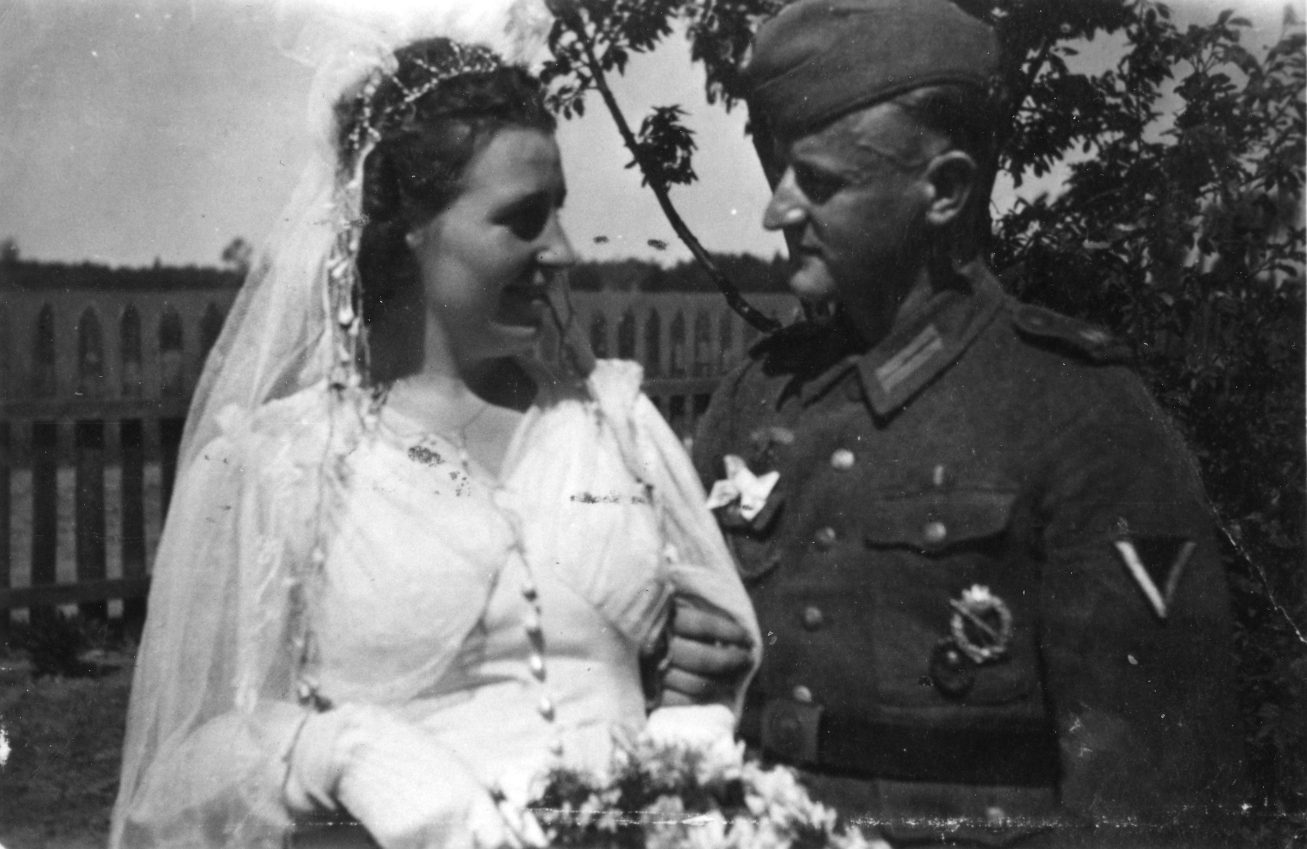
Uncle Johann
The youngest brother of the father came to Łaszewo when he was off duty. „Ich habe mit ihm Dame gespielt, aber jedes Mal fürchterlich hoch verloren. Manchmal hatte ich 11 blockierte Spielsteine.“ (I played draughts with him, but lost terribly badly every time. Sometimes I had 11 blocked pieces.) The wedding itself the author does not remember, „aber es waren viele Gäste da. Es sind zwei voll beladene Pferdewagen zum Bahnhof nach Raciąż gefahren.“ (but there were many guests there. Two fully loaded horse carts drove to the station at Raciąż.)
The last winter of the war
„Die Weihnacht verbrachten wir in Furcht vor dem, was kommen möge.“
We spent Christmas in fear of what might come.
From late autumn people began to talk about the war coming to an end, since the front was coming ever closer. German propaganda spread stories about the atrocities of the Russians — „sie verkündeten, die Russen würden vergewaltigen und den Frauen die Brüste abschneiden. Es herrschte allgemein Angst.“ (they proclaimed that the Russians would rape and cut off the women's breasts. There was general fear.)
The author closes his second chapter with this winter. What came afterwards — the arrival, the mother's return, the years in Zaborowo — stands in the following chapter, and it begins with a scene that the author describes as the end of his childhood.