In memoriam · 26 October 1933 to 22 February 2020
Bogdan Bomert
He wrote this chronicle. He was born on 26 October 1933 in Warschau (Warszawa), and on 22 February 2020 he died in Baunatal. Almost everything that stands on this page comes from his own manuscript — the day of his death is the only piece of information that the family added.
- Born
- 26 October 1933 in Warschau (Warszawa), in the Hospital of the Infant Jesus
- Name
- Bohdan — changed by himself to Bogdan in the post-war years
- Died
- 22 February 2020 in Baunatal, at the age of 86
- Parents
- Adam Aleksander Bohmert (1912–1944/45) and Władysława Szczepkowska (1909–1969)
- Siblings
- Halina (1937–2010), Gizela (born 1940) and the twin sister Renata, who died in the winter of 1940/41
- Occupation
- Technical draughtsman in the design office of the Danzig (Gdańsk) shipyard (Stocznia Gdańska)
- Marriage
- Teresa of the house of Chrobak, met on 27 May 1956, married on 30 May 1959
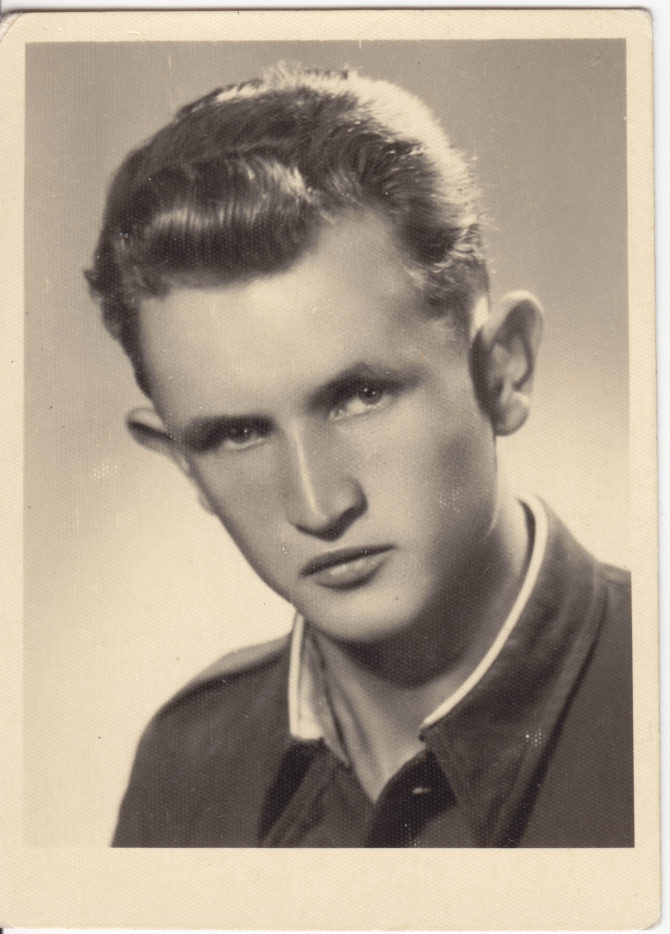
Life dates
The life of the author in stations
These details come from the manuscript, every single one of them from the chapter in which he tells it himself. The complete chronology of the family and everything that the volume records beyond him stands in the Register.
- Childhood
- Three years in Warschau, from 1936 in Działdowo
- War years
- From 1940 the German school in Płońsk, then the primary school in Łaszewo
- Loss
- In April 1944 the Gestapo takes the parents away; the father is shot in the forest
- After the war
- Five years in Zaborowo, from 1950 in Witkowo near Raciąż
- School-leaving examination
- 1951 at the grammar school in Raciąż
- Studies
- 1952 one semester of mechanical engineering in Warschau, then evening studies in Danzig (Gdańsk)
- Labour battalion
- 1 October 1953 to 20 December 1955, the “Rozbark” mine in Bytom
- Danzig shipyard
- From 1 May 1956 technical draughtsman in the design office, until retirement
- Wedding
- 30 May 1959 at the registry office, in church on 4 July 1959
- Volume
- 70 pages, signed in Baunatal in July 2012
- Died
- 22 February 2020 in Baunatal, at the age of 86
He was born as the second child of Adam and Władysława Bomert in Warschau, in the Hospital of the Infant Jesus. The family stayed three years in the city; in 1936 it moved to Działdowo, where the father took up bookbinding. In the summer of 1939, out of fear of the war, the father brought him and his sister Halina to the grandmother in Łaszewo. The years of the occupation he spent between Ćwiklinek, Łaszewo, Płońsk — where from 1940 he attended the German school — and Gralewo.
In April 1944 the Gestapo took the parents away. The father was taken to Nowy Dwór Mazowiecki and shot in the forest, the mother to Ravensbrück. In the spring of 1945 Aunt Julianna brought him and Halina to the grandmother in Konopki; in July the mother returned from the camp on a Sunday. Then followed five years in Zaborowo, a village without electricity, and the move to Witkowo near Raciąż. In 1951 he passed his school-leaving examination, in 1952 he began to study mechanical engineering at the Technical University in Warschau — he lasted one semester, in the second he gave up. For a year he helped his mother in trade and brought the goods alone to the big cities.
At the end of July 1953 the family moved to Danzig, mother and son found work in the shipyard. On 1 October 1953 he was called up and did not go into the army but into the labour battalion: until 20 December 1955 he carried bundles of timber underground in the “Rozbark” mine in Bytom, to the working face. After his return he began on 1 May 1956 as a technical draughtsman in the design office of the shipyard; later followed the evening studies of mechanical engineering at the Technical University in Danzig, and he practised the profession until retirement. On 27 May 1956 he met Teresa of the house of Chrobak at a school ball, while the white tango was played. In 1959 the two married.
Enclosure 4
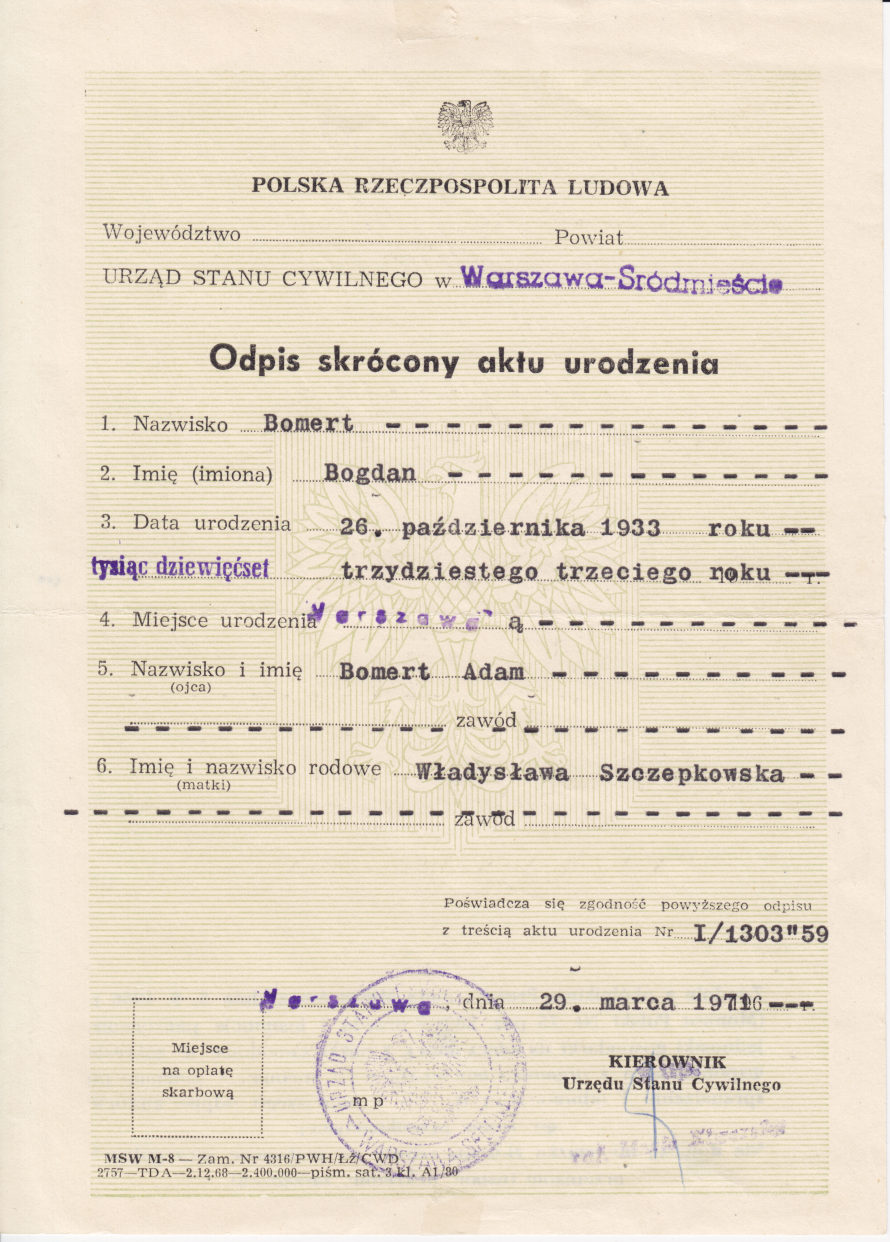
The certificate of his birth
The manuscript begins with the parents; the first certificate that concerns the author himself is the fourth of the enclosures. It already carries the name Bogdan — the name of his birth is named by his text alone.
Teresa's family
Who stands in the certificate of the bride
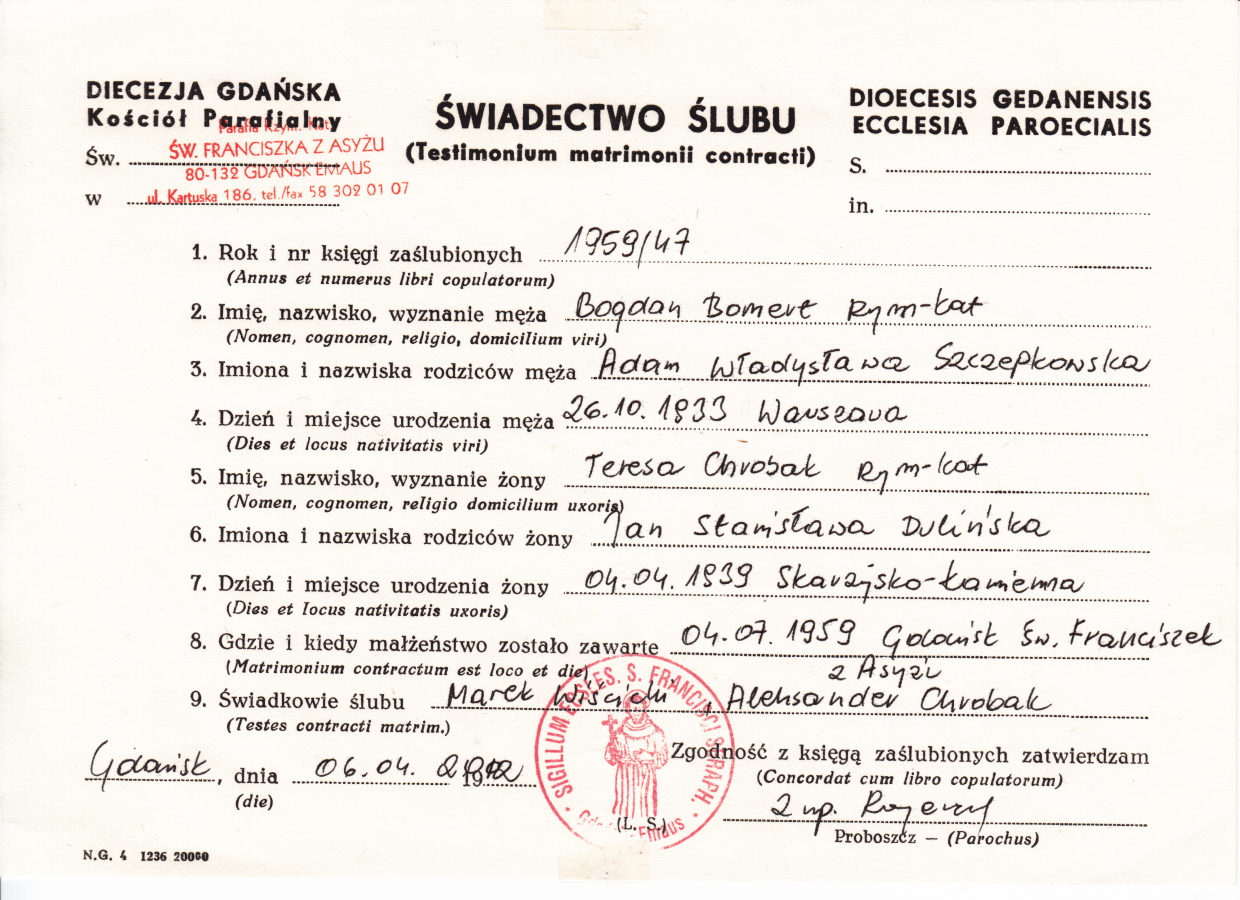
Teresa of the house of Chrobak is the woman whom the author met on 27 May 1956 at a school ball, when the white tango was played, and whom he married in 1959. About her origins his manuscript says almost nothing. The marriage certificate, however, which accompanies the volume as the eighth enclosure, names her parents. On the appendix page it stands as a facsimile; here stand its fields.
- Born
- 4 April 1939 in Skarżysko-Kamienna — barely five months before the war. What the handwriting of the certificate gives is to be read as „Skawińsko-Kamienna“; meant is the town on the Kamienna, 32 kilometres north of Kielce
- Parents
- Jan and Stanisława, née Dulińska; the family name of the bride — Chrobak — is borne by her father
- Married
- At the registry office on 30 May 1959, in church on 4 July 1959, both in Danzig
- Wedding church
- St Francis of Assisi — the parish that the manuscript calls only the „Pfarrkirche des Emaus-Viertels“ (parish church of the Emaus quarter)
- Marriage register
- Year 1959, number 47
- Witnesses
- Two names; the second — Aleksander Chrobak — bears the name of the bride, the first lies under the stamp of the parish
- First household
- With Teresa's parents: two rooms with kitchen, no bathroom, besides the young couple ten more persons
For a week after the wedding the two lived in Zakopiańska Street (ulica Zakopiańska), in the household of the mother and Gizela. Then they moved to Teresa's parents — Halina's jealousy of her Stasiu, writes the author, was the reason. The household into which the bride brought her husband was cramped: two rooms with kitchen, no bathroom, and besides the two of them ten more persons.
There are only a few places at which Teresa occurs in this volume at all, and none of them follows her family further. One falls in the autumn of 1959: when the mother regained her strength after the radiation treatment in Sopot, she helped „sowohl Teresa als auch Halina mit ihren Familien“ — the daughter-in-law and the daughter, each with her own.
both Teresa and Halina with their families.
The last occasion that the volume records for this marriage is its golden wedding: fifty years after the wedding, counted from the year of marriage 1959, thus in the year 2009. The recording that was to sound then the author made himself; it is described further down on this page. Who came out of this marriage and what became of the three families the volume no longer tells — that is the continuation that he expressly left to others. What this website has gathered about the children and the three households stands under The descendants.
What the certificate does not say. It names Teresa's parents, but no siblings and no date of her parents; nor does the manuscript follow the family of the bride beyond the wedding, and the place of her birth the manuscript names nowhere; it stands only in the handwriting of this certificate, which can be read as „Skawińsko-Kamienna“. Meant is Skarżysko-Kamienna on the Kamienna — the resolution that the family confirms, and the name under which the place register carries the entry. A second Teresa stands moreover already in the third chapter: in 1945 she sits at the table with Aunt Julianna in Konopki. The volume gives her no surname and does not connect her with the bride.
Gallery
The author in pictures
The following fourteen photographs stand singly in the chapters of this volume; the fifteenth, the image from the labour battalion, stands in the head of this page. Here they stand together in the order of the manuscript: as a child led by the aunt's hand, in the shop of Ćwiklinek, on the school benches of Łaszewo, in the circle of the siblings, in the school-leaving class, underground and as bridegroom. These are the fifteen image numbers in which the author himself can be seen.
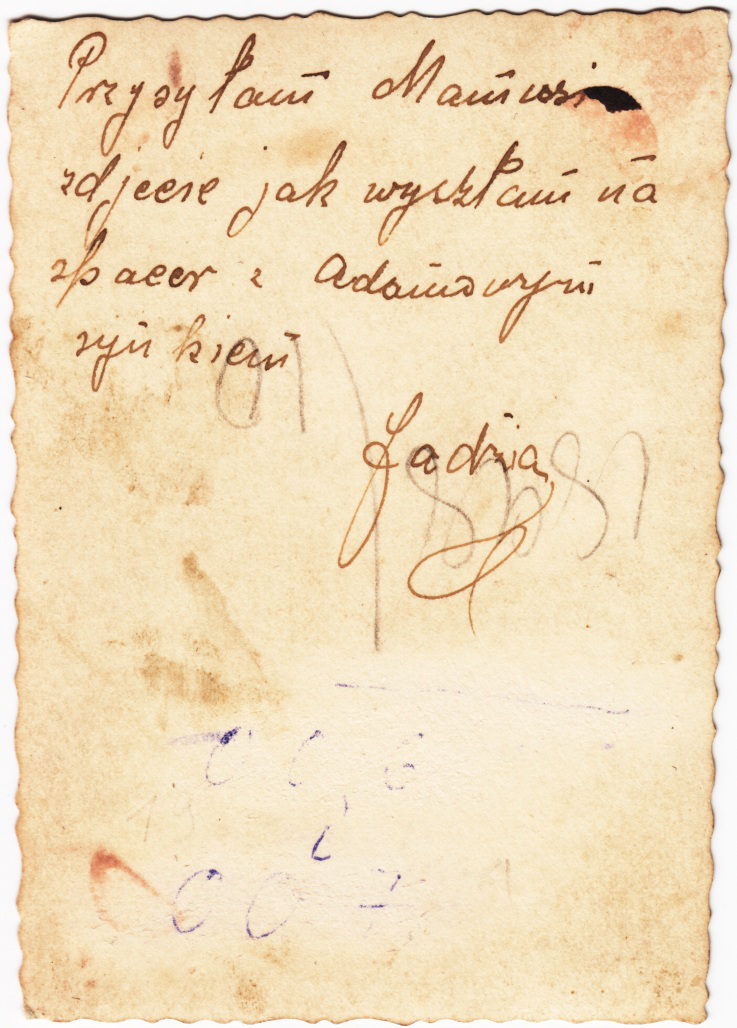
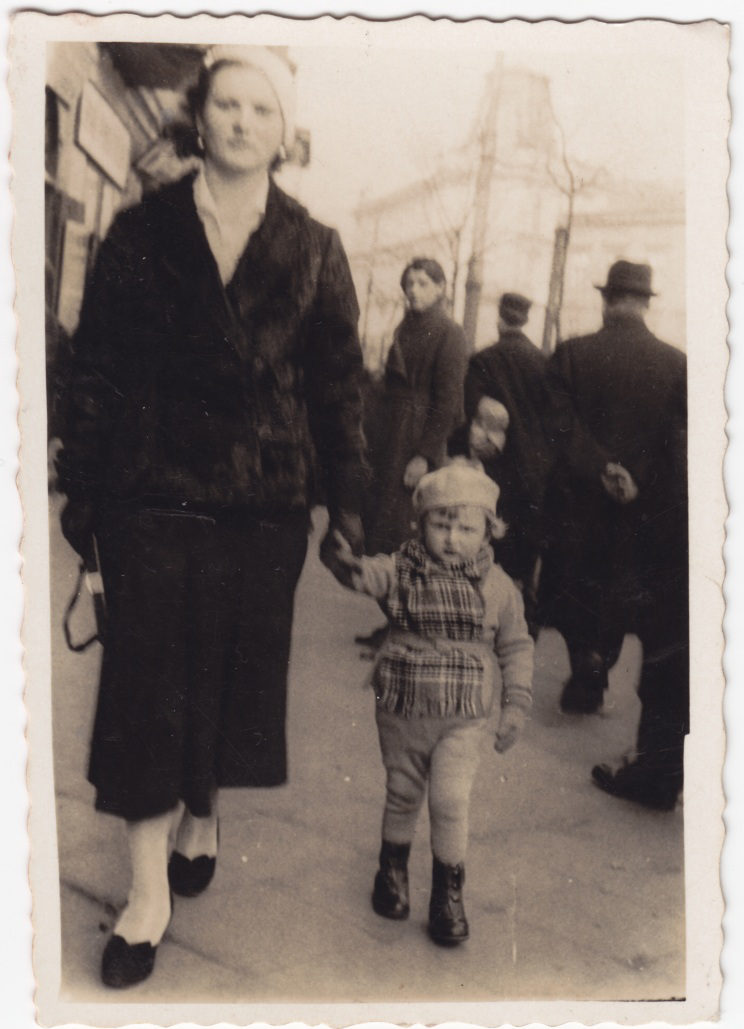
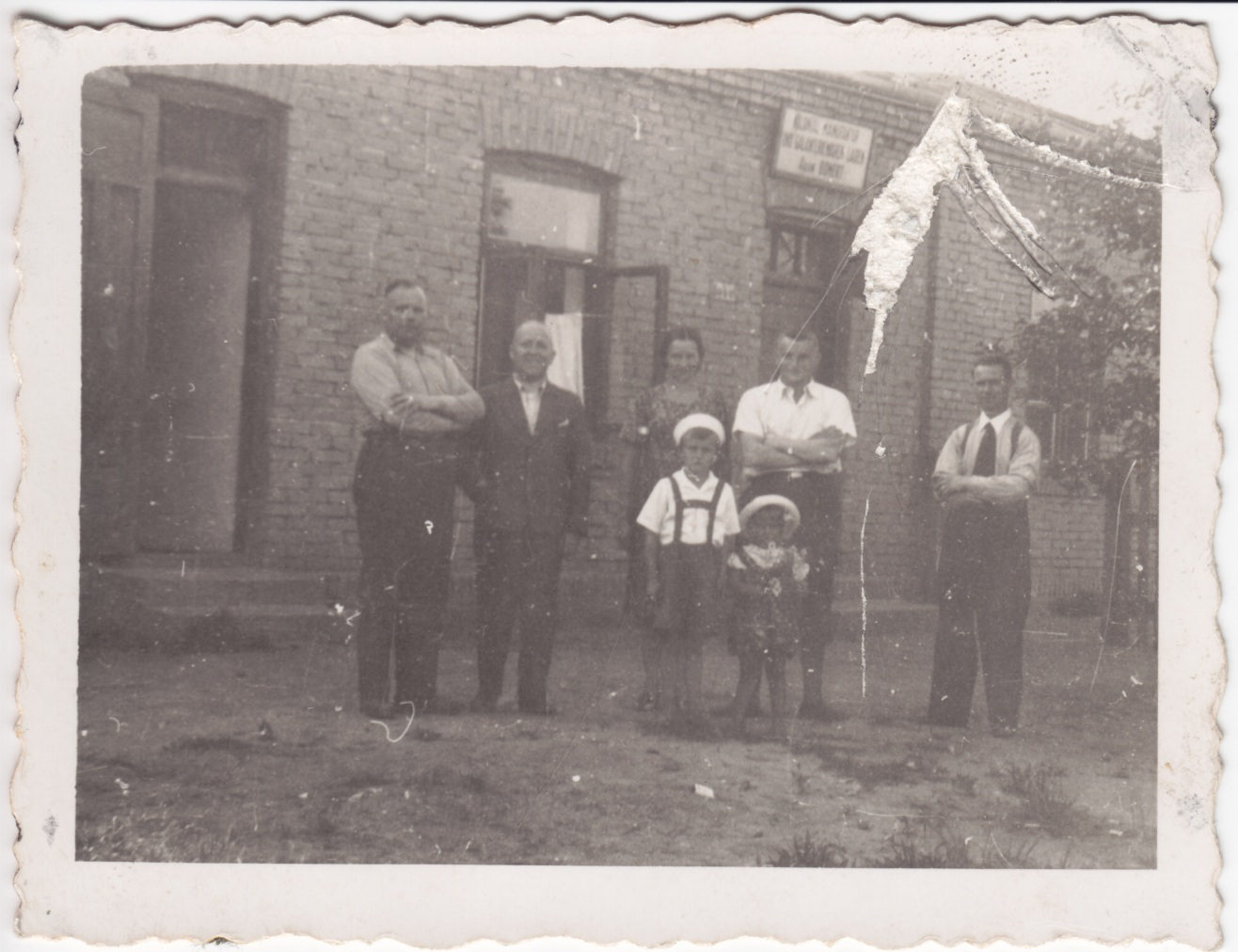
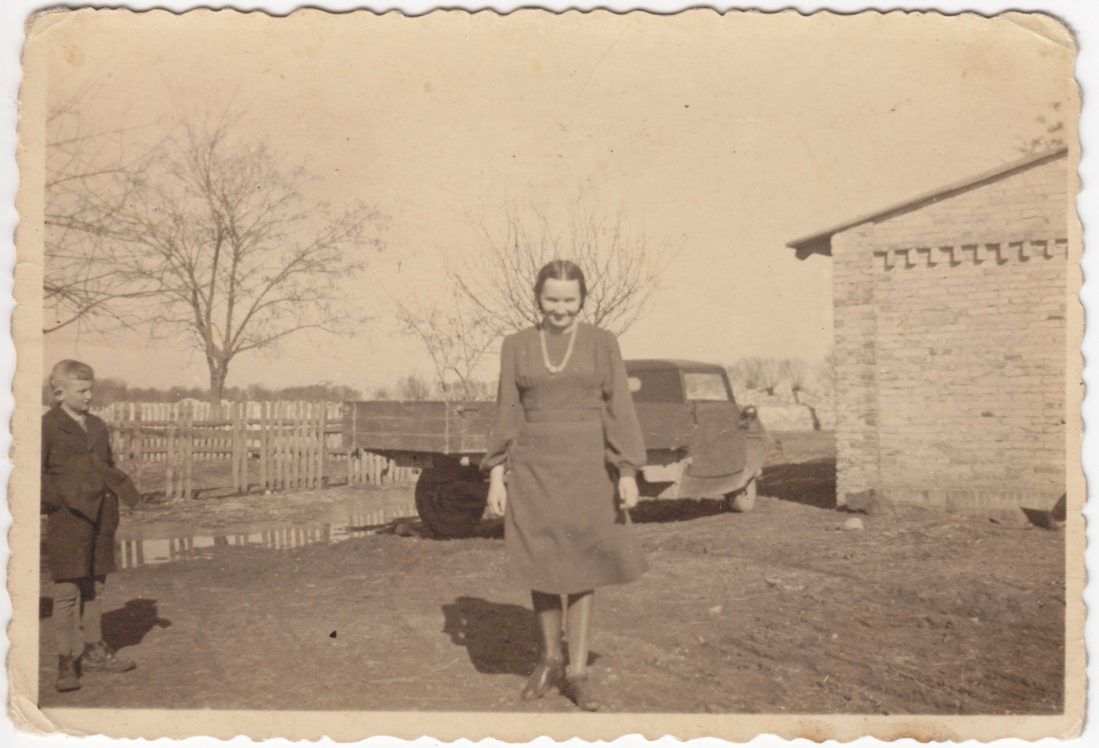
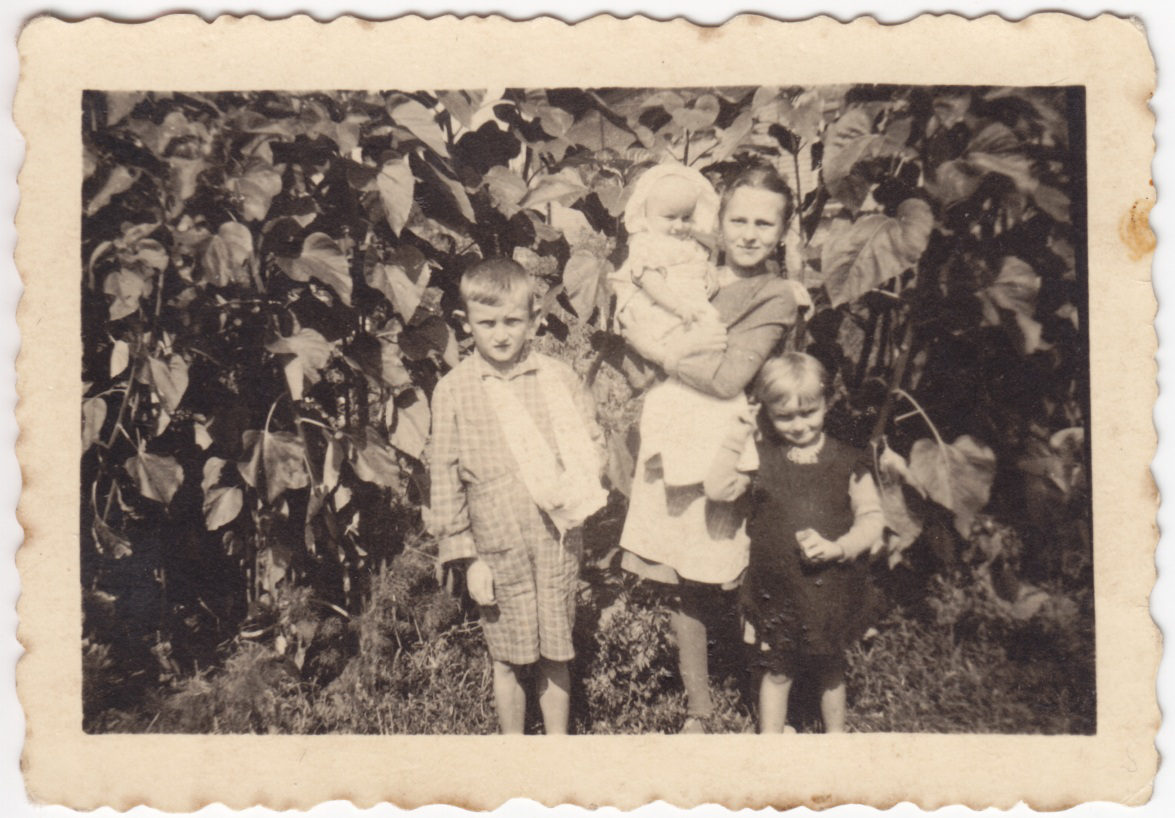
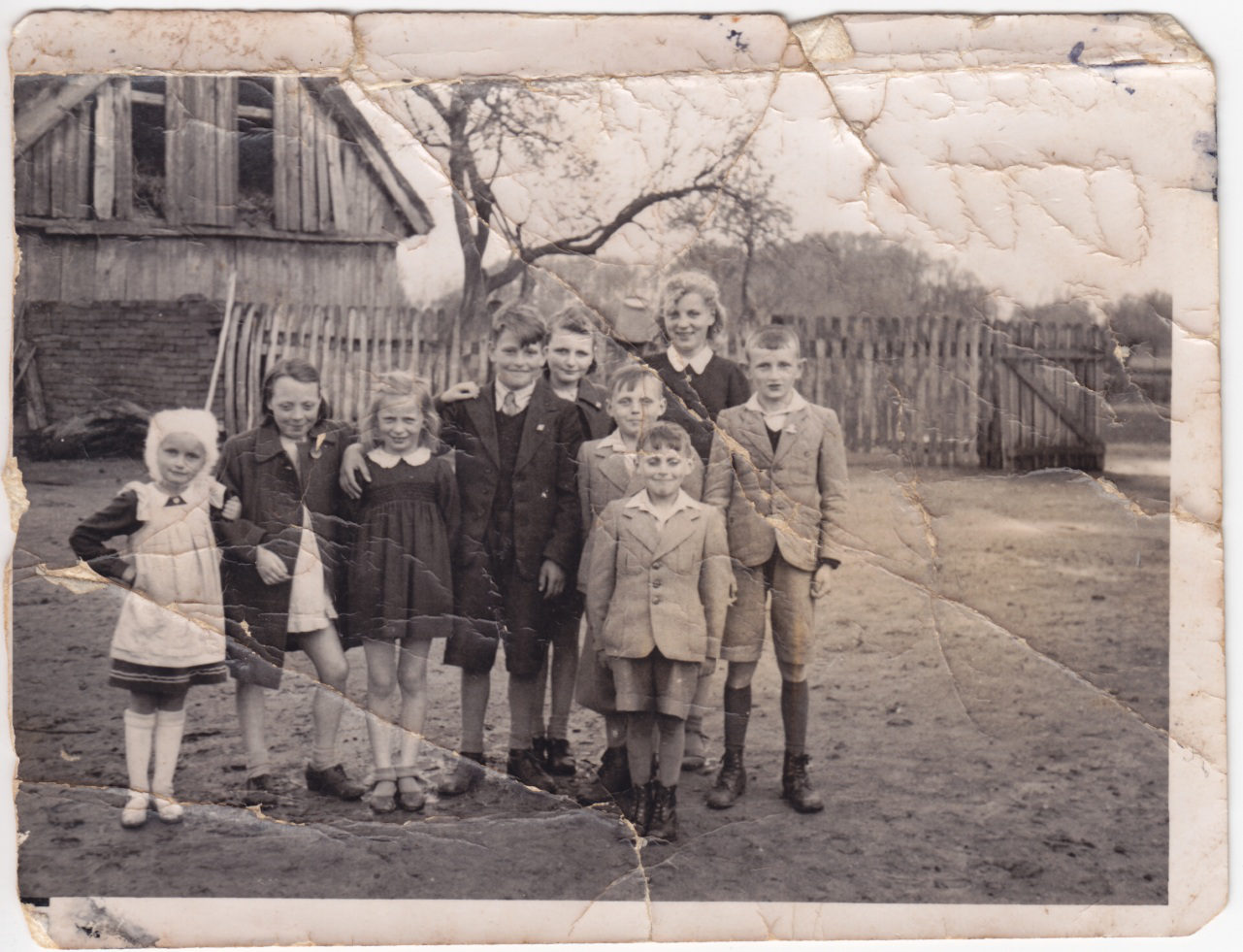
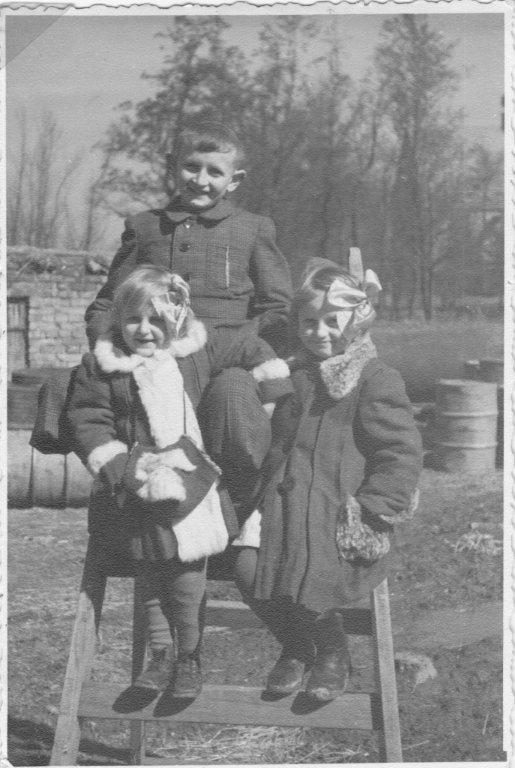
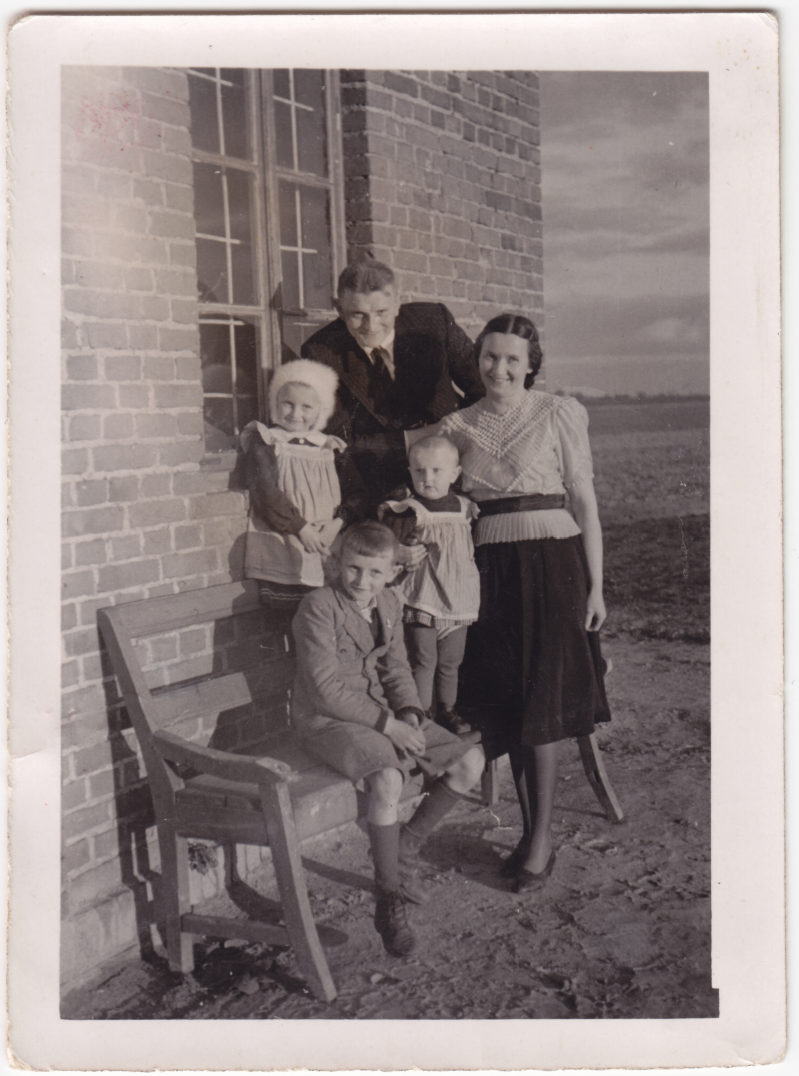
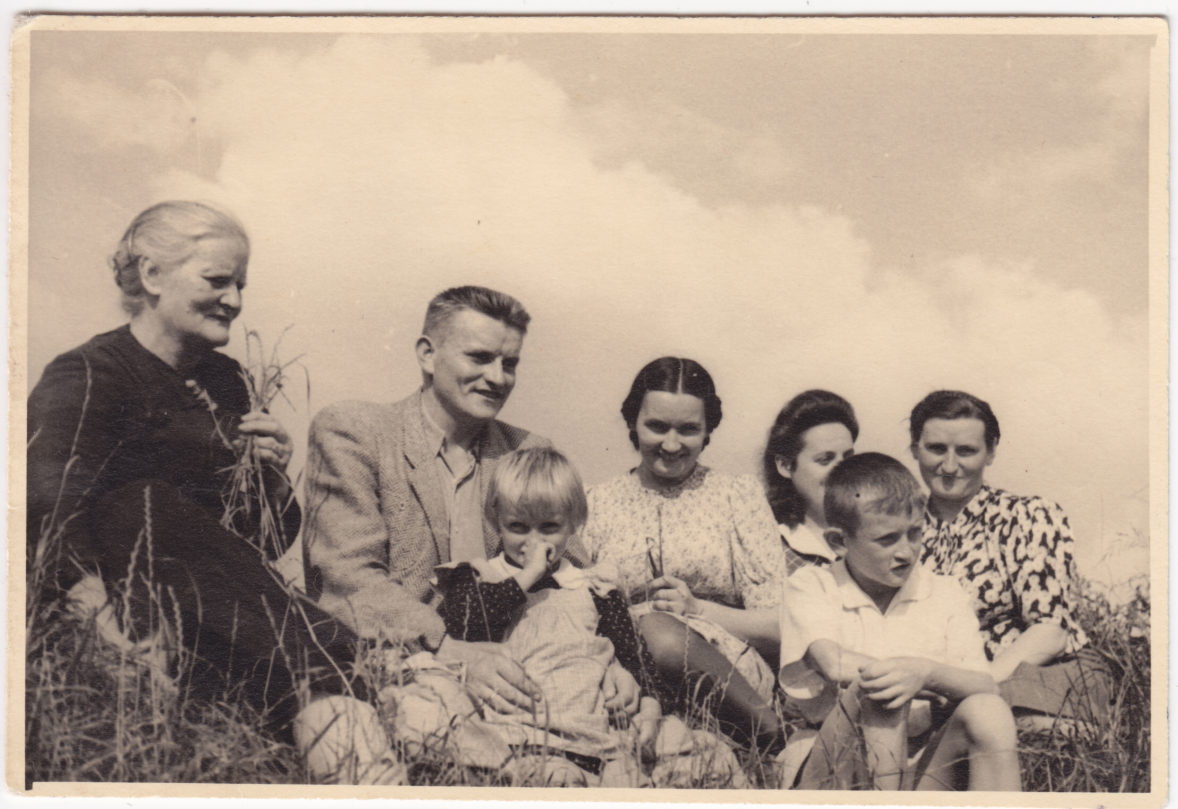
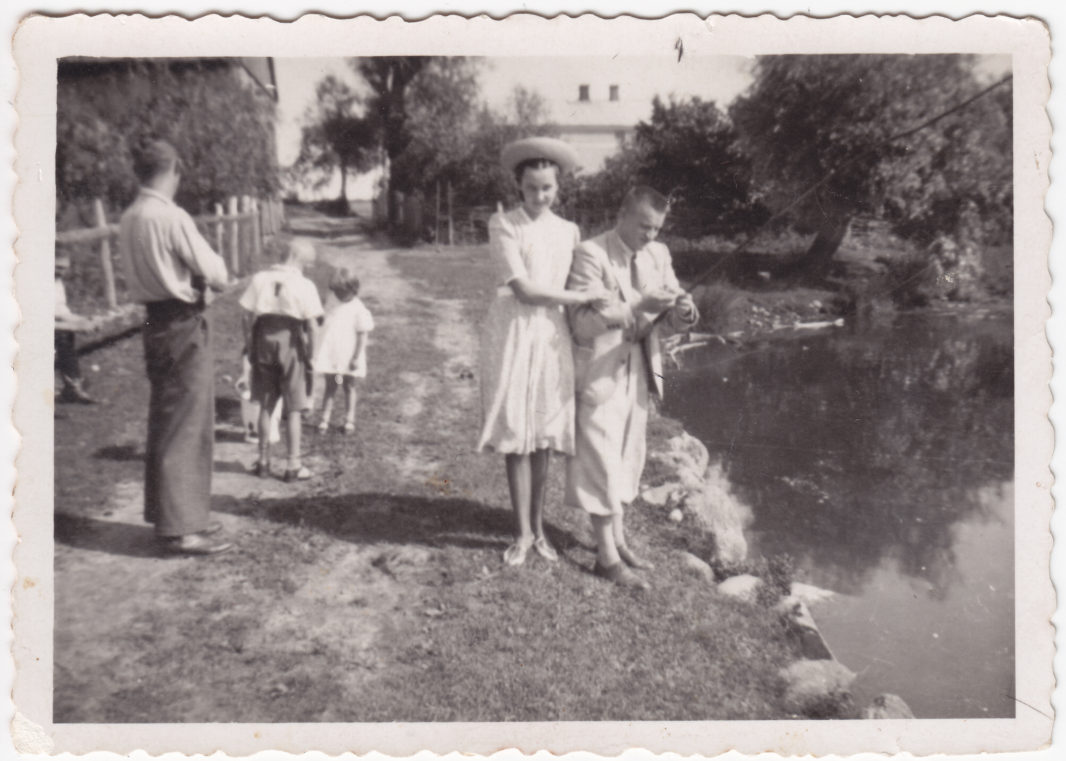
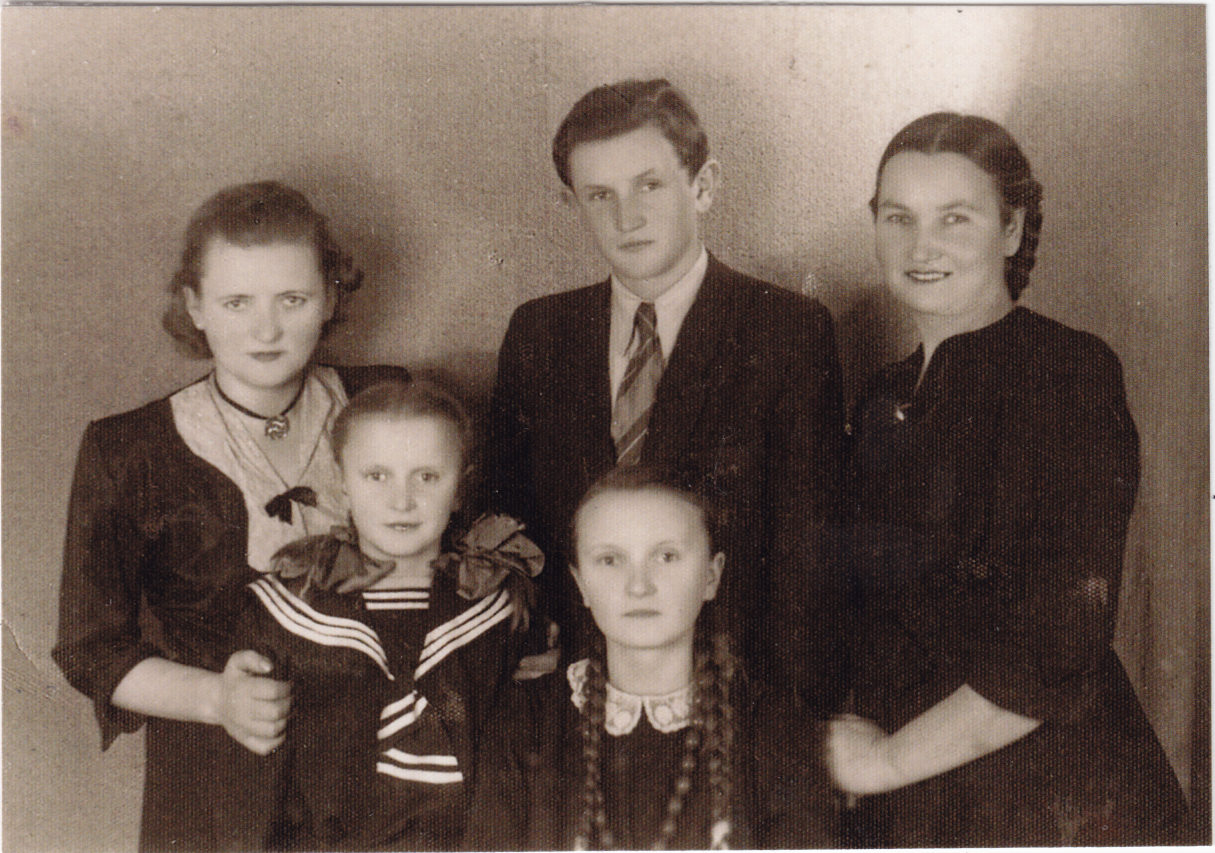
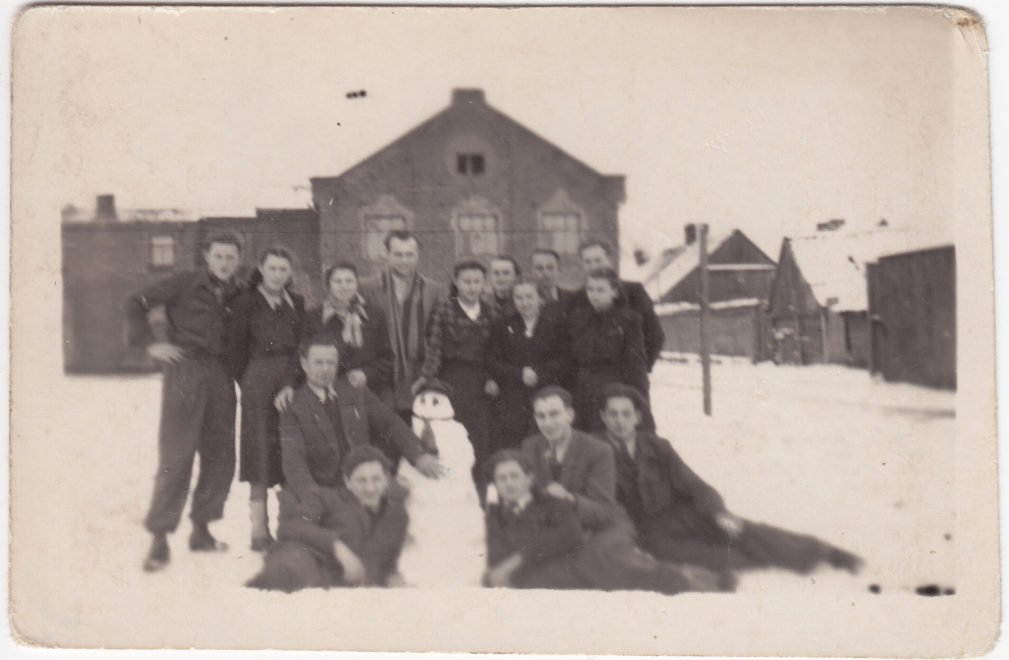
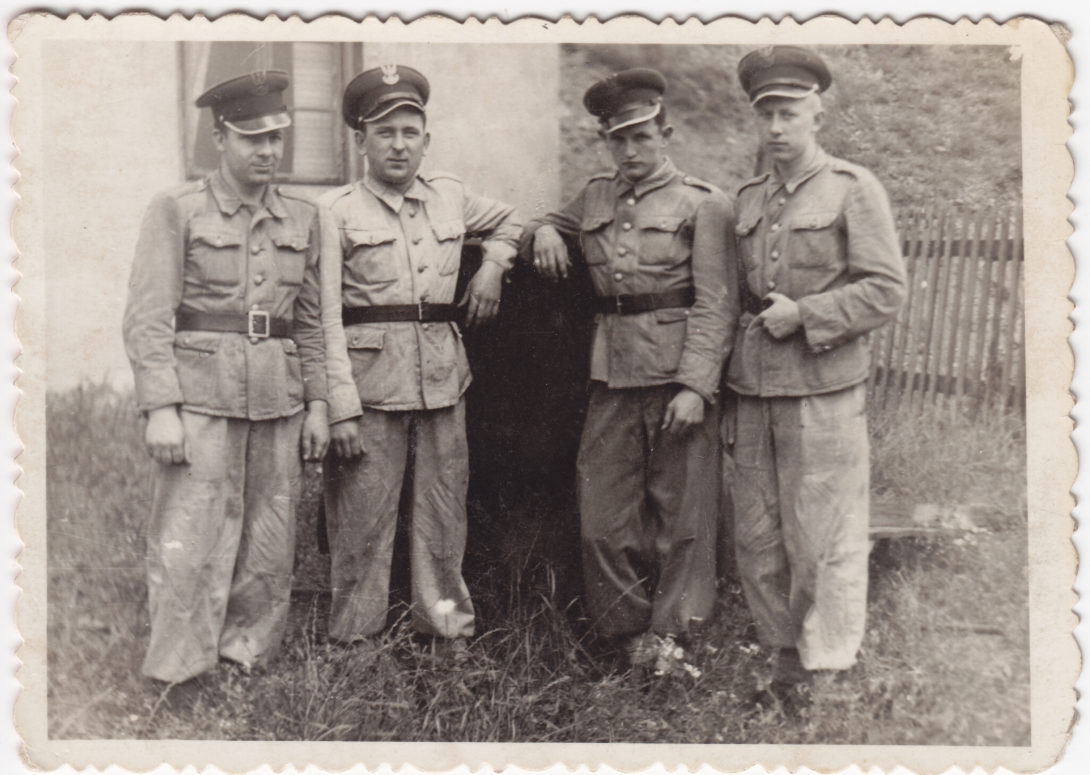
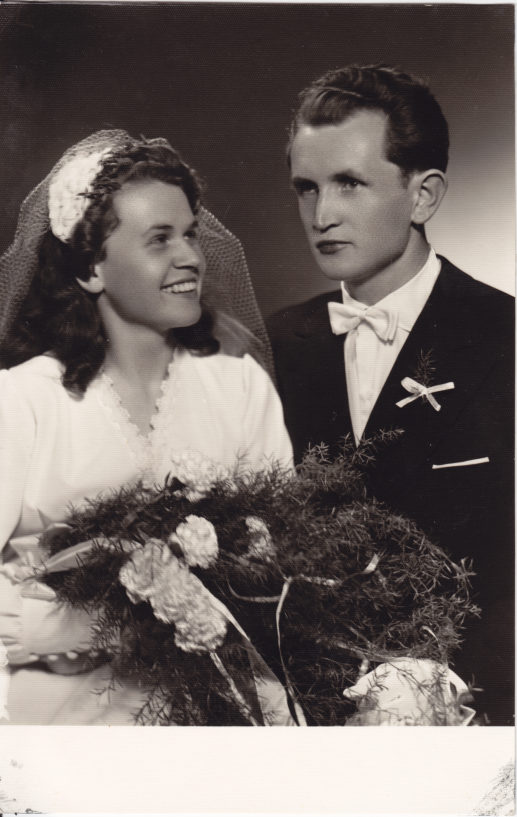
Where the images end. The most recent photograph in which the author can be seen was taken in 1959 at his wedding. From the sixty years after — profession, children, old age, Baunatal — the volume carries not a single image of him; the last photographs of the manuscript show his sisters and his brother-in-law. This page cannot close the gap. It names it, so that nobody takes the photographs for a selection.
His closing word
And then he asks for forgiveness
On the penultimate page of his manuscript the author draws the boundary of his own narrative. These are the last sentences he wrote; they stand here as he signed them.
Sollte ich in meiner Erzählung jemand oder etwas vergessen oder etwas anders dargestellt haben, als dies in Wirklichkeit passiert ist, dann bitte ich alle um Vergebung.
Das menschliche Gedächtnis (und meins allen voran) ist manchmal nicht sehr zuverlässig und das benutze ich als meine Entschuldigung.
Die weiteren Lose der drei Familien, das sind schon drei andere Geschichten. Vielleicht wird sich jemand dieser Aufgabe stellen.
Ich danke für Euer Verständnis.
Bogdan · Baunatal, Juli 2012
Should I have forgotten anyone or anything in my narrative, or have described something differently from the way it actually happened, then I ask forgiveness of you all. Human memory — and mine above all — is sometimes not very reliable, and that I use as my excuse. The further fortunes of the three families are already three other stories. Perhaps someone will take on this task. I thank you for your understanding.
One recording belongs to the volume, which is missing in the source itself. Enclosure 13 is the explanation of a song: „Die angehängte Aufnahme sollte während der goldenen Hochzeit von Bogdan und Teresa in der Dominikaner Kirche in Danzig abgespielt werden. Technische Schwierigkeiten ließen dies jedoch nicht zu.“ He recorded it at the age of 74, thus between October 2007 and October 2008. The sound recording is not enclosed with the PDF file; here too only the text has remained.
The attached recording was to be played during the golden wedding of Bogdan and Teresa in the Dominican Church in Danzig. Technical difficulties, however, did not allow this.
How this volume came into being. In March 2012 the author was still doing research himself: he travelled to Raciąż and spoke with the daughter of the local community head there, and on 21 March 2012 he photographed in Działdowo the house in which his parents had met. Four months later he signed in Baunatal.
In memoriam
Died on 22 February 2020 in Baunatal
- Day of death
- At the age of 86; the chronology carries him as the closing entry
- News
- From the family; everywhere it carries the note Nachtrag der Familie (family addendum) instead of a page number
- Left behind
- 70 pages of manuscript, four chapters, 34 image numbers, thirteen enclosures — the source of this website
Bogdan Bomert signed his volume in July 2012 in Baunatal, seventy-eight years old. Barely eight years later he died there. What he left the family is this text.
About the volume: author, source situation and open questions · Register and chronology from 1909 to 2020 · The descendants · Back to the overview