Chapter 3 · pages 28 to 40 of the manuscript
The end of the Second World War
„Ich weiß nicht warum, aber ich habe mir das Datum genau gemerkt, es war der 17. Januar 1945.“ (I do not know why, but I remembered the date exactly: it was 17 January 1945.) Between that day and the move to the Baltic coast lie five years in Zaborowo: poverty, a well, a round stove — and a mother who came back from the camp.
- Arrival
- 17 January 1945 in Łaszewo, from the direction of Radzanów
- Konopki
- spring 1945, probably in March — two days on foot
- The mother's return
- July 1945, on a Sunday, after a two-week way home
- Zaborowo
- probably October 1945 until the holidays of 1950
- Stations afterwards
- Witkowo 1950, school-leaving examination 1951, Technical University in Warschau (Warszawa) 1952
- Images
- Image no. 24a to 28
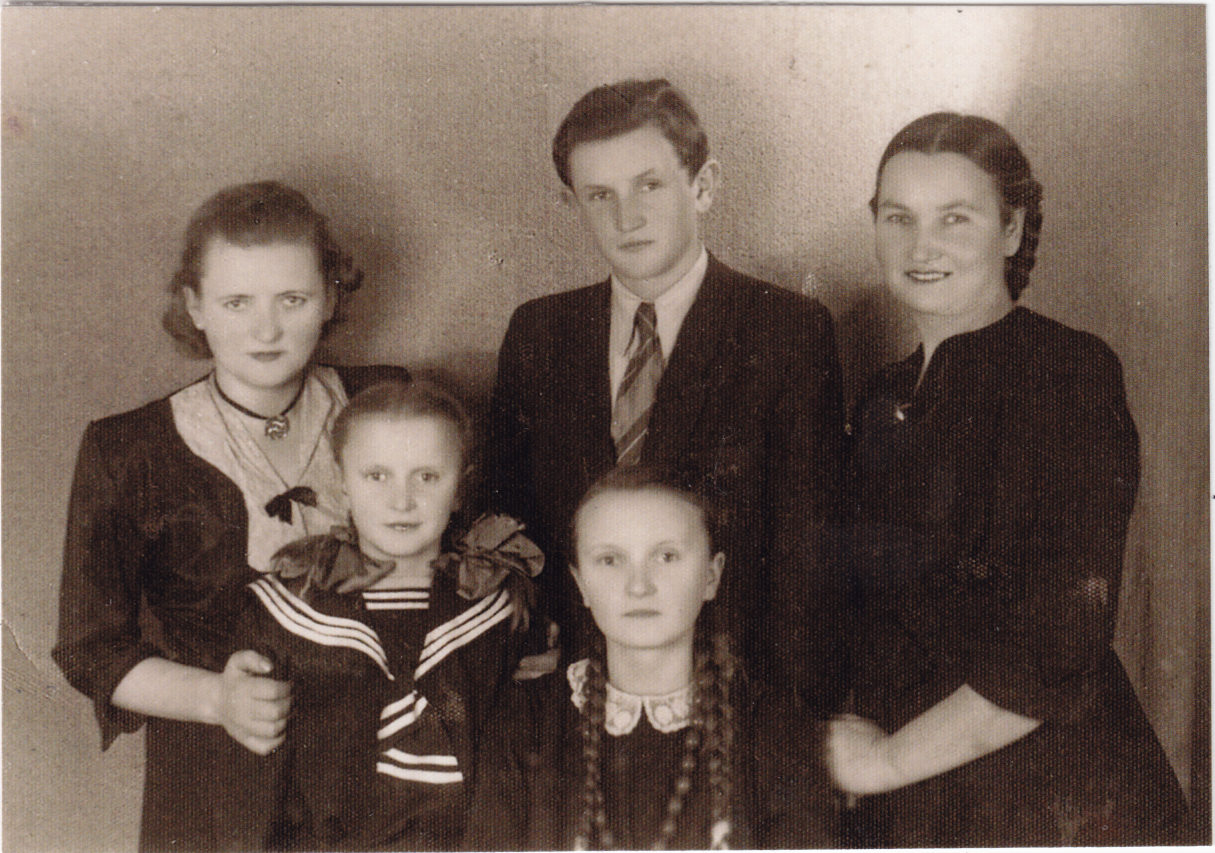
17 January 1945
The front comes through the village
Beforehand the grandmother had packed the valuable things into crates and brought them to Polish acquaintances in the neighbouring village. Then came the arrival of the Russians in Łaszewo. „Die Russen fuhren — bis an die Zähne bewaffnet — schnell durch, sie kamen aus Richtung Radzanów und fuhren weiter Richtung Siemiątkowo. Nach den ersten paar Wagen kamen einige Zeit später weitere.“ (The Russians drove through quickly — armed to the teeth; they came from the direction of Radzanów and drove on towards Siemiątkowo. After the first few wagons, more came some time later.)
A few soldiers stayed in the yard. „Sie nahmen ein junges Schwein, schnitten ihm die Kehle durch und fingen an, es auf einem langen Stiel wie auf einem Rost zu braten.“ (They took a young pig, cut its throat and began to roast it on a long pole as if on a grill.) A Russian officer took quarters in the house. Aunt Jadwiga was visiting, and because she was a beautiful woman the officer took a liking to her — „was dazu führte, dass die Soldaten sich zivilisiert benehmen mussten“ (which meant that the soldiers had to behave in a civilised way). Since everyone spoke Polish, the children were not treated as Germans.
After some time the soldiers moved on, and the house became the meeting place of the Kolm, Riemer and Bomert families. „Wir beteten und warteten voller Furcht, was kommen möge.“ (We prayed and waited full of fear of what might come.) For a time the children stayed with Aunt Irena in Siemiątkowo: „Dort stürmte nicht selten ein Russe mit einer Pistole in der Hand ins Haus und schrie: ‚kuda germaniec?‘, der also nach Deutschen suchte.“ (There a Russian not seldom stormed into the house with a pistol in his hand and shouted: ‘kuda germaniec?’, so he was looking for Germans.)
Then the rule of the Polish population began. „Haus und Hof unserer Oma übernahm die polnische Familie Wyrzykowski, und unsere Oma, Mutter von zwei Söhnen, die sie durch die Nazis verloren hat, musste in ihrem eigenen Haus als Bedienstete arbeiten.“ (Our grandma's house and farm were taken over by the Polish family Wyrzykowski, and our grandma, the mother of two sons whom she lost to the Nazis, had to work in her own house as a servant.)
Image no. 25
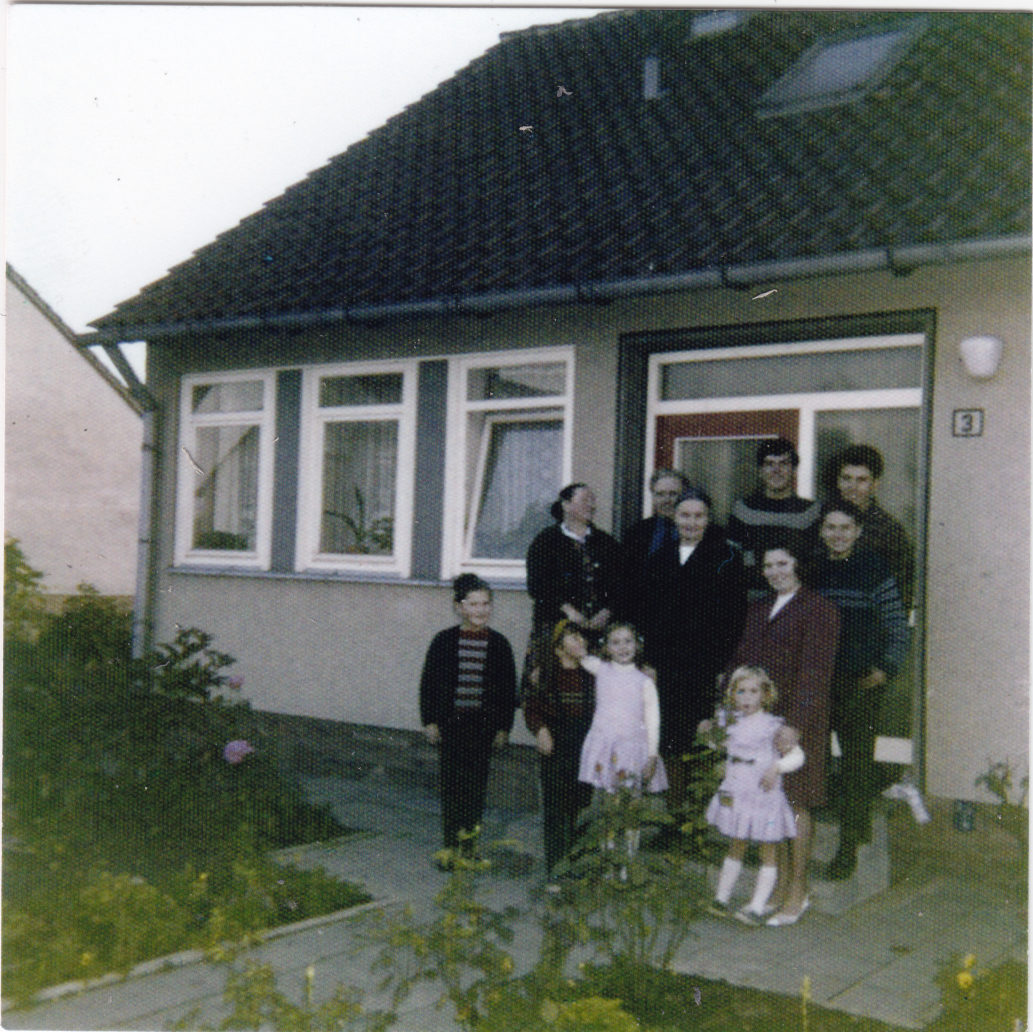
„An dieser Stelle möchte ich erwähnen, welche Konsequenzen das ‚menschliche‘ Verhalten während der Besatzungszeit hatte.“
The author in his commentary on page 28 — he sets two cases side by side that ended in the same village
At this point I should like to mention what consequences the ‘humane’ behaviour during the occupation had.
In the household of Aunt Irena in Siemiątkowo there worked a Polish family which took it over after the arrival of the Russians. „Sie haben die Tante nicht nur in Frieden gelassen, sondern ihr sogar geholfen. Sie gaben ihr Geld und brachten sie mit ihren Kindern zum Bahnhof in Raciąż, von wo sie nach Breslau fahren konnte. Von dort aus gelangte sie nach Deutschland.“ (They not only left the aunt in peace, they even helped her. They gave her money and brought her with her children to the station in Raciąż, from where she could travel to Breslau (Wrocław). From there she reached Germany.)
Another German woman treated her servants so badly during the occupation that after the arrival they beat her to death with spades. The author places the two cases side by side without a comment.
„Jede Familie in Łaszewo ereilte ein anderes Los.“ (Every family in Łaszewo met a different fate.) Aunt Jadwiga spent some time in a camp for Germans in Lublin. The Kolm family was sent for a few years to the camp in Łambinowice in southern Poland — „es war ein sehr hartes Lager, und viele Insassen haben den Aufenthalt nicht überlebt“ (it was a very hard camp, and many inmates did not survive the stay).
Shortly before
The crates in the neighbouring village
The grandmother had hidden the crates before the front passed through. What became of them the author does not tell — he tells only that the grandma worked as a servant in her own house after the war.
Spring 1945
„Oma Sabina versammelte, wie eine Glucke ihre Küken, alle ihre Kinder bei sich.“
Grandma Sabina gathered all her children around her like a hen gathering her chicks.
In the spring, probably in March, Aunt Julianna came to Łaszewo and took the author and Halina with her to Grandma Sabina in Konopki. Gizela stayed for the time being with Grandma Józefina. „Wir waren zwei Tage unterwegs nach Konopki. Das Wetter war gut, und so gelangten wir ohne Probleme ans Ziel.“ (We were two days on the way to Konopki. The weather was good, and so we reached our destination without problems.)
- At the table
- 15 persons, in a house with one room and a kitchen
- Present
- Aunt Stasia with Bernard and Marylka, Aunt Julianna with Teresa, Uncle Józef with Władka, the three Bomert children, Aunt Zosia and Uncle Kazik
- Draught animal
- an ox instead of a horse
- Bread
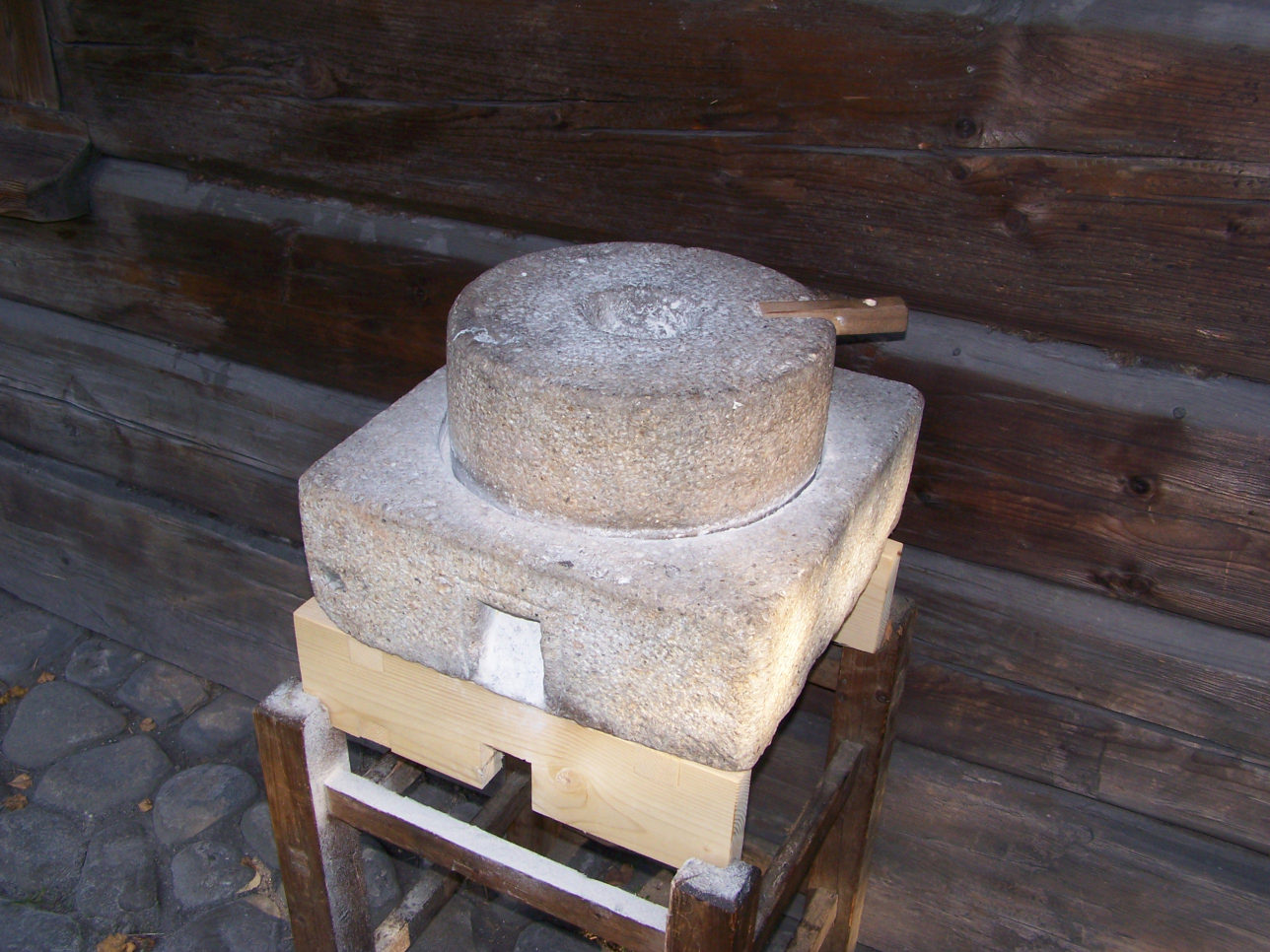
- the flour was ground with a millstone — two large stones, the upper one filled with grain, turned with a stick that hung from the ceiling above
- Spirit
- bimber from corn mash, up to 60 per cent, distilled at night by moonlight
- Heating
- peat cut by hand, driven by an ox through a two-metre-high machine
The peat was dug out with special spades near alders and birches — the land belonged to Grandma Sabina. „Es gab eine spezielle Maschine, die 2 m hoch war — wie ein großer Fleischwolf hochkant aufgestellt mit dem Auslauf nach unten —, angetrieben durch einen Ochsen. Der Torf wurde oben reingeworfen, und unten kam eine quadratische Schlange von 15 mal 15 Zentimetern raus. Man legte ein Brett drunter, schnitt es in Abständen von 60 Zentimetern ab — so dass es eine Person tragen konnte — und legte es ins Gras. Das trocknete dann in der Sonne, und im Winter hatte man kostenloses Heizmaterial.“ (There was a special machine that was 2 m high — like a large mincing machine set up on end with the outlet downwards —, driven by an ox. The peat was thrown in at the top, and at the bottom a square strand of 15 by 15 centimetres came out. One put a board underneath, cut it off at intervals of 60 centimetres — so that one person could carry it — and laid it in the grass. That then dried in the sun, and in winter one had free heating material.)
The path beside the grandmother's house was very sandy, „der Sand reichte bis zu den Knöcheln“ (the sand reached up to the ankles), and served the children as a playground and a pitch for ball games. „Jetzt ist da eine Asphaltstraße mit rasenden Autos. Das Haus steht nicht mehr. Das vernachlässigte Dach ist eingestürzt, und Onkel Antek, der Mann von Tante Zosia, hat das Haus abgerissen.“ (Now there is an asphalt road there with cars racing along. The house no longer stands. The neglected roof has collapsed, and Uncle Antek, the husband of Aunt Zosia, has torn the house down.)
From the first months after the war the author tells a scene that in a single sentence contains the whole climate of these months. In Konopki a barn was on fire, and out of curiosity he went there. When he came back, Grandma Sabina said: „Bogdan, wenn so was passiert, halt Dich fern, sonst behauptet noch jemand, ein Deutscher hätte es getan.“ (Bogdan, when something like that happens, keep away, otherwise somebody will claim a German did it.)
„Dennoch fühlten wir Kinder uns als Gruppe relativ frei in Konopki.“ (Nevertheless we children felt relatively free as a group in Konopki.) And then came the summer.
July 1945, on a Sunday
The return
„Ich war an den Eisenbahnschienen und schaute mir von weitem eine Hochzeit an. Onkel Józef kam zu mir und sagte, dass Mama wiedergekommen sei. Ich glaubte ihm nicht — in dem Glauben, er wolle mich nur nach Hause locken, um mir irgendeine Arbeit aufzubrummen. Als ich dann nach Hause kam, fand ich Oma Sabina bewusstlos auf dem Bett und die Mama saß neben ihr — sie war braun gebrannt und irgendwie klein. Ich hatte sie groß in Erinnerung, als sie verhaftet wurde.“ (I was at the railway tracks and from a distance I watched a wedding. Uncle Józef came to me and said that Mama had come back. I did not believe him — believing that he only wanted to lure me home to lumber me with some work. When I then came home, I found Grandma Sabina unconscious on the bed and Mama sitting beside her — she was tanned brown and somehow small. I remembered her as tall when she was arrested.)
„Unsere Freude kannte keine Grenzen. Mama hatte nur eine kleine Tasche, und in den Pulli war auf dem Rücken ein großes Kreuz eingenäht.“ (Our joy knew no bounds. Mama had only a small bag, and in the jumper a large cross was sewn into the back.) From this the author draws a balance that goes beyond his own case: „Ich danke Gott bis heute für die Rückkehr unserer Mutter. Wäre sie nicht wiedergekommen, dann hätten wir nichts zu lachen gehabt. Als Kinder einer Deutschen und ohne Mutter hätte sich niemand um unsere Zukunft gesorgt. Von einem Abitur und dann einem Studium hätten wir nur träumen können.“ (I thank God to this day for the return of our mother. Had she not come back, we would have had nothing to laugh about. As the children of a German woman and without a mother, nobody would have cared about our future. Of a school-leaving examination and then a course of studies we could only have dreamt.)
„An einem der Rastplätze versteckte sich Mama mit einer anderen Gefangenen aus Kwidzyn in einem Toilettenhäuschen — die aus Holz mit einem Herz in der Tür. Auf einmal öffnete eine SS-Frau die Tür und sah die erschrockenen Frauen an, doch statt sie zu erschießen, schloss sie die Tür und zog mit dem Lager weiter.“
The way home from Ravensbrück, as the mother told it · Manuscript, page 31
At one of the resting places Mama hid with another prisoner from Kwidzyn in a privy — the wooden kind with a heart in the door. Suddenly an SS woman opened the door and looked at the frightened women, but instead of shooting them she closed the door and moved on with the camp.
When the Russian front came closer, the camp was evacuated, and all the prisoner women set off westwards, surrounded by SS women. After the hiding place the two women sought shelter on a country estate, where they waited for the end of the war until 9 May. „Die guten Menschen auf diesem Landgut sorgten dafür, dass Mama nicht sofort anfing, viel zu essen, und langsam ihre Kräfte wiedergewann.“ (The good people on this estate saw to it that Mama did not at once begin to eat a lot, and slowly regained her strength.) After that followed a further march eastwards, until they came upon trains — mostly goods trains with open flat wagons. „Alles in allem brauchte Mama zwei Wochen, um nach Konopki zu gelangen.“ (All in all Mama needed two weeks to reach Konopki.)
Summer 1945
The departure from Konopki
Since there were many children in Konopki, quarrels were never far off. „Die Kinder haben sich gestritten, die Eltern dieser Kinder auch, und der Ärger war vorprogrammiert. Nach einem dieser Streite sagte Mama zu uns: ‚Kinder, was wollen wir hier, wir ziehen weg.‘“ (The children quarrelled, the parents of these children too, and the trouble was programmed in. After one of these quarrels Mama said to us: ‘Children, what do we want here, we are moving away.’)
For this farewell the manuscript holds a second, harsher version — that of Gizela. She writes that the grandmother said while milking in the byre that they had to go, because the whole village was enraged: „Wir wären Deutsche und hätten kein Recht hier zu sein. Wenn wir hier blieben, würden sie uns verbrennen und ermorden.“ (We were Germans and had no right to be here. If we stayed here, they would burn and murder us.) Gizela adds: „Ich erinnere mich bis heute daran und danke unserer Oma, dass durch uns nicht mehr Menschen ermordet wurden.“ (I remember it to this day and thank our grandma that through us no more people were murdered.)
The author sets against this what Aunt Julianna said in Danzig (Gdańsk): it had not been like that, and the grandmother had not thrown them out. He himself records that a four-and-a-half-year-old Gizela could hardly remember it so exactly — „oder vielleicht doch?“ (or perhaps she could after all?). Here too he leaves both versions standing.
The next day they went to the station. „Beim Aufsteigen auf den Wagen — eine einfache Plattform — habe ich unglücklich mit der Tasche dagegen gehauen, so dass die Thermosflasche kaputt gegangen ist.“ (While climbing onto the wagon — a simple platform — I unfortunately hit it with the bag, so that the thermos flask was broken.)
- Konopki → NasielskDeparture on an open platform, change for Raciąż.
- One nightOvernight stay with a priest they knew; from him the father had rented the house in Gralewo.He had formerly been a priest in Gralewo.
- On footThe way to Gralewo, with a stop in Złotopole, one kilometre before the village.
- ZłotopoleRenting a kitchen — one bed, one table, four persons. The mother travelled to Płońsk, where Mrs Czekalińska lent, or rather gave, her 3000 złoty.„Damals war das viel Geld.“ (Back then that was a lot of money.)
- ŁódźPurchase of sewing threads, silk scarves and other things; the son went from house to house and tried to sell the goods.
At that time what tasted best to them was „das Brot aus Gralewo“ (the bread from Gralewo). When the mother was away, the author cooked potatoes and dressed them with a piece of bacon the size of a fingernail — „das war dann unser Mittagessen“ (that was then our lunch).
Once Aunt Karola, the wife of Uncle Heniek, came to visit with her sister while the mother was away. „Ich glaube, dass sie uns mitnehmen wollten, um Polen zu verlassen. Da Mama aber nicht da war und sie keine Zeit hatten zu warten, gingen sie wieder. Wäre Mama zu Hause gewesen, hätte uns vielleicht ein ganz anderes Los ereilt.“ (I believe that they wanted to take us with them in order to leave Poland. But since Mama was not there and they had no time to wait, they went away again. Had Mama been at home, perhaps a quite different fate would have befallen us.)
School
Two days in a Polish school
In Gralewo the author attended a Polish school again. „Bei einem Diktat habe ich einmal auf einer halben Seite ca. 30 Fehler gemacht — manchmal mehrere pro Wort.“ (In one dictation I once made about 30 mistakes on half a page — sometimes several per word.)
At that time one of the servants from the parents' shop, a teacher by profession, became a teacher in the neighbouring village. She took him in so that he could go to school. „Nach zwei Tagen in einer polnischen Schule kam ein Mann in die Schule und sagte, er würde es nicht zulassen, dass sein Sohn in einer Bank mit einem Deutschen sitzen würde. Also musste ich die Schule verlassen.“ (After two days in a Polish school a man came into the school and said that he would not allow his son to sit on a bench with a German. So I had to leave the school.)
The next school was one on a large country estate in Kaczorowy. He entered the 5th class and was moved up to the 6th in the same school year, which he finished in 1946. „Da viele polnische Kinder während der Besatzungszeit keine Schule besucht haben, saß ich in der Nachkriegszeit mit 18- und 20-Jährigen in einer Klasse. Das, was sie konnten und taten, war für mich uninteressant.“ (Since many Polish children did not attend a school during the occupation, in the post-war period I sat in a class with eighteen- and twenty-year-olds. What they could do and did was uninteresting to me.) The teacher was Mrs Święcka, whose husband had once bred the father's pigeons in Gralewo.
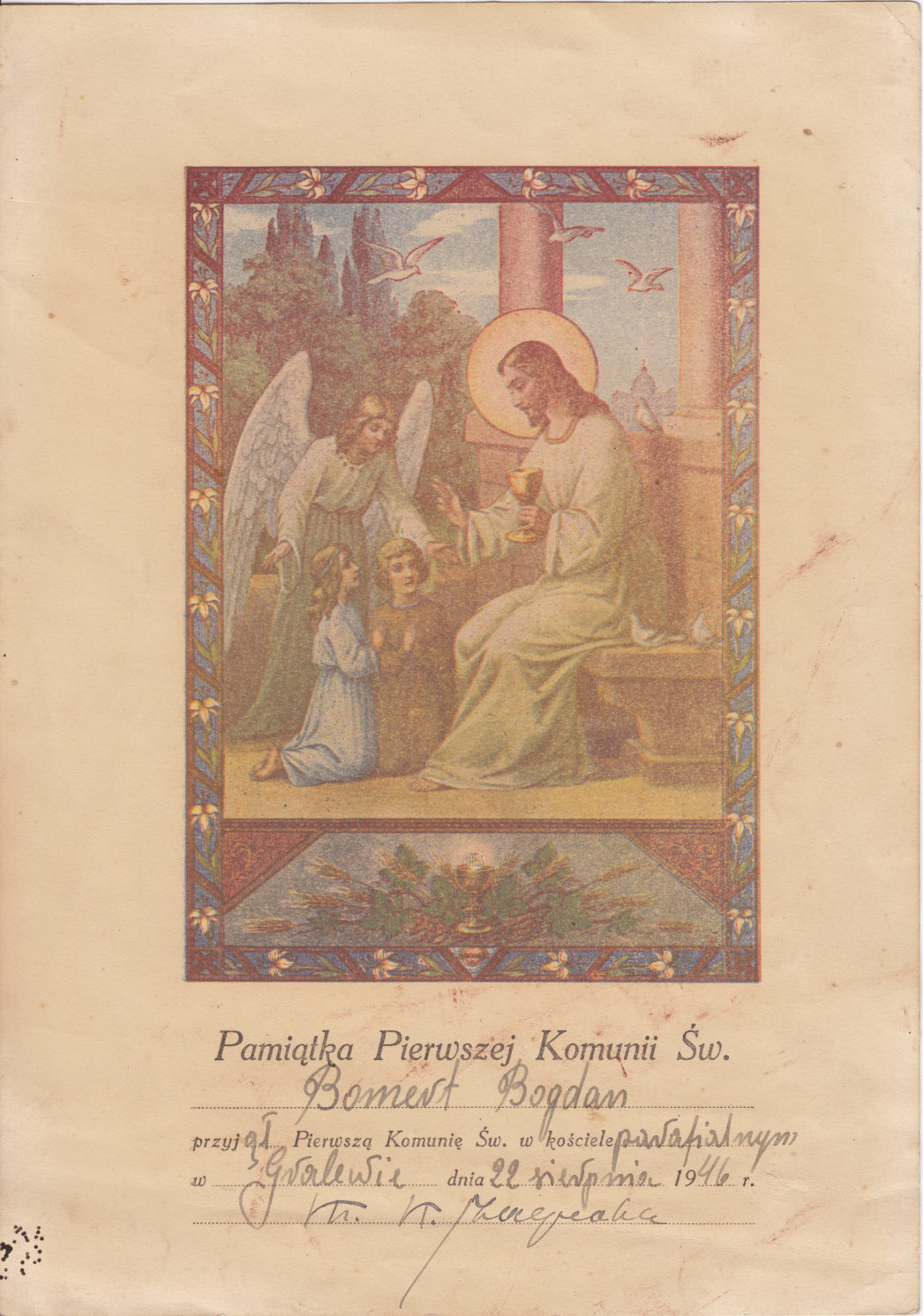
On 22 September he went to his First Holy Communion in Gralewo. „Auch Halina und Gizela gingen in der gleichen Kirche zur Kommunion, jedoch gibt es keinerlei Andenken an diese Ereignisse.“ (Halina and Gizela too went to Communion in the same church, but there are no mementoes of these events whatever.)
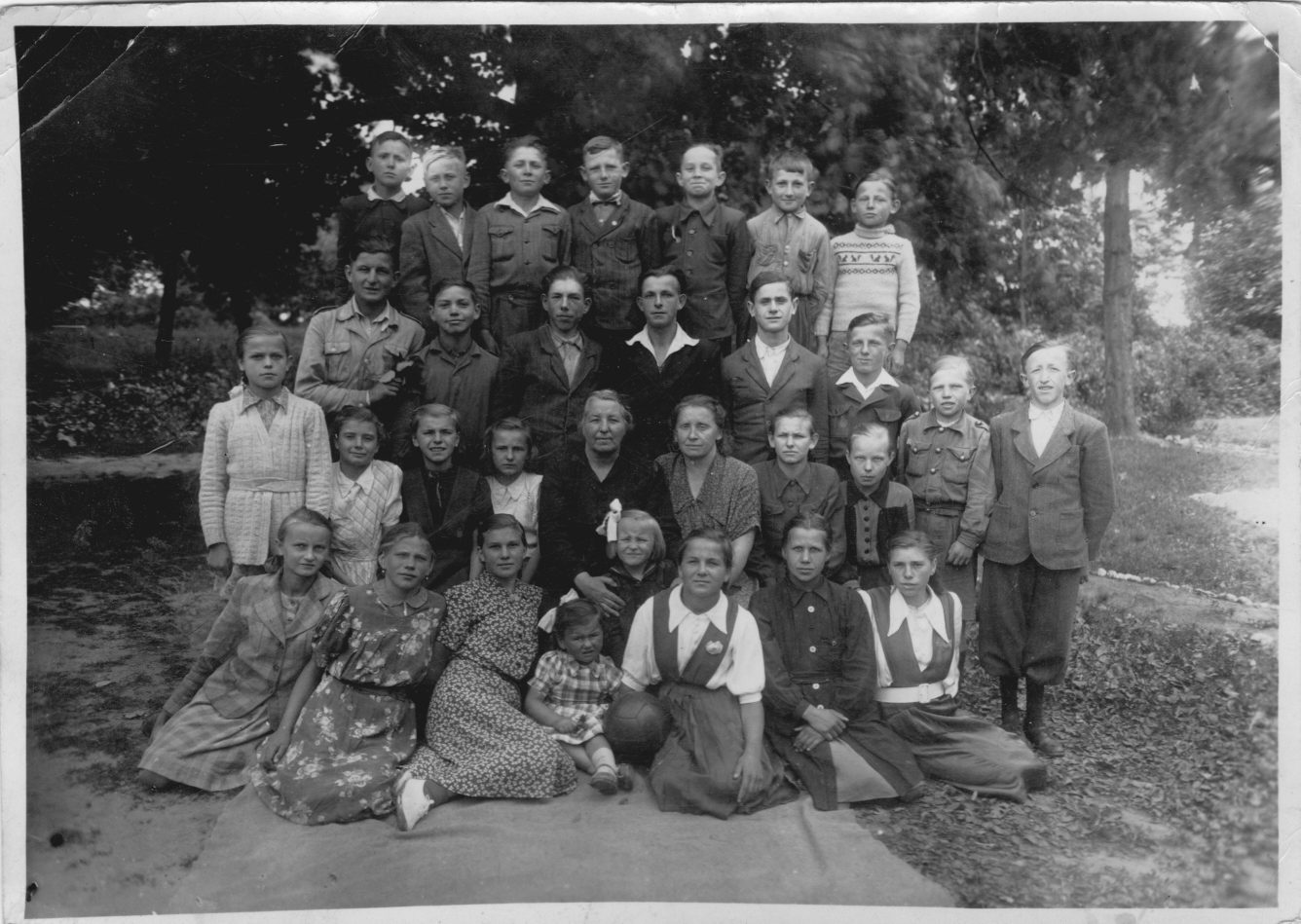
Zaborowo · probably from October 1945
Five years in a wooden house
„Zaborowo ist ein kleines Dorf mit nur einigen Häusern, etwa 5 km sowohl von Gralewo als auch von Raciąż entfernt. Dort verbrachten wir fünf Jahre — gute und schlechte. Gute, weil unsere liebe Mama mit uns war. Schlechte, weil wir oft allein waren und am Anfang sehr am Hungertuch nagten.“ (Zaborowo is a small village with only a few houses, about 5 km from both Gralewo and Raciąż. There we spent five years — good ones and bad ones. Good, because our dear Mama was with us. Bad, because we were often alone and at the beginning we went very short of food.)
Everyday life
Market journeys, well water, a round stove
The year 1946 was very hard for the family, for the mother especially. In Gralewo the father had seen to it that she did not have to cook; Aunt Zosia looked after Halina and Gizela, a servant looked after the household. „Jetzt musste Mama alles von Neuem lernen. Kochen und sogar Brot zu backen. Der erste Versuch endete in einem Misserfolg.“ (Now Mama had to learn everything anew. To cook and even to bake bread. The first attempt ended in a failure.)
She began to travel to Raciąż and the surrounding area, where there were markets, bought eggs, butter, cheese as well as hens, cocks, geese and the like there and took them to Bromberg (Bydgoszcz), Posen (Poznań) and Stettin (Szczecin), „um es dort gewinnbringend zu verkaufen“ (in order to sell it there at a profit). She returned home either on Saturday evening or early on Sunday; on Monday she set off again. The author cooked and went to school. „Aber manchmal gab es nichts zum Kochen. Und manchmal aßen wir den ganzen Tag nichts. Lediglich abends brachten uns gute Menschen — ich weiß noch den Namen: Rokitniccy — einen Laib Brot und eine Kanne Milch.“ (But sometimes there was nothing to cook. And sometimes we ate nothing the whole day. Only in the evening did good people — I still know the name: Rokitniccy — bring us a loaf of bread and a jug of milk.)
In winter wood had to be gathered in the forest, for heating and for cooking. In the fine large room a small round stove served as a cooker and as heating — „und im ersten Winter auch als Beleuchtung“ (and in the first winter also as lighting). There was no water from the wall: it had to be brought up from a deep well with a bucket and a sweep. „Besonders im Winter war das schwer, da sich um den Brunnen herum durch das verschüttete Wasser Glatteis gebildet hatte und ein 12-jähriger Junge nicht viel Kraft hatte. Der Begriff ‚Bad‘ war mir damals fremd.“ (Especially in winter that was hard, since around the well the spilt water had formed a sheet of ice and a twelve-year-old boy did not have much strength. The word ‘bath’ was foreign to me then.)
There was no electricity and no radio, and no boredom either: in summer hide-and-seek on the big farmyard and gathering mushrooms — „bis zu 100 große Steinpilze nach einem Ausflug“ (up to 100 large ceps after one outing) —, in winter small sledges on which one stood with one's feet, shod with wire and steered with a long stick at whose end sat a larding needle.
The flight
In summer a glider landed near the village and shortly afterwards a biplane, a “Kukuruznik”. In the evening the author brought the pilot food from Raciąż by bicycle — „als Dank für das Essen hat er mich mitgenommen. Nach unserer Landung kamen gleich ein paar Jungs zu mir, um zu gucken, ob ich nicht die Hosen voll hatte vor Angst.“ (as thanks for the food he took me with him. After our landing a few boys came straight up to me to look whether I had not messed my trousers with fear.)
The herbs
„Unsere Mama war eine sehr schlaue Frau, sie sorgte nicht nur für genug Essen und eine gute Ausbildung, sondern auch für unsere Gesundheit.“ (Our Mama was a very clever woman; she saw to it not only that we had enough food and a good education, but also that we had our health.) In summer the children gathered herbs in order to use them in winter as a bath additive in a tin tub. „Unsere Haut hatte einen zarten Glanz, und trotz des mageren Essens kannten wir keine Erkältung oder Schnupfen — dank eben dieser Kräuter.“ (Our skin had a delicate sheen, and despite the meagre food we knew no cold or running nose — thanks to those very herbs.)
Parcels from America
„Eine Zeit lang bekamen wir Pakete aus Amerika von der Familie Rossol — das war der Onkel von Onkel August Schmalz, dem ersten Mann von Tante Jadwiga. Diese Pakete haben uns sehr geholfen, die Zeit der Armut zu überstehen. In einem der Pakete waren Schlittschuhe für mich — eine Freude für den ganzen Winter.“ (For a time we received parcels from America from the Rossol family — that was the uncle of Uncle August Schmalz, the first husband of Aunt Jadwiga. These parcels helped us very much to get through the time of poverty. In one of the parcels there were ice skates for me — a joy for the whole winter.)
About the neighbours the author writes a sentence that seems to surprise even himself: „Unsere Mitmenschen und die Kinder vor allem waren uns gegenüber sehr freundlich gesinnt. Sie behandelten uns wie normale Dorfbewohner und nicht wie ehemalige Deutsche. Dabei war Zaborowo doch nur 5 km von Gralewo entfernt, und alle wussten, wer wir dort gewesen sind und dass das vor nur eineinhalb Jahren war.“ (Our fellow men and the children above all were very kindly disposed towards us. They treated us like normal villagers and not like former Germans. Yet Zaborowo was only 5 km from Gralewo, and everyone knew who we had been there and that it was only a year and a half ago.) He sees the reason in the attitude of the parents: „Sie halfen damals vielen Menschen, wo sie es nur konnten.“ (At that time they helped many people wherever they could.) The death of the father through the Gestapo and the mother's stay in Ravensbrück had also contributed to it.
And about himself he notes at this point the least friendly thing that stands in this chapter: „Ich war schon in der 6. Klasse, und obwohl ich nicht zu den Schlauesten zählte, konnte ich zwei Sprachen. Mein Polnisch war schwach, dafür konnte ich perfekt Deutsch. Deshalb konnte ich kaum von jemandem etwas lernen. In diesem wichtigen Abschnitt meines Lebens hat sich meine Persönlichkeit eher wenig entwickelt. Ich war ein einfacher, primitiver Dorfjunge.“ (I was already in the 6th class, and although I did not count among the cleverest, I could manage two languages. My Polish was weak, but in exchange I could speak perfect German. That is why I could hardly learn anything from anyone. In this important section of my life my personality developed rather little. I was a simple, primitive village boy.)
But the evenings of these years belong to the best that the author wrote down at all: „Ich erinnere mich noch an die kuscheligen Abende, an denen wir zusammen mit Mama und satt vom Essen zuhörten, wie ich ‚Quo Vadis‘ vorlese.“ (I still remember the cosy evenings on which, together with Mama and full from the meal, we listened as I read out ‘Quo Vadis’.)
In Zaborowo they lived until the holidays of 1950. In this time Uncle Kazik and Józef visited them, Aunt Julianna from the mother's side and Aunt Jadwiga from the father's side.
1950 to 1952
Witkowo, the grammar school and the school-leaving examination
In the holidays of 1950 the family moved to Witkowo, about half a kilometre from Raciąż. The flat was not as comfortable as in Zaborowo, but the school was very close — the most important reason for the move.
The sisters would not have been able to reach the school from Zaborowo, and the school in Kaczorowy had only six grades. The author was already in the 11th class of the grammar school. As rent they had, apart from the money, sometimes to help the owner with the threshing.
„1951 habe ich das Gymnasium abgeschlossen und mein Reifezeugnis bekommen. Das Gymnasium in Raciąż — einer kleinen Stadt — hatte viele gute Lehrer.“ (In 1951 I finished the grammar school and received my school-leaving certificate. The grammar school in Raciąż — a small town — had many good teachers.) He names three of them and their effect. Prof. Borkowska, the Polish teacher, was an outstanding educationalist: „Dank ihr ist mein ärmlicher Wortschatz der polnischen Sprache stark gewachsen.“ (Thanks to her my poor vocabulary of the Polish language grew greatly.) Prof. Kisielińska was excellent in mathematics: „Dank ihr wurde mein Interesse für Mathe entzündet, obwohl ich nicht viel gelernt habe.“ (Thanks to her my interest in maths was kindled, although I did not learn much.) And Prof. Zalewski, the physics teacher, „hat uns gar nichts beigebracht“ (taught us nothing at all): „Man musste am Anfang der Stunde lediglich das Wort ‚Gewehr‘ in den Raum werfen, und die Stunde war hin, denn danach ging es nur noch um Gewehre.“ (One only had to throw the word ‘rifle’ into the room at the start of the lesson and the lesson was ruined, for after that it was only about rifles.)
For a year he helped the mother afterwards. „Auf den Markt fuhren wir gemeinsam, und die Waren brachte ich allein in die großen Städte. Die Mädels haben gelernt und gespielt.“ (We travelled to market together, and the goods I brought alone to the big cities. The girls studied and played.)
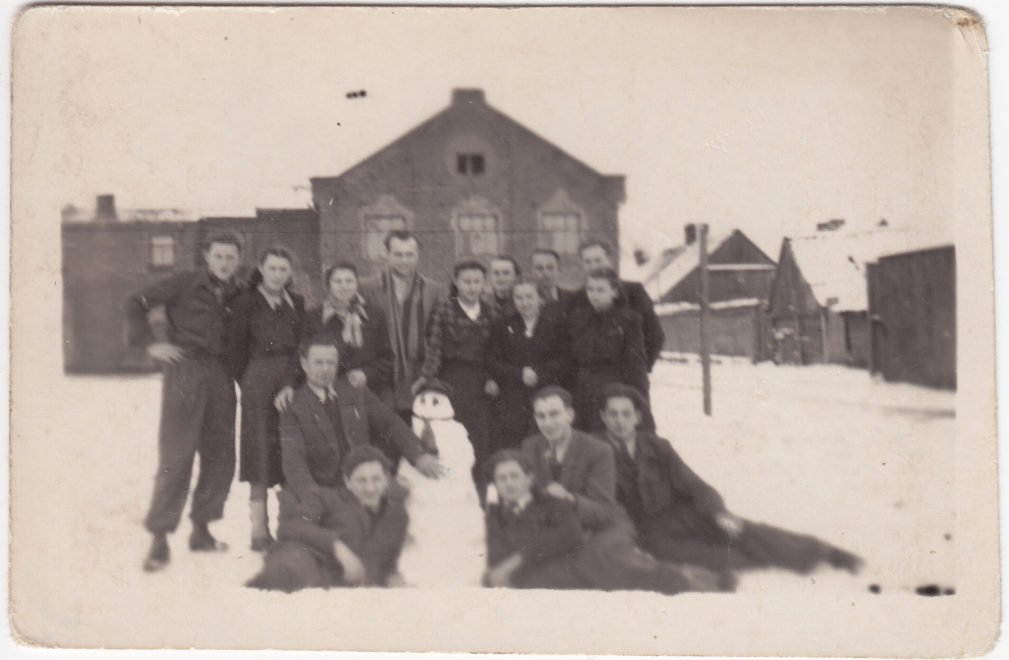
In 1952 he received a place to study mechanical engineering at the Technical University in Warschau (Warszawa) and moved into the student hostel at Grójecki Street no. 39. „Das erste Semester habe ich abgeschlossen, das zweite aber nicht geschafft, da ich nicht gelernt hatte — wie dumm von mir. Eigentlich habe ich schon in der Schule wenig gelernt. Ich wurde immer versetzt, weil ich ausreichend talentiert gewesen bin. Jetzt bereue ich das sehr!“ (I completed the first semester, but did not manage the second, since I had not studied — how stupid of me. Actually I had already learnt little at school. I was always moved up because I was sufficiently talented. Now I regret that very much!)
After the failed course of studies he returned home, and the mother decided that they would move to Danzig (Gdańsk). He also wrote down her reason: „Es gab in dem kleinen Ort Raciąż keine Zukunft mehr für uns, nachdem ich das Studium verbockt hatte.“ (There was no future for us any more in the small town of Raciąż, after I had messed up my studies.)