Chapter 4 · pages 41 to 48 of the manuscript
Life in Danzig
„Ende Juli 1953 fuhren wir nach Danzig.“ (At the end of July 1953 we travelled to Danzig (Gdańsk).) From Raciąż a mother comes to the Baltic coast with three children — and within three years there stand two marriages, a flat with a bathroom and a profession that lasts until retirement.
- Move
- At the end of July 1953, Danzig
- First positions
- Mother and son in the Danzig shipyard (Stocznia Gdańska): material issuing, tool department W-3
- Labour battalion
- 1 October 1953 to 21 December 1955, the “Rozbark” mine (Rozbark) in Bytom (Bytom), 660 metres deep
- Drawing office
- 6 January 1956 back in the shipyard, from 1 May 1956 technical draughtsman in the design department
- Marriages
- Halina 8 February 1958, Bogdan 30 May and 4 July 1959, Gizela 16 April 1966
- Death of the mother
- 30 March 1969
- Images
- Image no. 29 to 34
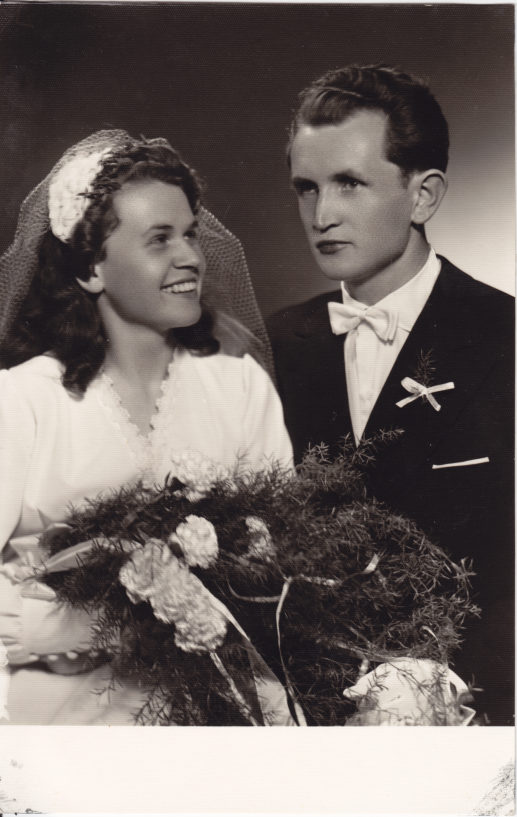
At the end of July 1953
Why Danzig of all places
The answer stands in the first sentence of the chapter: „In Danzig wohnte Tante Julianna und Onkel Stanisław Szczepkowski, Mamas Cousin; er arbeitete auf einem relativ hohen Posten in der Danziger Werft.“ (In Danzig there lived Aunt Julianna and Uncle Stanisław Szczepkowski, Mama's cousin; he worked in a relatively high position in the Danzig shipyard.) Anyone who had such a kinship and moreover a working position in prospect in the largest enterprise of the city moved to the Baltic coast and not into another village.
The author at first stayed briefly with Aunt Julianna, the mother with the girls with Uncle Szczepkowski in Okrąg Street. Then mother and son received positions in the Danzig shipyard — he in the general warehouse at the material issuing, she in the tool department W-3 at the tool issuing.
He moved into the Hotel “Narwik”, a workers' hotel near Nowy Port; the mother and her daughters came into a hotel in Jelitkowo (Sopot i Jelitkowo). Three months later, on 1 October 1953, the author was called up into the Polish Army.
- Kinship
- Aunt Julianna and Uncle Stanisław Szczepkowski, a cousin of the mother, in a leading position in the shipyard
- Arrival
- At the end of July 1953
- Work
- Mother and son in the Danzig shipyard
- Accommodation
- Son in the workers' hotel “Narwik” near Nowy Port, mother and daughters in Jelitkowo
- Call-up
- 1 October 1953
1 October 1953 to 21 December 1955
„Das klingt vielleicht schön — aber faktisch kam ich in das Arbeitsbataillon.“
That may sound nice — but in fact I came into the labour battalion.
Instead of military service the author had to work in the “Rozbark” mine in Bytom. He names the reason without beating about the bush: „der Grund war meine deutsche Vergangenheit“ (the reason was my German past). He also names his fellow conscripts: „Personen, die für Diebstahl oder Raub verurteilt worden waren, und junge Männer aus der tiefsten Provinz.“ (persons who had been sentenced for theft or robbery, and young men from the deepest province.)
„In den ersten Tagen nach der Einberufung dachten einige, als sie saubere, weiße Kloschüsseln sahen, dass sie sich darin waschen könnten! Es gab also nichts, was ich von ihnen hätte lernen können.“ (In the first days after the call-up some of them, when they saw clean white toilet bowls, thought they could wash in them! So there was nothing that I could have learnt from them.) Since his twentieth birthday, that is since 26 October 1955, he worked underground until 20 December 1955 at a depth of 660 metres.
„Die Arbeit war nicht leicht. Ich war Teil der sogenannten Holzbrigade, also derjenigen, die unter Tage von unter dem Schacht etwa 2 m lange Holzballen zur Bruchwand transportieren, wo die Bergarbeiter die Kohle förderten. Die Ballen mussten auf dem Rücken bis zur Bruchwand getragen werden, manchmal sogar mehrere hundert Meter weit. Mit dem Holz wurde der Schacht ausgekleidet.“ (The work was not easy. I was part of the so-called timber brigade, that is of those who underground transport about 2 m long bundles of timber from under the shaft to the coal face, where the miners extracted the coal. The bundles had to be carried on the back to the coal face, sometimes even several hundred metres. The shaft was lined with the timber.)
„Was aber noch schlimmer war, war die Gefahr. Einige Kameraden sind unter Tage gestorben. Ich hatte Glück — eines Tages kam nach einem Gebirgsschlag die Decke aus Kohle nur einige Millimeter von mir entfernt herunter. Sie ‚streichelte‘ mich lediglich an der Schulter.“ (But what was worse still was the danger. Some comrades died underground. I was lucky — one day, after a rock burst, the coal roof came down only a few millimetres away from me. It merely ‘stroked’ me on the shoulder.)
The work nevertheless had one advantage, and the author names it first in economic terms: „Der Vorteil dieser Arbeit lag darin, dass ich bezahlt wurde. Dadurch konnte ich Mama mit dem Lebensunterhalt helfen. Sie bekam nämlich nur sehr wenig, um sich und die zwei jungen Damen durchzubringen.“ (The advantage of this work lay in the fact that I was paid. In this way I could help Mama with the living. For she received only very little to keep herself and the two young ladies going.) At Christmas Halina came to visit — „das war für mich eine große Überraschung und Freude, denn die Reise war weit und kostete Geld“ (that was a great surprise and joy for me, for the journey was far and cost money).
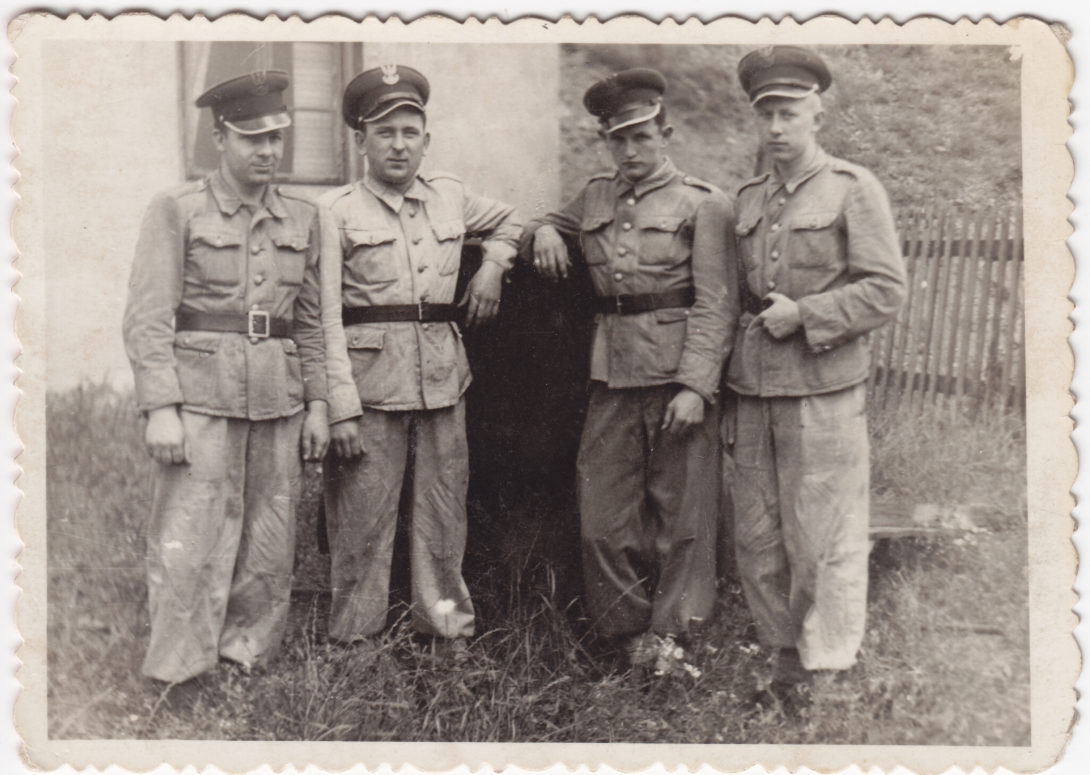
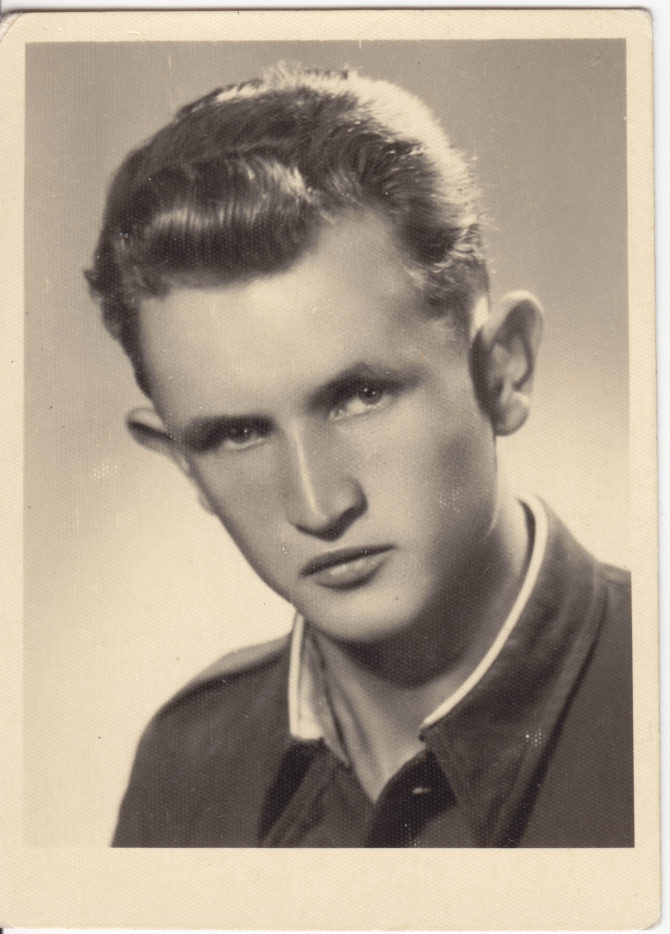
Two rooms, kitchen, bathroom
The flat in Zakopiańska Street
While the author was still with the labour battalion, the mother was allocated a flat by the Danzig shipyard: ul. Zakopiańska 16, flat 7. „Eine sehr schöne Wohnung — zwei Zimmer, Küche, Bad! Mama war überglücklich!“ (A very beautiful flat — two rooms, kitchen, bathroom! Mama was overjoyed!) It was furnished with his wages from the mine, „da wir nichts hatten“ (since we had nothing).
In June 1955 Halina received her school-leaving certificate and could begin to work. Gizela went to school no. 8 in Danzig, she still had three years to go until the school-leaving examination.
„Nach Hause kam ich am 21. Dezember 1955. Ich habe Gott gedankt für seine Fürsorge in dieser schweren und gefährlichen Zeit.“ (I came home on 21 December 1955. I thanked God for his care in this hard and dangerous time.) After some days, on 6 January 1956, he began to work again in the Danzig shipyard — at first at a small capstan lathe, later at a large lathe. Despite two incomes it was not easy: „Zum Frühstück gab es nur Brot mit Schmalz. Physische Arbeiter waren damals schlecht bezahlt.“ (For breakfast there was only bread with lard. Physical workers were badly paid in those days.)
„Diese physische Arbeit befriedigte jedoch meine Ambitionen nicht. Noch während meiner Zeit bei der Armee habe ich einen Kurs für technisches Zeichnen abgeschlossen.“ (This physical work, however, did not satisfy my ambitions. Still during my time in the army I completed a course in technical drawing.) On 1 May 1956 he began his work as a technical draughtsman in the design department of the Danzig shipyard. „Dies war der Beginn meines Abenteuers mit den technischen Zeichnungen. Später kam noch das Studium des Maschinenbaus an der Technischen Hochschule in Danzig — mit Pausen —, und den Beruf habe ich bis zur Rente ausgeübt.“ (This was the beginning of my adventure with the technical drawings. Later there followed the study of mechanical engineering at the Technical University in Danzig — with interruptions —, and I practised the profession until my retirement.)
The professional path
- 1953Material issuing in the general warehouse of the Danzig shipyard.
- 1953–1955Labour battalion, “Rozbark” mine; in parallel a course in technical drawing.
- 6.1.1956Back in the shipyard, at first at the lathe.
- 1.5.1956Technical draughtsman in the design department.„Der Beginn meines Abenteuers mit den technischen Zeichnungen.“ (The beginning of my adventure with the technical drawings.)
- from 1956Evening studies in mechanical engineering at the Technical University of Danzig, with interruptions.
„Am 27. Mai 1956 auf einem Schulball habe ich meine zukünftige Frau Teresa kennen gelernt. Als ich den Saal betrat, spielten sie gerade den sogenannten weißen Tango. Sie bat mich um den Tanz, der damals begann und bis heute glücklich andauert.“
About the encounter with Teresa from the house of Chrobak · Manuscript, page 43
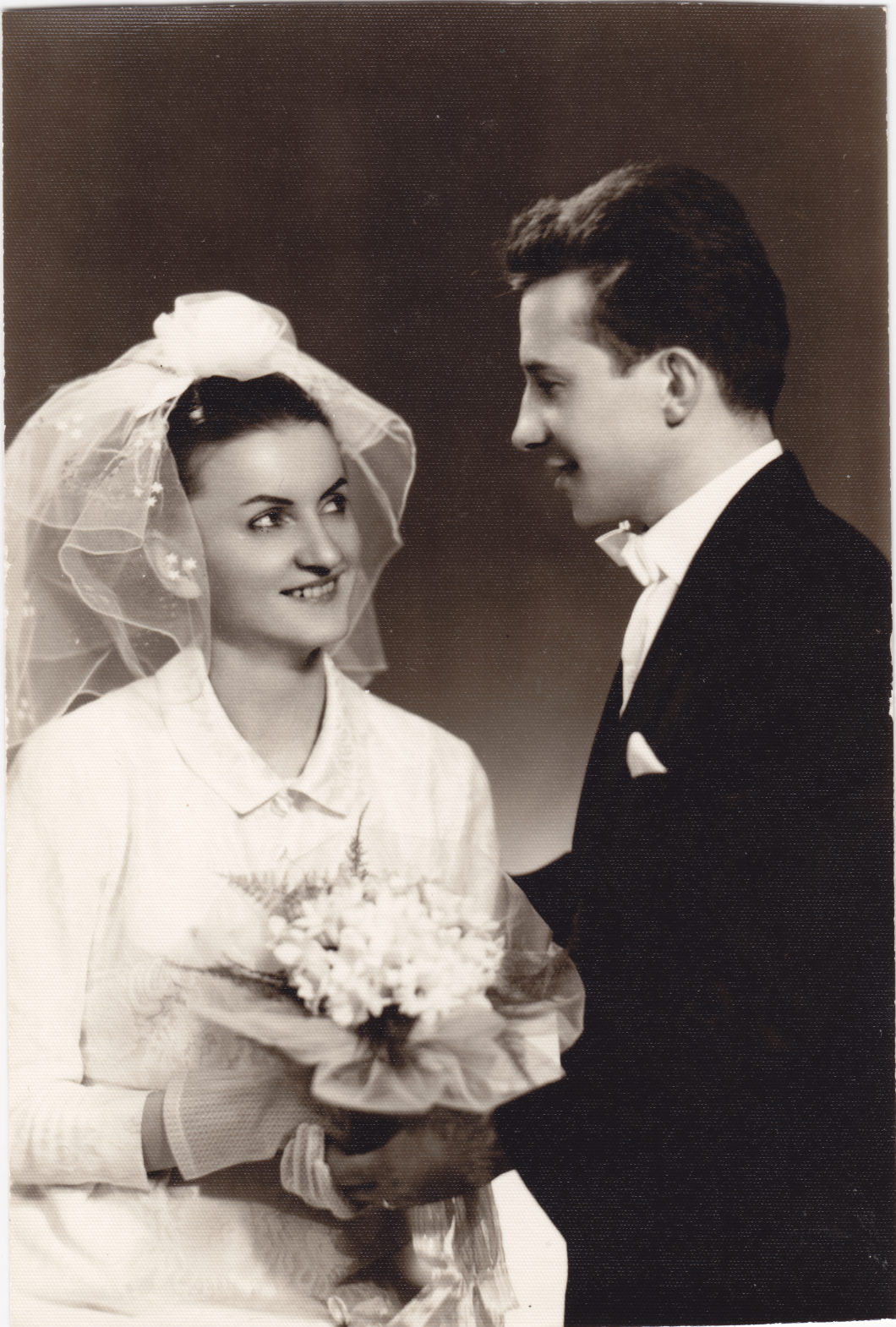
On 27 May 1956, at a school ball, I met my future wife Teresa. As I entered the hall, they were just playing the so-called white tango. She asked me for the dance that began then and happily continues to this day.
„Wir begannen ‚miteinander zu gehen‘. Dieses ‚Miteinandergehen‘ dauerte über drei Jahre.“ (We began ‘going out together’. This ‘going out together’ lasted over three years.) After almost three years they decided to marry: on 30 May 1959 the marriage took place at the Danzig registry office, the church wedding on 4 July 1959 in the parish church of the Emaus district. „Und so entstand die zweite soziale Zelle, eine neue Familie.“ (And so the second social cell came into being, a new family.)
After the wedding the two lived for a week in the flat in Zakopiańska Street with the mother and Gizela. Then they moved to Teresa's parents: two rooms with a kitchen, no bathroom, and besides them another ten persons.
Before that: Halina and Stanisław
A new social cell
In October 1956 Halina began to work for the administration of the postal directorate. „Bei drei arbeitstätigen Personen einer vierköpfigen Familie wurde das Leben etwas einfacher.“ (With three working persons in a family of four, life became somewhat easier.) But the greatest joy was the flat: „mit zwei Zimmern, Küche, B A D (!) und extra-WC. Es ist schwierig, die Verhältnisse in Zaborowo mit denen in der schönen Wohnung zu vergleichen.“ (with two rooms, kitchen, B A T H (!) and a separate WC. It is difficult to compare the conditions in Zaborowo with those in the beautiful flat.)
Through a friend from Raciąż, Rysia Skibińska, Halina met the sailor Stanisław Kowalski. On 8 February 1958 Halina Bomert and Stanisław Kowalski married. „Es entstand in unserer Familie eine neue soziale Zelle, eine neue Familie.“ (In our family a new social cell came into being, a new family.)
The author has left a comment at this point that raises the book beyond itself: „An mehr Details des Kennenlernens von Halina und Stanisław kann ich mich nicht erinnern. Und sie danach fragen kann ich nicht mehr. Unsere liebe Schwester starb unerwartet, am 20.03.2010, als sie in Danzig war.“ (I cannot remember more details of how Halina and Stanisław met. And I can no longer ask her about it. Our dear sister died unexpectedly, on 20.03.2010, when she was in Danzig.)
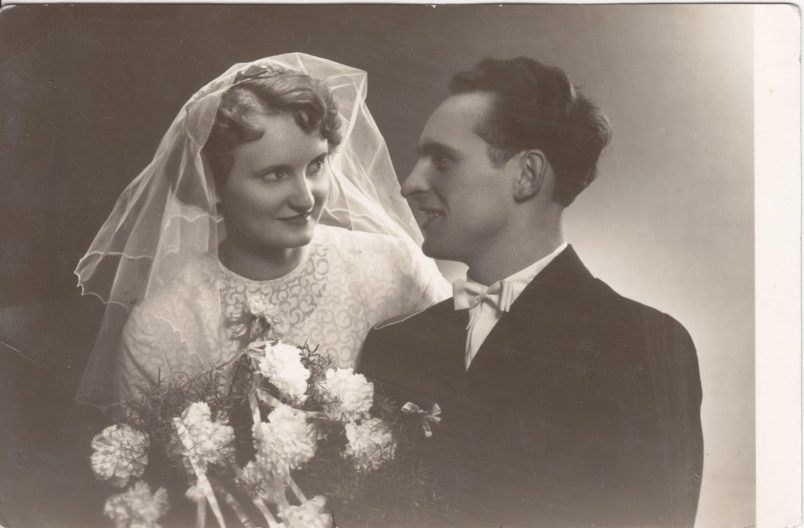
The youngest sister
Gizela and Adolf Gruszyc
On 2 June 1958 Gizela finished school and received her school-leaving certificate. After a further training for assembly-line work she began to work in the Danzig television works — there she met Adolf Gruszyc. On 16 April 1966 both the civil and the church wedding took place in the parish church of the Emaus district.
„Und so wuchs unsere Familie um eine weitere soziale Zelle an, eine dritte Familie.“ (And so our family grew by one more social cell, a third family.) The young married couple moved into a flat in the “Young Quarter” in Wrzeszcz.
Until then, in the household in Zakopiańska Street, the mother, the author and Gizela lived in the large room, Halina and Stanisław in the small one. The author worked as a technical draughtsman and gradually sketched „immer weniger mit Tusche und immer mehr mit dem Bleistift“ (less and less with Indian ink and more and more with the pencil); in parallel the evening studies at the Technical University of Danzig ran on.
1959 to 1969
„Gott schenkte uns weitere 10 Jahre mit unserer Mama.“
God granted us another 10 years with our Mama.
In the autumn of 1959, fifteen years after the operation of 1944, the signs of the illness returned. The mother had to go to the oncological hospital in Sopot for radiation treatment.
„Die Behandlung war sehr unangenehm, aber auch erfolgreich — Gott schenkte uns weitere 10 Jahre mit unserer Mama. Trotz der Schwere dieser Behandlung erlangte sie bereits nach kurzer Zeit ihre Kräfte und half sowohl Teresa als auch Halina mit ihren Familien. Es kam vor, dass, wenn wir von der Arbeit kamen, die Wäsche schon gewaschen war — sie lag schon eingeweicht in der Wanne. (Eine Waschmaschine konnten wir uns nicht leisten.)“ (The treatment was very unpleasant, but also successful — God granted us another 10 years with our Mama. Despite the severity of this treatment she regained her strength after only a short time and helped both Teresa and Halina with their families. It happened that, when we came home from work, the washing was already done — it was already lying soaked in the tub; we could not afford a washing machine.)
About the share of the two sisters in this time the author notes only the bare essentials: if his memory does not deceive him, Halina and Stanisław had applied for a flat in Malczewski Street and had also received it; Halina's children are called Krzysiek, Andrzej and Marek.
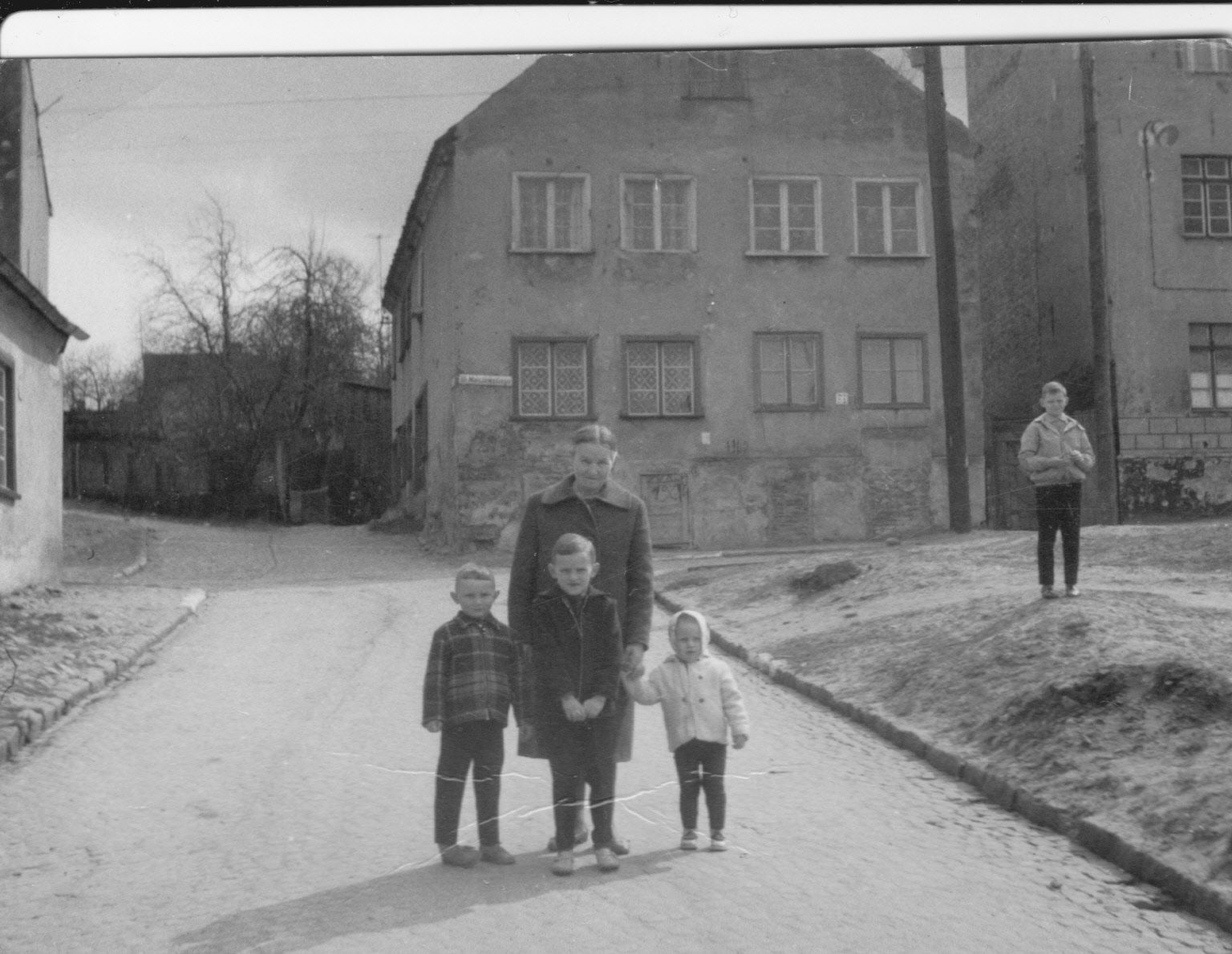
The chapter ends with the balance that the author draws on his parents — the father, who lost his life at the age of 32, and the mother, who died on 30 March 1969 after the cancer of 1944. „Unserer Familie, also der Familie von Adam und Władysława, hatte ein schweres und kompliziertes Los. Besonders für unsere Eltern war es sehr schmerzhaft. Papa verlor sein Leben in Qualen im Alter von 32 — so alt ist jetzt unser jüngster Sohn Paul. Ich bin voller Bewunderung und Anerkennung für unsere Mama, aber sie tut mir auch sehr leid. In ihrem kurzen Leben gab es mehr schwierige und schmerzhafte Momente als freudige. Auch ihr Leben endete in Schmerz und Leid. Der Krebs, der sie 1944 angegriffen hatte, ließ nicht locker, und der Herr rief sie am 30. März 1969 unter Schmerzen zu sich.“ (Our family, that is the family of Adam and Władysława, had a hard and complicated fate. Especially for our parents it was very painful. Papa lost his life in torment at the age of 32 — that is how old our youngest son Paul is now. I am full of admiration and recognition for our Mama, but I also feel very sorry for her. In her short life there were more difficult and painful moments than joyful ones. Her life too ended in pain and suffering. The cancer that had attacked her in 1944 did not let go, and the Lord called her to himself in pain on 30 March 1969.)
At this point the narrative of the manuscript ends. What follows are the enclosures: certificates, a report, a map — and the recollections of the sister. On the penultimate page stands the closing word with which the author asks the family for forbearance.