First leaf · page 2 of the manuscript
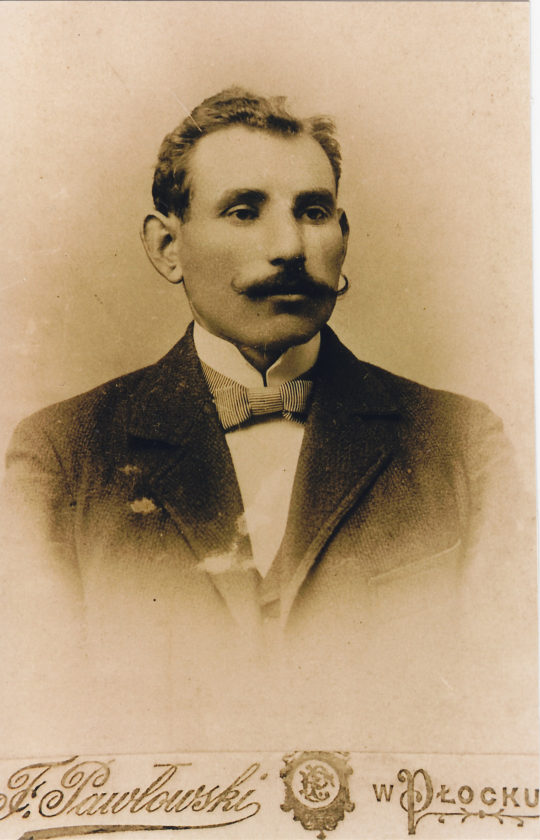
Jan Bomert, Adam's father
The second leaf of the manuscript carries a name, a portrait and nothing besides. The author devoted a page of its own to his grandfather — and gave it not one sentence.
- Name
- Jan Bomert — the spelling of the manuscript; the family also appears there as Bohmert
- Died
- 11 October 1918, according to the account of his wife Josephine
- Wife
- Josephine Bomert, written elsewhere in the manuscript as Józefina
- Children
- seven: Ludwig, Sigismund, Adam, Irena, Henryk, Jadwiga and Johann
- Son Adam
- born on 9 April 1912 in Wola Brwileńska near Płock — the author's father
- Portrait
- studio photograph from the house of E. Pawłowski in Płock, taken before 1918
The state of the sources
Two sentences, one date, one picture
About Jan Bomert the manuscript says almost nothing, and what it does say stands elsewhere — not on his page but where the children's grandfather is spoken of. The most important piece of news: he died on 11 October 1918, in the year in which his wife Josephine was expecting the youngest son, Johann.
The second thing the volume records is a gap. In the family photograph on the father's page, which the author carries under number 3, the grandmother sits with seven children — the grandfather is missing. The author gives no reason for this; he states only the fact: „Auf dem Foto ist nur Großmutter Josephine mit sieben Kindern, es fehlt Großvater Jan.“ (In the photograph there is only Grandmother Josephine with seven children, Grandfather Jan is missing.)
Jan Bomert's date of birth, place of origin, profession and place of death do not emerge from the manuscript. This edition does not supply them. Anyone expecting a line of ancestors here is instead told the limit that the author himself accepts.
- Died
- 11 October 1918
- Surviving children
- 7
- Youngest child
- Johann — born after the father's death, 1918/19
- Date of birth
- Origin
- Profession
One name, two spellings. In the family's papers “Bomert” and “Bohmert” stand side by side: Adam Aleksander is born on page 3 as Bohmert, while he and his father carry Bomert in the rest of the text. The volume keeps both forms, and this edition follows it in that.
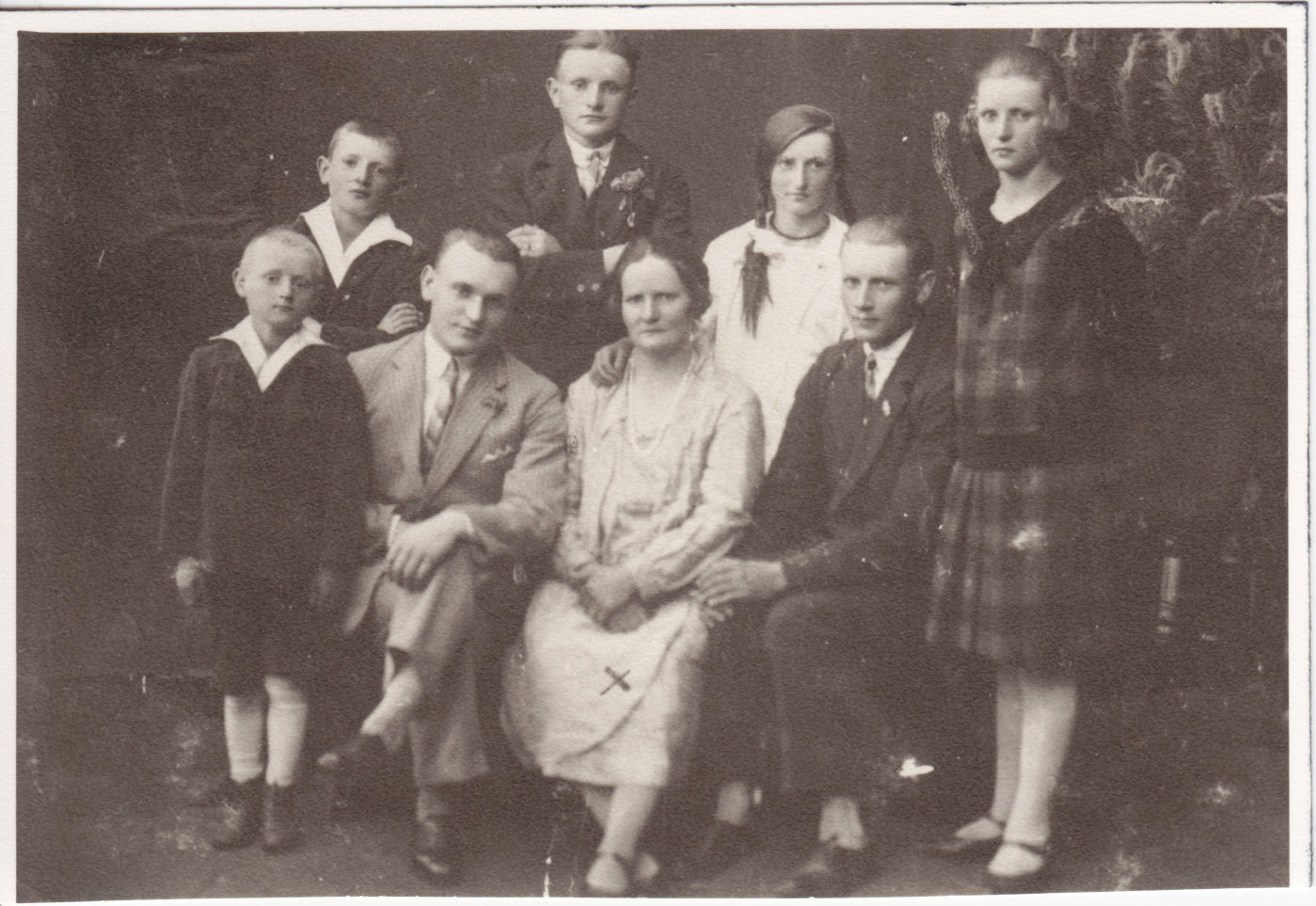
The picture no. 3
Seven children and a seated woman
The photograph was taken in a studio, before a painted background of foliage and a curtain. The women wear light dresses, the men jacket and tie, two boys sailor suits with large collars. The mother is seated, the children stand around her — the occasion of such a picture in these families was almost always a loss.
The author placed this photograph in his first chapter, not with the parents but as evidence for the father's origins. It shows what remained after 11 October 1918: seven children, of whom the youngest was not yet born.
Who is which person in the picture stands as the author wrote it down. Some of those named are followed in detail elsewhere in the manuscript — Ludwig as the family's first casualty of the war, Henryk as the chronicler with whom Bohdan lodged in Płońsk in 1940, Johann as the bridegroom of the year 1944.
Register of the siblings
What became of the seven children
Gathered not from the grandfather's page but from the whole volume: each entry names only what the author himself writes about that person.
- Ludwigthe eldest brother Was executed „gleich zu Beginn des Krieges“ (right at the beginning of the war) together with his wife Wanda of the house of Mac — the first casualty of this war in the family.The author calls him Uncle Ludwig at this point; he names no date.
- Sigismundbrother Father of Egon, Heinz, Jürgen and Peter. In the year 2000 Egon and Jürgen travelled with the author to Płońsk to look for the house of the family Heniek.Chapters 2 and 3 of the manuscript
- Adam Aleksanderour father Born on 9 April 1912 in Wola Brwileńska near Płock. Bookbinder in Działdowo, afterwards a merchant with a grocery, textile and dairy business. Member of the Armia Krajowa, arrested in April 1944, tortured in Nowy Dwór Mazowiecki and shot in the forest.Chapters 1 to 3 of the manuscript
- Irenathe sister Married to Johann Meyer, resident in Siemiątkowo Koziebrodzkie. Her household employed a Polish family during the occupation, whom she left in peace after the arrival of the Russians and accompanied as far as the station at Raciąż. In 1966 Uncle Meyer invited the mother to West Germany.Chapters 2 and 3 of the manuscript
- Henrykour family chronicler Lived with his wife Karola in Płońsk in a single-storey house. Bohdan lodged with him when, from 1940, he attended the German school in Płońsk; after every return Henryk had him empty his pockets. In the year 2000 the house was photographed and was in a pitiful condition.Chapter 2 of the manuscript
- Jadwigathe sister Was the village head of Słoszewo in 1940 and saw to it, with „Gaben in Form von Gänsen und Enten“ (gifts in the form of geese and ducks), that the father could open a shop in Ćwiklinek. She later spent some time in a camp for Germans in Lublin.Chapters 2 and 3 of the manuscript
- Johannthe youngest brother The son with whom Josephine was pregnant on 11 October 1918. In the war years he came to Łaszewo when he was off duty and played draughts with Bohdan — usually with eleven blocked pieces. On 22 April 1944 he married Olga Krüger in Łaszewo.Chapter 2 of the manuscript, image no. 24
The volume begins with a blank
Jan Bomert is the only ancestor of this volume to whom a page of his own belongs and about whom nothing stands on it. The author found a portrait for him — „E. Pawłowski in Płock“ (E. Pawłowski in Płock) is written beneath it — and gave him no other word. Everything else about him stands where it happened to fall.
Anyone reading the chronicle from its first page therefore begins not with a narrative but with what a family archive yields: a face, a date and the list of the seven children, one of whom was the author's father.